Adele and Miraijin's mother-daughter relationship
The HummingbirdAdele and Miraijin’s mother-daughter relationship is founded on a choice Adele makes for herself: she will have a child without naming a father, and she will raise that child with a conviction that she represents a new beginning. The decision makes motherhood both an expression of Adele’s independence and the basis of a wider family bond, as Marco accepts the role of helping bring Miraijin up and later treats that responsibility as the purpose of his life.
Adele’s decision and its meaning
Adele tells Marco that her child will be born without a father and that she will be a contented single mother, without regret or concern. She calls the child the Man of the Future. Marco is startled by the plan: he wonders whether her rejection of a father might reflect harm or denial, and whether he can responsibly support a young mother and child. Yet he also hears her announcement as an extraordinary declaration of love and accepts it, deciding to follow her lead rather than demand an explanation she has not offered.
The father’s identity remains unknown to Marco and the people around Adele; she has never told anyone who he is. The lack of an identified father is not presented as a mystery Adele is trying to solve. In the circle of young people she spends time with, the choice is treated as understandable, and Marco makes an effort to respect that outlook even though the arrangement conflicts with his own instincts. He understands that Adele expects him to help fulfill the paternal function, and he agrees to do so.
Her decision also develops within a relationship already marked by intense attachment. When Adele was about three, she told Marco she had a thread extending from her back to the nearest wall, and explained that she had to move carefully so others would not become caught in it. Marco recognized, briefly and fearfully, the significance of her disclosure and of the closeness between them, then repressed what he had seen. Later, a therapist interpreted the thread as expressing Adele’s unusually close and exclusive bond with her father, and advised that she spend much more time with him. Marco and Marina reorganized their family life around the recommendation, with Marco taking on more daily care. Against this history, Adele’s expectation that Marco will also stand beside her through pregnancy and birth extends the practical as well as emotional work of their bond.
Pregnancy, birth, and the name
Adele makes the major arrangements for her pregnancy and delivery. She has already chosen the child’s name, Miraijin, and selects a water birth at Santa Maria Annunziata Hospital rather than Careggi, where Marco works and could have arranged certain privileges. Marco accompanies her to checkups, helps with practical needs, and accepts her decisions about what she will and will not do during pregnancy. His role is neither to take over nor to remain at a distance: he must find a form of involvement that respects Adele’s autonomy while answering the trust she places in him.
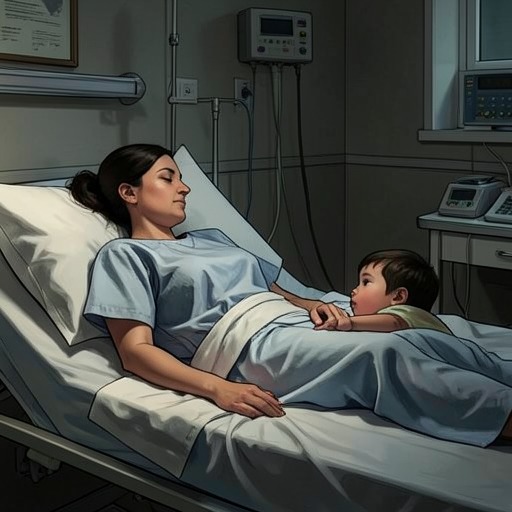
At the birth, Adele wants Marco in the tub with her, holding her during labor. He has considered the possibility with his psychoanalyst, and he is conscious that his presence has been discussed and weighed by others. Still, he says yes. At eleven in the morning on October 20, 2010, he joins Adele and the midwife, Norma, in the water. The experience is unlike the delivery he remembers from Marina’s much longer labor years earlier: Marco feels useful and included rather than helpless, and is surprised by the calm of the event.
As Miraijin is lifted from the water and brought to Adele, Marco watches her take her first breath. Adele then tells him that the child is a girl and repeats her understanding of the birth: the Man of the Future is a woman. The moment gathers their separate roles into one scene: Adele has carried and delivered her child, while Marco has been invited to share in the beginning of her life. For him, the water birth becomes an unusually happy family memory, and for Adele it confirms the future she has insisted on imagining.
A mother’s conviction and a daughter’s upbringing
Adele continues to describe Miraijin as the person who will renew humanity. While Adele is alive, Marco does not openly contest the claim; he repeats it, though he privately suspects that his daughter’s belief may help her endure what she has experienced. His willingness to echo her vision therefore begins partly as an act of care: he accepts the language in which Adele has chosen to understand her child, even before he believes it himself.
Adele’s life as a mother does not exclude study, work, or her own interests. She studies motor sciences and works part-time at a gym, while Marco anticipates that she will continue to pursue her passions. When she goes away to surf or climb, he cares for Miraijin at home. He has prepared himself for Adele’s independence and has saved money to support her, but he remains anxious about the risks of the sports she loves. The arrangement depends on both her freedom to leave and his readiness to provide continuity for the child in her absence.
The novel presents that continuity against Adele’s unstable childhood. As a child, she experienced upheaval between Italy and Germany and a difficult relationship with Marina; the thread she imagined behind her back recurred as family life changed, then disappeared when her parents began to understand what she needed. Later, when Adele returns from Munich, the thread appears again as a tangled web and points toward a way out of an intolerable situation. Marco comes to understand the image as a form of wisdom through which Adele had guided her family toward what she experienced as the lesser evil. His care for Miraijin thus takes place with an awareness that stability was something Adele herself had lacked and worked to create for her daughter.
After Adele’s death
Adele dies when Miraijin is still a child, leaving Marco to become the principal source of stability in her life. He is not prepared for the loss, but he continues to care for Miraijin and gradually sees his responsibility differently. The belief that Adele had voiced—that her daughter would be the Man of the Future—first seemed to him an imaginative support Adele needed. In time, after her death, he comes to believe it himself: Miraijin was born to change the world, and he has been given the privilege of raising her.
Marco’s belief takes shape through the events he sees as marking his life, including the loss of his sister Irene, the upheaval of his marriage, his father’s death, and Adele’s death. He interprets these experiences not as proof that suffering was good, but as the painful ground on which his responsibility to Miraijin rests. The relationship that began with Adele’s decision to become a mother therefore continues beyond her life: Marco’s care preserves the family future she imagined, while his eventual conviction gives that care a meaning he had once regarded as his daughter’s private faith.
Significance of their bond
The relationship connects Adele’s claim to autonomy with her reliance on family care. She determines that there will be no named father and makes the choices surrounding pregnancy and birth, yet she asks Marco to take part, first by accepting the paternal function and then by being physically present at the delivery. His participation does not erase her independence; it makes their different roles part of the same undertaking.
The bond also reverses the direction of care over time. Marco’s early efforts to understand Adele’s thread lead him to reorganize his working and domestic life around her needs. Later, after Adele becomes a mother, he supports her choices and looks after Miraijin when Adele is away. After Adele’s death, that practical role becomes an enduring commitment. Miraijin’s future is consequently held together by two linked forms of devotion: Adele’s insistence that her daughter can begin a new human future, and Marco’s decision to remain responsible for the child who embodies that hope.