Adele’s thread
The HummingbirdAdele’s thread is an imagined line running from her back to a wall, but it is more than a childhood oddity: it gives visible form to the bond between Adele and Marco Carrera, and to the guilt Marco briefly recognizes before repressing it. Its disappearance seems to confirm one explanation, only for its return years later to overturn another. The thread’s changing presence traces a relationship whose meaning is never fully settled by the adults who try to explain it.
The Thread Appears
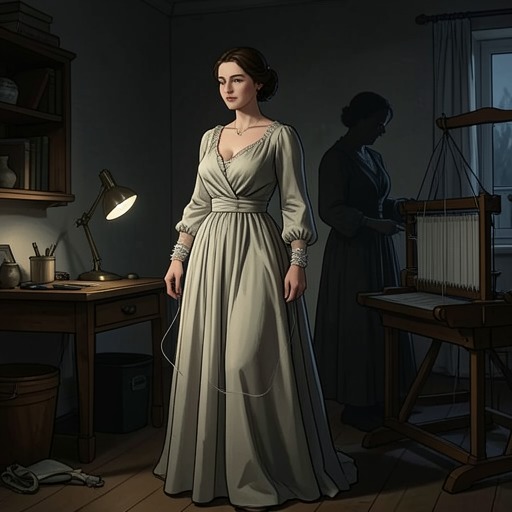
On a bright Sunday in August, while Adele and Marco have breakfast in the kitchen of their house in Bolgheri, the three-year-old tells her father that she has a thread attached to her back. It extends to the nearest wall, she explains, and nobody else can see it. Because people might trip over it or become caught in it, she must remain close to the wall whenever possible. If someone does get tangled, she has to walk around them to free them.
Marco asks whether everyone has such a thread or whether it belongs only to her. Adele says that only she has one, and that what seems strange to her is not her own thread but the fact that other people have none. Asked how she manages at home, she says that her parents do not pass behind her back. She demonstrates the careful detour she makes when someone does. The gesture turns an invisible difficulty into a rule shaping the child's movement through the space she shares with others.
For Marco, the revelation is also a beginning. Until then, his relationship with his daughter had been comparatively indefinite; now he feels that it has started. When Adele says he never walks behind her, he experiences a shiver and recognizes, for an instant, a terrifying connection between her disturbance and his sister Irene. The narrative presents this as a flash of foreknowledge: at the beginning of a relationship, its later course may briefly appear already contained in its first moment. Marco immediately represses what he has seen and continues as if the recognition had never happened.
A Private Explanation and a Father's Role
The thread remains a secret between father and daughter for the rest of that summer, though Marco tells Marina about it without telling Adele he has done so. Marina tries to remember not to pass behind the child, at the beach, in the house, and in the garden. Often she remembers too late. Adele then patiently circles around her to unwind the imagined skein, repeating the same careful movement when her grandparents pass behind her. The adults are moved by the child's precision, even as the thread makes her daily movements answer to a constraint they cannot see.
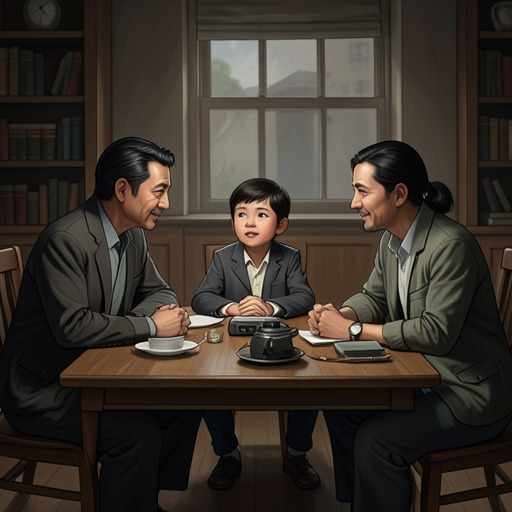
When Adele's difficulty with school becomes a serious concern, her parents take her to Dr. Nocetti, who calls himself the Magician Manfrotto to his young patients. Adele goes to his studio twice a week and says only that they play. Before Christmas, Dr. Nocetti offers the parents his interpretation: the thread ties Adele not to the walls but to her father, expressing a close and exclusive bond formed, he believes, because she fears losing him. He recommends that Marco spend much more time with her, ideally more time than Marina does.
Marco accepts the practical consequence. He shifts from being the parent who comes home from work in the evening to the one who takes charge of daily care: school runs, appointments, clothes, bathing, and meals. That change also gives him more say in decisions about Adele. He enrolls her in the public Vittorino da Feltre elementary school near their home, despite Marina's preference for private school, and later makes another consequential decision without consulting her first.
Fencing and the Disappearance
One January afternoon, Marco enrolls Adele in fencing and begins taking her to lessons twice a week. He does not first discuss the decision with Marina, instead presenting it as a harmless activity that might help. It does. In the fencing gym, Adele encounters masks, flexible swords, and the quick, charged rhythm of the sport. The imagined thread disappears almost immediately. She stops circling around people who pass behind her, stops talking about the line, and stops crying at school or resisting the daily journey there. The change comes before she starts elementary school, when the family fears her difficulty might otherwise become more complicated.
Marco initially thinks fencing has solved the problem. The apparent fit is especially striking because he knows nothing about the sport, and because the mask and the movements of fencing seem to offer Adele a world into which she can enter. But Dr. Nocetti does not revise his explanation: he maintains that the thread vanished because Marco had become a constant presence in his daughter's life. Marina eventually agrees with him, treating the timing of fencing and the thread's disappearance as coincidence. The thread's end thus becomes a dispute over cause as much as a relief from a child's distress.
The explanation accepted by the adults leaves Marco with a moral cost. Under Dr. Nocetti's account, the thread appeared because Marco had not spent enough time with Adele, while the sport to which Marco attributes her recovery counts for nothing. Marco believes this account is not the truth, but chooses not to contest it, for the sake of family peace and his daughter. The object disappears, yet its meaning remains in circulation: a private experience becomes a family story about paternal absence, care, and responsibility.
The Thread Returns
Years later, Marina recounts that Adele's thread returned after Adele went to Germany. Adele had been living there and, according to Marina, never left the house. Marina brought her back to Italy to live with her. The thread disappeared again. Its recurrence links the imagined line to a change in Adele's circumstances, but the account does not describe precisely how the thread returned or what Adele experienced while it was present.
Marina also revises her earlier understanding. For years, she says, she thought the problem had been related to fencing; now she accepts that Dr. Nocetti was right and that the thread was about her. The return and second disappearance sharpen the contrast between a visible symptom and its disputed cause. Fencing coincided with the first disappearance, but Marina's later conclusion gives the decisive role to Adele's relationship with her father rather than to the sport.
Meaning and Narrative Function
The thread makes an invisible attachment legible as a physical arrangement: Adele must stay near a wall, notice who approaches from behind, and move around anyone who becomes caught. Its rules belong to her perception, yet they reorganize the behavior of her family. Marina changes how she moves through shared spaces; Marco changes how much care he provides and how he understands his responsibility. As an imagined object, the thread is not merely a symbol applied from outside: it acts within family life, prompting gestures, decisions, and conflicting explanations.
Its disappearance offers no final proof. The adults can connect it to Marco's increased presence, to fencing, or to both, while the later return in Germany unsettles any simple resolution. The narrative's opening meditation on relationships gives the object a further weight: Marco's first recognition of the bond, and his immediate forgetting, is presented as a moment when he sees what their relationship may become. The thread then recurs across Adele's childhood and adulthood as an image of closeness that can be felt, denied, and briefly made visible, but never conclusively explained.