Daniele Carradori
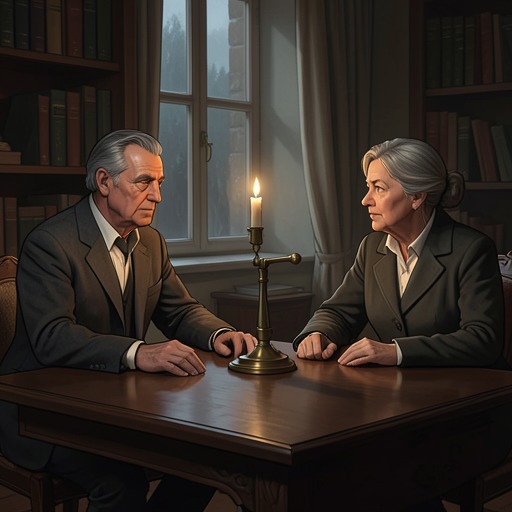
The HummingbirdDaniele Carradori is a psychoanalyst whose decisive act is to violate the confidentiality that defines his profession in order to warn Marco Carrera of a danger no one else can disclose. Introduced as a small, bald, bearded man with a magnetic gaze, he arrives in Marco’s ophthalmology clinic not as a patient seeking treatment but as the bearer of information that will break open the doctor’s carefully ordered life.
Identity and Introduction
Carradori enters the narrative in Rome’s Trieste district on a morning in mid-October 1999. In Marco’s clinic, the ophthalmologist is finishing an appointment with an elderly woman suffering from ciliary blepharitis, for which he prescribes antibiotic drops after treating the chronic tendency of the condition with N-acetylcysteine. Outside the consulting room, Carradori waits, looking down at his shoes rather than at the magazines on the tables. The contrast between Marco’s precise medical work and the visitor’s grave, unspoken purpose establishes the encounter as a collision between ordinary professional routine and a danger that medicine cannot resolve.
The room is rendered through its objects as well as its people: an outdated Thorens record player, a Marantz amplifier, mahogany AR6 speakers, and Graham Nash’s Songs for Beginners playing quietly. When the previous patient leaves, Marco invites Carradori in. His name is familiar to the doctor, but the visitor’s presence is unexpected. Carradori’s appearance is sparely specified—short, bald, and bearded—while his gaze is described as magnetic, a quality that foreshadows the force of the news he has come to deliver.
The Breach of Professional Boundaries
Carradori begins by asking Marco not to report him to the Order of Doctors or, more pointedly, to the Italian Psychoanalytic Society. He explains that what he is about to do is forbidden and could be severely sanctioned within his profession. He has never imagined himself breaking this rule, he says, but believes Marco is in grave danger and that he alone knows it. His decision to warn the doctor therefore places Carradori in direct conflict with the professional obligation of confidentiality.
The breach is not presented as casual indiscretion. Carradori frames it as a choice compelled by the exceptional stakes: preserving the rule would leave Marco unaware of a threat, while disclosing what he knows exposes the analyst to professional consequences. In this scene, his ethical position is defined less by abstract claims than by the act itself. He accepts the risk of being reported because he judges that Marco’s safety takes precedence over silence.
The Warning and Its Consequences
The conversation moves from Carradori’s warning to the intimate facts that make it devastating. Marco asks whether he and Luisa have made a vow of chastity, and the question reveals how far the relationship has moved from ordinary romantic possibility. Carradori then states that Marco’s marriage is already over and that Marina will soon have another son, one who is not Marco’s. The news joins two ruptures: the collapse of the marriage and the revelation of a child conceived outside it.
Carradori’s role is that of the person who makes the hidden situation speakable. He does not soften the disclosure into reassurance; its force comes from its plainness. The facts he gives reorganize Marco’s understanding of his family and marriage, while the scene’s earlier emphasis on professional boundaries casts the revelation as knowledge obtained at a cost. The physician who can treat a patient’s eyes cannot use his medical science to lessen the pain of what Carradori tells him.
Later Contact and Narrative Role
Carradori reappears in a later chronological strand under the heading “How Did It Go” and the year 2010. He identifies himself on the telephone as Carradori, addressing Marco as “doctor.” The brief exchange marks continuing contact between the two men, though the available scene does not specify what brings them back into conversation or what Carradori does next.
Across these appearances, Carradori functions as both a boundary-crosser and a messenger. His first visit turns the clinic’s threshold into the passage between routine and crisis: he waits outside while Marco completes an ordinary consultation, then enters carrying knowledge that alters the doctor’s understanding of his life. His later call confirms that he remains part of Marco’s story beyond the initial disclosure. The character’s significance rests on this tension between professional silence and personal intervention, and on the consequences of choosing, at a decisive moment, to speak.