Luigi Dami Tamburini
The HummingbirdLuigi Dami Tamburini is a wealthy Sienese heir whose varied interests—in tennis, a family bank, a cultural foundation, and private gambling—make him a hinge between Marco Carrera’s practical affairs and his buried appetite for risk. First approached as a generous benefactor and friend, he becomes the host who can draw Marco from respectable dinners into the ruinous gambling world Marco has been waiting to re-enter.
Identity and Public Position
Luigi comes from a prominent Sienese family whose fortune rests on numerous properties and land. The family’s holdings also include the production of Brunello di Montalcino, properties between Florence and Siena, a mineral-water source on Mount Amiata, and a small family bank. The bank and the Dami Tamburini Foundation are based in Florence, giving Luigi’s influence a reach beyond his family’s home city.
The Foundation collects private photographic archives and material connected with twentieth-century visual culture, including posters and postcards. Its institutional purpose becomes significant to Marco when he is trying to find a home for his mother’s extensive photographic work. Luigi’s wealth is therefore not presented only as private comfort: it also gives him access to a cultural institution capable of taking custody of a collection that Marco finds emotionally difficult to handle.
Tennis, Friendship, and the Archive
Marco meets Luigi through tennis. After Marco has returned to playing regularly, a friend recruits him for a charity doubles tournament at the Cascine during Pitti Uomo week. The format draws partners by lot before each round. Marco is paired with Luigi in the semifinal; despite Luigi’s many double faults, they win, and they are then drawn together again for the final, which they also win. Luigi is delighted by the repeated pairing and grateful to Marco for helping him succeed.
He responds by inviting Marco to his villa in Vico Alto, near Siena. The dinners become a way for the two men to get to know each other: Luigi takes an interest in Marco’s life and talks about his own. In these conversations, he tells Marco about the Foundation and its work collecting photographic archives. Marco, who has struggled to approach the photographs left by his mother, mentions the collection almost tentatively. Luigi puts him in contact with the Foundation’s president, who promptly arranges to see it.
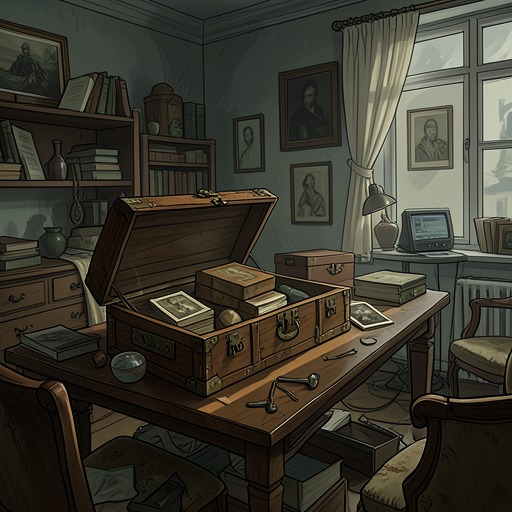
When Marco presents the archive at the family house in Piazza Savonarola, the encounter changes his own understanding of what his mother left behind. The photographs record architects, designers, and artists, include a substantial section on women architects, and follow the making of plastic objects from studio design to factory production. They also document radical-architecture exhibitions and visual-poetry events, as well as the 1966 flood in Florence. Among the flood photographs is one image of Marco’s father, smiling beneath a streetlamp outside the National Library. The archive’s donation gives the photographs an institutional future and helps resolve Marco’s difficulty with the house and its contents.
Luigi’s role in this transfer is substantial, though not fully transparent. The Foundation’s president offers Marco twenty thousand euros for the material. Marco refuses payment and insists that the archive is a donation; he wants the Foundation to take it, rather than to buy it from him. As the president studies him, Marco becomes convinced that the man is testing whether he is sincere and whether he might be recruited into some kind of scheme. Marco cannot prove that suspicion, but believes the president accepts the donation because the risk of being exposed is not worth taking. He also suspects the president would not have made the journey if he had known from the outset that Marco planned to give the archive away. The narrative does not establish that Luigi directed the offer or knew of any such ulterior purpose; what it does show is that Luigi’s introduction opens the door to both the successful transfer and Marco’s unease about the people arranging it.
The Invitation Behind the Invitation
The dinners at Luigi’s villa have more than one character. Marco initially knows the elegant gatherings, which have a strong hint of Freemasonry but no gambling. Later, after Marco alludes to his past as a player and his desire to revive it, he finds himself at a different kind of evening. The change is not immediately dramatic: the gambling gatherings can seem like a sparkling variation on the dinners, with roulette and chemin de table among relaxed conversation. Some guests attend both kinds of event, and Marco can even bring a hammock for the sleeping child without attracting suspicion.
That harmless appearance does not satisfy Marco. What he misses is the “smell of ruin,” not merely the games themselves. He reasons that casual gambling must be a cover for a more serious operation, and that a third, secret class of invitation must exist. The narrative confirms his suspicion: the more visible gambling evenings shield a genuinely clandestine den. Their guests include powerful institutional figures, among them a deputy prosecutor and officials whose presence would make an ordinary police raid less likely. The fictional division between the dinners is thus also a system of protection: respectable sociability conceals the activity that the respectable surface is designed to hide.
The innermost gatherings are kept secret and participants use assumed names whether or not they know one another. Luigi, a passionate contradaiolo, takes the name Drago. That pseudonym marks the crossing from public host to concealed participant, while the aliases of the other guests turn the gathering into a social world with its own identities and rules. Luigi is not simply someone who happens to gamble; he presides over the passage between an acceptable public circle and a hidden one.
Marco’s Return to Gambling
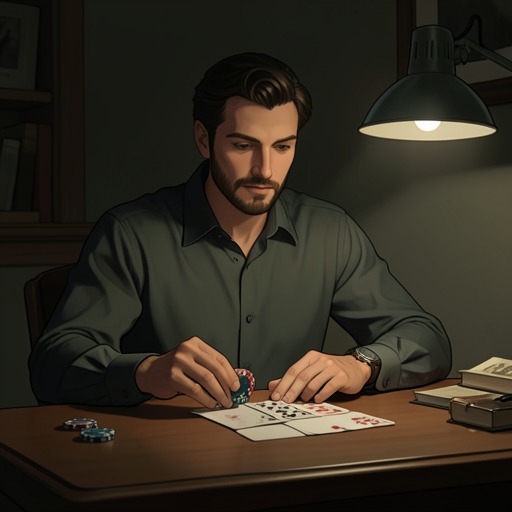
Luigi’s importance to Marco is clearest in the way access to these evenings affects Marco’s choices. Marco has long kept gambling outside the life he has built around family, but the passion never disappears. The dinners first offer him proximity to the tables without the danger he is seeking; once he realizes that a more serious game may be possible, he pursues the secret invitations. What draws him is not just money or recreation. He wants the bodily intensity of play to overpower what torments his mind, and he seeks a deliberately degrading rebellion against grief, respectability, and the consolation of accepting punishment.
After Adele’s death, Marco’s renewed gambling becomes, in the narrative’s terms, his real rebellion. The pleasure of the game is something he had sacrificed to family life, yet he had never fully managed to extinguish it. Luigi’s establishment supplies the threshold through which that suppressed desire returns, from the polished dinners to the concealed den where Marco can find the risk he craves. The relationship between the men therefore carries a sharp imbalance: Luigi supplies the setting and the invitation, while Marco brings the need that makes the hidden game feel like an answer to mourning.
Their friendship is not thereby erased. Later, Marco describes Luigi as his doubles partner in over-one-hundred tournaments and says that, until the previous night, he would have called him a friend. That qualification registers a break in trust without denying the long history of partnership. Across the two men’s shared arenas, the same ability to pair up has different consequences: on the tennis court it produces victories and access; around the gambling tables it exposes the cost of what that access makes possible.