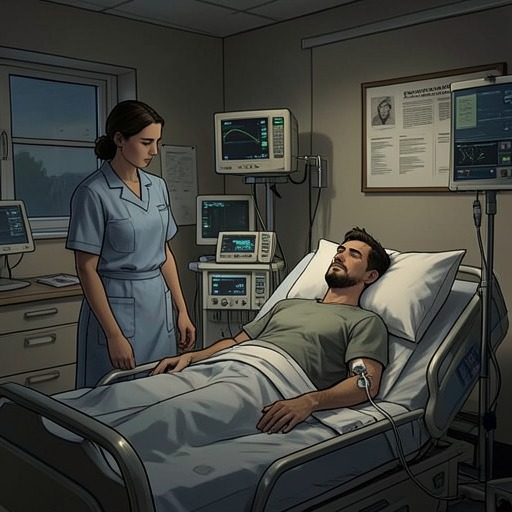
Marco Carrera’s experimental growth treatment and growth spurt
The HummingbirdMarco Carrera’s experimental growth treatment and growth spurt began in autumn 1974, after years in which his short stature had set him apart. The treatment was expected to bring him toward ordinary growth, but instead his body changed with startling speed: he gained sixteen centimeters in eight months, then stabilized at a height slightly above the national average. The episode establishes a defining pattern in his life, in which prolonged stillness gives way to sudden transformation, and later becomes part of the story’s meditation on chance, bodily change, and purpose.
Treatment and Unexpected Result
At fifteen, Marco had been kept outside the ordinary range of his peers by his small stature. In October 1974 he measured 1.56 meters; by the following June he had reached 1.72 meters, an increase of sixteen centimeters in eight months. The growth then settled rather than continuing unchecked: he was 1.74 meters at sixteen, 1.76 at seventeen, 1.78 at eighteen, and gained a final centimeter the next year, leaving him just above the national average.
The treatment was experimental, and its outcome exceeded its physician’s expectations. Dr. Vavassori had anticipated that, over fifteen months rather than eight, Marco would gain only about two-thirds of the eventual increase. The intended result was a less markedly short stature, not the rapid leap that occurred. No explanation resolved why the treatment had such an unusually strong effect.
The Family’s Interpretations
Marco’s mother, Letizia, believed the treatment might not have caused the change at all. She attributed the sequence—initially insufficient growth, then a sudden surge, then alignment with ordinary anthropometry—to an unfolding already encoded in Marco’s nature, an idea she associated with D’Arcy Wentworth Thompson.
His father, Probus, held two responses at once. He was pleased that the treatment he had insistently pursued had succeeded, yet the result’s departure from the expected course made him wonder whether it represented a loss of control over what had been done to his son. He feared that an unforeseen consequence might appear years later, including infertility, degenerative disease, tumors, or malformations. Dr. Vavassori had acknowledged that delayed side effects were a risk of an experimental protocol, but dismissed the idea that success beyond expectations necessarily increased that risk as foolish and somewhat paranoid.
Marco’s Experience and Later Pattern
Marco did not initially experience the growth as a medical problem to analyze. His body, which had resisted growth for years, now changed rapidly, and he concentrated on keeping pace with it. From November to June he grew about two centimeters a month, an alteration that occupied his attention. The narrative presents his response as a capacity to inhabit the bodily change before turning it into an explanation: he was neither frightened nor ashamed, but adapted to the abrupt transformation.
In retrospect, the growth becomes an early model for the rhythm of Marco’s life. He can remain apparently still for years while events move around him, then be thrown suddenly into an unfamiliar situation, often through a painful transition. The question of why such changes happen to him emerges later, but the account suggests that he does not ask it until he can find an answer.
Retrospective Meaning
The treatment’s consequences remain uncertain in the family’s account: Probus fears a future cost, while Letizia sees the growth as part of a larger natural design. The novel likewise places measurable facts beside interpretations that cannot be verified. Sixteen centimeters in eight months is precise; whether the result came from the treatment, from Marco’s nature, or from a design visible only in retrospect remains unsettled.
Much later, Marco understands his exceptional life as having a purpose: the painful events that have marked it, he comes to believe, prepared him to raise his granddaughter, Miraijin. That later conviction gives the growth episode a retrospective place in his story, but does not erase its original uncertainty. What first appears as an anomalous medical outcome becomes one of the earliest examples of the sudden changes through which Marco’s life advances.