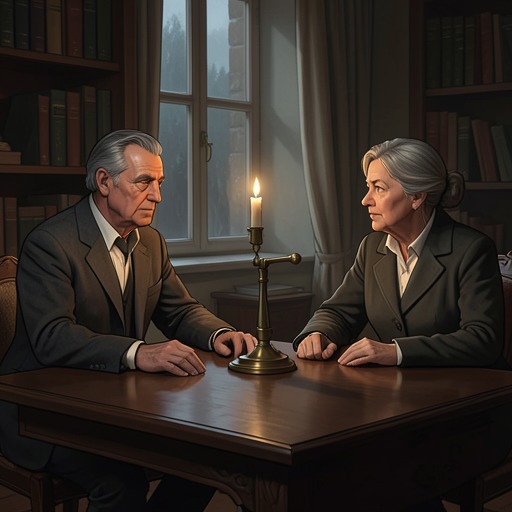
Marco receives growth hormone treatment
The HummingbirdMarco Carrera’s growth-hormone treatment is a turning point in his adolescence and in his parents’ marriage: after years of explaining away his short stature as the grace of a hummingbird, Letizia Delvecchio and Probo Carrera confront a diagnosed hormone deficiency and agree to pursue an experimental treatment in Milan. The intervention brings Marco almost sixteen centimeters of growth in eight months, but its significance lies as much in the family argument that precedes it as in the physical change itself.
The body called a hummingbird
Marco is markedly shorter than his peers through childhood. His mother, Letizia, gives this difference an affectionate and reassuring name: hummingbird. For her, the nickname gathers together Marco’s smallness, beauty, grace, and speed, qualities she treats not as signs of illness but as evidence of a distinctive nature. She repeatedly tells herself that there is no cause for concern, and her account makes his body part of an idealized image of the child she loves.
Probo’s response changes as Marco approaches adolescence. While Marco is still a child, Probo tries to trust his wife’s reassurance; when his son’s body shows no intention of developing normally, however, worry turns to guilt. He begins to question whether the parents have allowed a treatable condition to go unaddressed. The dispute is therefore not only about the meaning of Marco’s stature: it is also about the responsibility to act when a child’s development appears to be diverging from the norm.
Diagnosis and the decision to seek treatment
When Marco is fourteen, Probo can no longer accept waiting. The account describes him on a small Vespina, his body appearing so out of scale with it that Probo is finally compelled to intervene. Consultations and tests establish that Marco has a moderate, not severe, form of statural hypoevolutism, caused by insufficient production of growth hormone. The diagnosis gives a medical name and cause to what Letizia had understood through the hummingbird image.
At the time, treatment is not an established option for a case of this severity. Experimental protocols are generally reserved for severe hypoevolutism, including dwarfism. Among the specialists the family consults, only the pediatric endocrinologist Vavassori, in Milan, says that he can help Marco through a program he has been conducting for several years. His proposal turns the family’s disagreement into a concrete decision: whether to accept an experimental intervention or leave Marco’s growth to nature.
The parents’ conflict
Letizia objects that treatment would interfere with the harmony of growth and form. To support her position, she invokes D’Arcy Wentworth Thompson’s On Growth and Form, a book central to her intellectual convictions. Probo counters that failing to act is itself a choice, and the argument escalates from a quiet disagreement into a loud, prolonged quarrel. Their exchange exposes how differently each parent has made sense of the same child: Letizia sees a graceful exception to ordinary development, while Probo sees a son who may need medical help.
Irene’s intervention during the quarrel brings the parents back together. Their reconciliation does not erase their unhappiness or settle the conflict through easy agreement. Instead, they stop fighting outright and remain together, continuing to hurt and argue softly. In the aftermath, both make an effort to meet the other’s position: Letizia tries to relinquish what her analyst calls the myth of the hummingbird, while Probo tries to treat the decision not as a personal victory but as a chance to share something important with his wife.
Assessment and outcome
Probo takes Letizia to meet Vavassori in Milan and gives her responsibility for independently checking the proposed treatment. He also agrees to take her judgment into account before making a final decision. Letizia repeats the research Probo has already undertaken and concludes that the Milan specialist’s protocol is the only serious possibility their scientific community can offer to help Marco grow. Their agreement is practical rather than a restoration of marital happiness, but, for once, they find themselves on the same path.
The later account confirms that, at fourteen, Marco was taken by his father to Milan for experimental hormone treatment, despite his mother’s opposition, and that the treatment was followed by almost sixteen centimeters of growth in eight months. It also repeats Marina Molitor’s belief that Letizia wanted Marco to remain small, presenting that claim as something Marina had been told rather than an uncontested explanation of Letizia’s motives. The treatment thus leaves two linked records: a bodily change measurable in time and height, and a family history in which the meaning of that change remains contested.
Significance
The episode sets medical knowledge against parental interpretation without making the choice a simple contest between science and sentiment. The diagnosis identifies a hormone deficiency, and the experimental protocol offers a possible response; at the same time, the treatment is chosen through a fraught process shaped by affection, fear, intellectual conviction, and the parents’ damaged relationship. Letizia’s hummingbird image both dignifies Marco’s difference and risks making his smallness part of her private ideal of him. Probo’s insistence on treatment, conversely, arises from concern that reassurance has become a way of avoiding a problem.
The treatment marks a change in Marco’s body, but the narrative gives equal weight to the decision-making around it: consultation, testing, disagreement, independent verification, and reluctant agreement. His growth is not presented only as a simple cure or triumph. It is the outcome of a family negotiation in which the parents briefly act together, even as their deeper unhappiness persists.