Marco's leap-day gamble against Dami Tamburini
The HummingbirdMarco's leap-day gamble against Dami Tamburini is the February 29, 2016 poker episode in which Marco Carrera stays at Dami Tamburini’s villa after Duccio Chilleri warns him to leave. Marco has come back to play while Miraijin, his five-and-a-half-year-old niece, is feverish; he then discovers that the old friend who once bore the name Blizzard has been hired to make him lose. Marco rejects the warning as an omen, chooses to remain, and wins a potentially ruinous sum. The episode makes luck and loyalty collide at the poker table: Marco’s decision is both a gamble with money and a refusal to let fear decide what his friendship with Duccio means.
The February 29 return
Marco arrives to play on February 29, a date that occurs only every four years. He insists to himself that he is not superstitious, yet admits that numbers and recurrences draw him in; the unusual date gives the evening a particular pull. This combination matters: he disavows belief in luck even as he is attracted to the calendar’s exceptional pattern. His choice to play is therefore not simply routine, but neither does the narration present it as a conscious attempt to challenge fate.
The decision carries an immediate responsibility. Miraijin has a temperature of thirty-eight, and Marco is troubled that he has gone out to play instead of staying with her. He has given her Tachipirina and reasons that her fever is not especially high, that she does not seem to be in pain, and that he could take her to a hospital in Siena if it rose. Those calculations ease his concern without erasing it: as he returns to the game, he continues to think of himself as abject for having left a sick child behind.
The journey and bedtime follow a familiar pattern. Miraijin sleeps in the car from Florence to Vico Alto, wakes on arrival at the villa, and then falls asleep again in a hammock in the room known as the study of pain. The name comes from an ancestor of Dami Tamburini, Francesco Saverio, Viscount of Talamone, who wrote an intimate diary called Pain about the suffering he attributed to his wife Luigina’s betrayals. Against that inherited language of anguish, the scene establishes the child’s quiet presence—and the concrete fact of her fever—as the counterweight to the adult gambling evening.
Recognition and warning
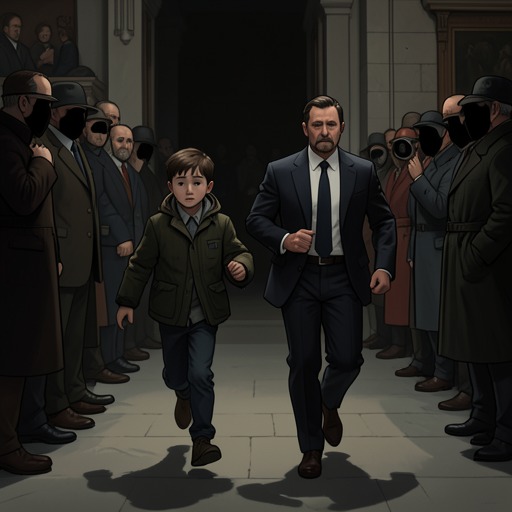
At first, Marco does not recognize the new player introduced by Drago. The two are presented under their playing names: Blizzard is introduced to Hanmokku, and Marco shakes the man’s hand without registering who he is. Only after his attention returns to the wiry man beside the host does recognition arrive from a distance. He identifies the man as Duccio, and recognizes the name Blizzard that had just passed unnoticed. Duccio, by contrast, has recognized Marco immediately and has been waiting for him with a smile.
Duccio interrupts Marco’s attempt to speak and takes him aside, asking him to show the way to a bathroom so that they can move away from Dami Tamburini’s receiving of guests. There, two facing mirrors multiply their figures. Duccio tells Marco to go home immediately and not to play that night, insisting that he speaks as a friend. His appearance is marked by difficulty speaking, which the narration associates with damage to his language and with the wax he carries, compatible with the results of a disease. The warning comes from a friend whose changed body and speech make the reunion unmistakably different from an ordinary meeting after a long absence.
Marco’s first response is a tangle of competing possibilities. He could leave without asking why, treating Duccio’s injunction as a second warning after Miraijin’s fever; he could demand an explanation for Duccio’s reappearance and intentions; he could apologize for the wrong he committed decades earlier; or he could lash out. Marco notices that the advice sounds less like friendly concern than a threat, and wonders whether his own past injury has made him impatient with the person he hurt. Before the warning can settle into a simple instruction, it reopens their history.
Why Duccio has come
Duccio explains that he has kept informed about Marco through another person, who has spoken of him over the years and is sorry for what has happened to him. Marco suddenly understands that his life has become a story told to others with pity. He has returned to childhood places, old friends, and former sports clubs without confiding in anyone about what has happened to him—or what continues to happen. He has not sought anyone’s shoulder to cry on; he has stood firm and carried on. The discovery that Duccio has heard this account, and that it has moved even him to compassion, gives Marco words for an apology he has not made.
Marco acknowledges that he made one serious mistake years earlier, when he was shocked, foolish, and alone, and that Duccio paid the consequences. He apologizes and says he would not repeat it. The apology does not make him accept Duccio’s warning as proof that Duccio is dangerous or unlucky. Marco says that he has never believed in the notion that Duccio brings bad luck and has always argued against those who did. He also says that he owes Duccio his life, so he cannot be afraid of him. In this exchange, the old injury and the debt of survival are not interchangeable: Marco can admit the harm he caused while refusing to let fear define the man who suffered it.
Duccio’s presence at the villa has a specific purpose. Dami Tamburini, Marco’s friend and doubles partner, has hired Duccio to make Marco lose and wants to see him cry. Duccio did not realize at first that the Hanmokku he was meant to ruin was Marco. Their pseudonyms concealed the target from him until the introduction in the room. Once Marco understands the arrangement, the warning becomes more than a generalized plea to avoid risk: it exposes a deliberate attempt by the host to turn a familiar game and partnership against him.
The choice to stay
Marco tells Duccio that, now he knows why he is there, he has a substantial advantage and intends to use it. Rather than leave, he leads Duccio to the study of pain. He asks him to be quiet, opens the door gently, and slips inside. Miraijin is asleep in the hammock with one arm hanging down; Marco places the arm back on her lap and touches his lips to her forehead, which is fresh rather than sweaty. He identifies her as his niece, gives her name and age, and says that wherever he is, she is always with him. His playing name, Hanmokku, comes from the hammock where she sleeps, whose supports can be removed.
The quiet visit clarifies what is at stake in Marco’s return to the game. He does not answer the warning by pretending that Miraijin is irrelevant: he has already worried over her fever, and now he checks on her before returning to the confrontation. Nor does his attachment make him withdraw. By showing Duccio the sleeping child and explaining the origin of his alias, Marco makes his bond with her part of the same scene as the decision to play. The hammock is at once a practical bed for Miraijin and the source of Hanmokku’s identity at the table.
Later, Marco recounts the warning and its source: an old friend he had not seen for more than thirty years had pulled him aside at a place where he had been playing nearly every week for three years. Duccio told him to go home because the boss had hired him to ruin Marco and wanted to see him cry. Asked whether he stayed, Marco answers that he did. The account marks the decision plainly; neither the warning nor the revelation of Dami Tamburini’s plan turns him away from the game.
Victory, risk, and the episode’s turn
Marco eventually discloses that he had come to play for an amount he did not have. He is ashamed to name it, explaining that losing it would have badly disrupted his life. The stakes are therefore not an abstract contest of skill: his decision exposes him to a financial loss he could not comfortably absorb, after he has been told that an opponent has been recruited to bring about precisely that outcome.
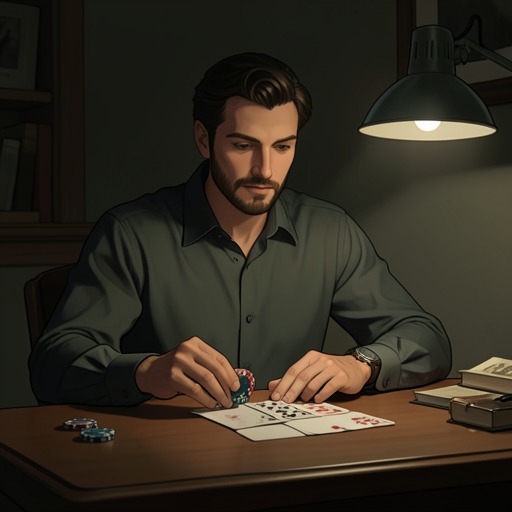
He does not lose. The decisive hand is a jack of diamonds against a jack of clubs, in Texas Hold’em, which Marco explains as Texas-style poker. The narrow, concrete detail of the opposing jacks gives the outcome its form: after the warning, the concealed target, and the unaffordable sum, the reversal rests on a single card-and-suit difference. Marco wins an absurd amount, though his later description of what he did remains mixed with the recognition that playing was itself absurd.
The episode’s victory does not erase the recklessness that precedes it. Marco has gone out while Miraijin is feverish, been warned by a friend he once wronged, and chosen to risk money he did not possess against a scheme arranged by his own doubles partner. Yet he is not simply carried by superstition or bravado: he rejects the idea that Duccio’s presence brings bad luck, apologizes for his past conduct, recognizes the specific danger, and stays anyway. The gamble’s decisive significance lies in that combination. A favorable result follows, but the scene’s central turn is Marco’s deliberate refusal to confuse an old friend with an omen—and his willingness to stake his finances on that refusal.