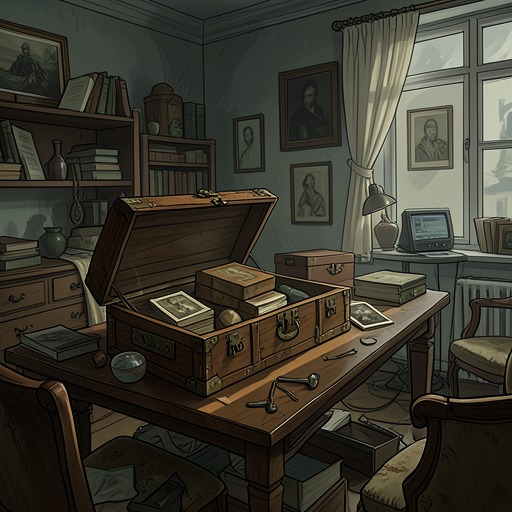
Marco’s mother’s photographic archive
The HummingbirdMarco’s mother’s photographic archive is a material record of the vivid world his mother inhabited and photographed, and its changing custody becomes a measure of how Marco understands inheritance. He first recoils from what the photographs reveal; years later, after winning a large sum at poker, he recognizes that he had mistaken disposal for generosity and asks for the archive back instead of keeping the money.
What the Archive Holds
The photographs preserve a social and creative world that Marco finds difficult to approach. His mother’s work brought together architects and artists, along with a broad company of people, objects, and scenes. Looking at it, he wonders which of the men she worked with might have been her lovers, and feels the absence of his father, Probo Carrera, from this world. The images place his mother at its center as the person behind the camera, surrounded by people and activity; to Marco, this makes the archive feel less like a neutral collection than evidence of a life whose fullness unsettles him.
That fullness sharply contrasts with the things Marco associates with his father: Probo Carrera’s Urania collection and models belong to what Marco describes as a solitary world. Both parents’ pursuits, he observes, had in some sense excluded the other. But his mother’s photographs intensify the imbalance for him: they show a whole world around her, while Probo is nowhere in it. Marco identifies jealousy, or something like it, as part of his response, and says the archive embarrassed and sometimes hurt him. He does not manage it for a long time.
Giving the Collection Away
Marco eventually finds a home for the archive at the Dami Tamburini Foundation, an institution associated with Luigi Dami Tamburini’s bank and focused on twentieth-century iconography. The archive’s transfer comes about through a chance encounter: at a charity doubles tournament organized during Pitti Uomo week, Marco is paired with Dami Tamburini, and they win both the semifinal and final. Marco later characterizes the donation as a way of entrusting the photographs to people who would value them more than he did.
That explanation is incomplete even to Marco. In retrospect, he sees that he had not truly donated the photographs; he had got rid of them. The distinction changes the moral weight of the transfer. What appeared to be an appropriate institutional placement had also allowed him to dispose of the trace his mother left on earth without having to live with it himself.
Reclaiming What He Had Surrendered
After a night when he wins €840,000 at poker, Marco refuses the money and asks instead for his mother’s entire photographic archive to be returned. Speaking to Giacomo Carrera, he says that, after a painful realization, he seemed at last to see things as they were: the only precious thing the man who possessed it had was the archive Marco had given him. He plans to collect it the following day and calls its return his real win.
The reversal is not a change in the archive’s contents but in Marco’s relation to them. He says he has no need for the money, has always enjoyed working without wanting to make a living from it, and regarded the winnings as a kind of damnation. Gambling, which had threatened him throughout his life, is suddenly visible to him as a danger rather than a promise. By trading away the winnings for the photographs, he turns a victory at the table into a refusal of the thing he had once used as an excuse to relinquish his mother’s legacy.
Memory, Evidence, and Inheritance
The archive matters because it preserves a presence that Marco had found painful to acknowledge. It is at once a record of his mother’s work and an inheritance he cannot comfortably receive: her photographs open onto a life filled with people and artistic activity, while also making the absence of Probo Carrera conspicuous. Marco’s eventual decision to retrieve them does not erase his earlier jealousy or discomfort; it gives those feelings a consequence he can finally recognize.
Elsewhere, Marco writes to Giacomo Carrera that his mother’s photographs were beautiful but could embarrass and hurt him, and explains why the world they recorded seemed to leave no room for his father. His later request for the archive back answers that earlier estrangement through action. The photographs thus recur as more than family property: they are a tangible trace of a person who is no longer present, and recovering them becomes Marco’s clearest acknowledgment that he had wrongly treated that trace as something he could simply hand away.