Marco's advanced pancreatic cancer
The HummingbirdMarco’s advanced pancreatic cancer arrives as a sudden, extensive diagnosis that overturns the apparent security of routine medical checks and threatens the future he has helped Miraijin imagine. The disease brings Marco’s professional knowledge into painful proximity with his own mortality, while his failing memory and continuing physical independence shape how he faces the time left to him.
Diagnosis and reversal
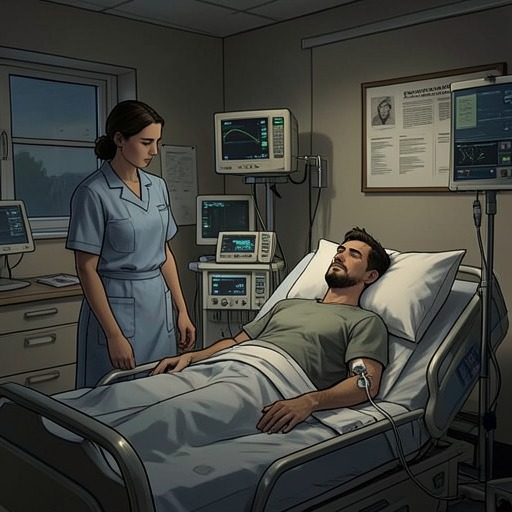
At seventy, Marco is still active and, in Miraijin’s imagined future, stands as he always has: someone who can remain in place while everything around him changes. Then a hospital report identifies a pancreatic carcinoma of great size and extensive spread. The speed of its appearance is central to the shock: Marco has undergone regular examinations every six months, and the previous check six months earlier found nothing.
The diagnosis overturns the confidence those examinations might have offered. It is not presented as a gradual decline that Marco could track over years, but as a dramatic change that seems to have taken hold within a single interval. The medical report gives the disease an unambiguous name, yet the speed of its growth remains a source of bewilderment for Miraijin and a question the narrative does not resolve.
The body and the knowledge of a doctor
Marco’s response is shaped by his medical knowledge. He says that he will fight, but Miraijin understands that he believes himself already dead: he knows what the diagnosis means. The contrast between his spoken resolve and the judgment he cannot hide makes the scene a confrontation between professional understanding and personal hope, rather than a simple declaration of either optimism or surrender.
The narration connects the cancer’s sudden appearance to Marco’s earlier growth. As a teenager, he underwent an abrupt growth spurt; now, at seventy, the rapid emergence of the tumor recalls that bodily history. The link is presented through comparison, not as a medically established cause. It also echoes his mother’s belief that his unusual growth was written in his chromosomes, while leaving open whether the resemblance is fate, coincidence, or the arrival of a feared turning point.
Effects on memory and independence
By the time Miraijin proposes inviting people from Marco’s past to gather, metastases have reached his brain and his memory comes and goes. He cannot remember the film that inspired her idea, nor the name she is trying to recall. He can still identify some parts of his estranged relationships clearly: he remembers that he ended contact with Luisa, that she later wrote to him without receiving a reply, and that he had spent years writing to Giacomo before Giacomo stopped responding. The illness therefore leaves memory uneven rather than simply absent, making some facts accessible while names and recent details slip away.
Pain is also part of Marco’s condition, and he considers whether to take oral morphine. Yet he remains far from the end in physical terms: he is still self-sufficient, and the narrative stresses that he has not become like his deceased parents in their final condition. Earlier, despite weakness, he managed a slow bicycle ride through a pine forest with Miraijin, while members of her escort followed on foot in case he lost his balance. That episode, which the two later laughed about, gives concrete measure to the difference between serious illness and complete dependence.
Consequences and significance
The cancer places a limit on the future Miraijin has imagined and helped to build. In the vision of her life, her grandfather has stood beside her as she becomes a public figure, and she expects him to remain active and present. The report of his illness makes that world collapse for her; the diagnosis changes not only Marco’s prospects but also the emotional meaning of the future she is trying to save.
At the same time, the disease does not erase Marco’s capacity to make decisions about his remaining life. Although pain, metastases, and fluctuating memory mark the approach of death, he is not yet wholly dependent. That distinction matters to his stated wish to leave on his own terms: the narrative frames his choice in relation to his present capacities, not as an inevitable consequence of having already lost them. The cancer thus becomes both a sudden biological crisis and the condition against which Marco’s knowledge, independence, and agency are measured.