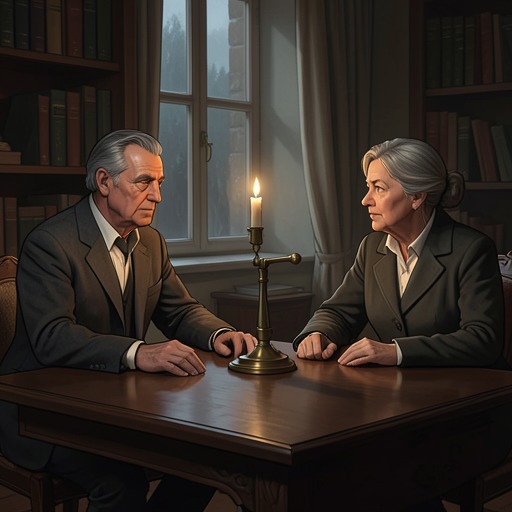
Probo Carrera and Letizia Delvecchio's marriage
The HummingbirdProbo Carrera and Letizia Delvecchio’s marriage is a long, unhappy union between people whose differences are visible to their children but whose reasons for staying together remain partly inexplicable. Their marriage passes its bitterness and silences into family life, yet it also produces moments of cooperation: when Marco’s delayed growth demands a decision, the couple set aside their opposing convictions and undertake a treatment path together.
A Union of Opposites
Letizia and Probo are both uprooted from their places of origin, but share little else. She is an architect absorbed in ideas and revolution; he is an engineer known for calculation and practical skill. Their contrasting temperaments infuse the household with impatience, silence, and quiet quarrels. The children are shielded from the arguments as much as their parents can manage, but Irene, four years older than Marco, listens closely and understands more of the conflict than he does.
The marriage’s unhappiness is not simply a failure of mutual affection. Probo’s love for Letizia is described as intense and enduring, but one-sided: she cannot accept or return it in the same way. That imbalance becomes a burden within the family, while Letizia’s many pursuits—including architecture, design, photography, yoga, and psychoanalysis—are presented as attempts to find balance. Her infidelities with members of Florence’s intellectual and architectural circles are known to Probo, adding another source of injury without ending the marriage.
Marco’s childhood can seem happy precisely because he does not recognize what Irene sees. He takes his parents as models and absorbs traits from both, even though those traits have proved difficult to reconcile within their relationship. The gap between his innocence and Irene’s early understanding shows how the same household can shelter one child from its tensions while making another acutely aware of them.
The Marriage Under Pressure
When Marco reaches adolescence without growing normally, Probo becomes increasingly alarmed. Medical consultations establish that Marco has moderate short stature caused by insufficient growth-hormone production; a treatment option is experimental. Probo wants to pursue it, while Letizia initially argues against interfering with nature and invokes D’Arcy Wentworth Thompson’s On Growth and Form to defend her position. Their disagreement escalates into a loud quarrel, carrying them far beyond the immediate question of treatment and threatening to expose how close they are to separation.
Irene intervenes, insisting that her parents settle the argument and declaring that no one should leave the house before she does. Her response shocks them into recognizing the effect of their conflict on their children. They repair the immediate breach and remain together, not because their underlying differences have been resolved, but because the prospect of the family breaking apart feels intolerable. The novel presents this intervention as a turning point for the parents and for Marco: thereafter, caution and self-denial in the supposed interest of the children take precedence over the possibility of separating.
Their choice is not portrayed as a solution. Both understand that unhappiness does not become harmless merely because it is chosen, and that a persistently unhappy marriage can pass its consequences on to the children. They nevertheless stay. The account emphasizes that neither had been happy even before they met; the short period of happiness they shared was at the beginning of their relationship, when they fell in love, married, and began a family. Their later life together is quieter than the quarrel that nearly broke the household, but remains painful and argumentative.
A Difficult Accord Over Marco
The treatment dispute brings the couple into an unusual period of cooperation. Letizia reconsiders her opposition and independently investigates the protocol proposed by a pediatric endocrinologist in Milan. Her inquiry leads her to recognize it as the only serious option then available to help Marco grow. Probo, in turn, does not treat her agreement as a victory over her; he takes her to meet the specialist, asks her to assess the proposal for herself, and undertakes to take her judgment into account before making a final decision.
Their agreement does not erase the strain in their marriage, but changes the way they face this particular problem. For once in a long time, they find themselves on the same path. Probo’s effort to make the decision something they can share reflects both his continued love for Letizia and the fragile possibility of partnership that persists beneath their conflict.
Care, Children, and the Marriage’s Afterlife
Years later, their daughter-in-law Marina and Marco disagree about how to respond to their granddaughter Adele’s belief that a thread connects her back to a wall. A psychotherapist interprets the thread as a sign of Adele’s close, exclusive bond with her father and recommends that Marco spend much more time with her. The resulting change in family roles is substantial: Marco takes on school journeys and daily care, reduces his work and other pursuits, and finds that he feels better with his daughter. The scene presents care as a force that can reorganize a household, though it concerns Marco and Marina’s marriage rather than Probo and Letizia’s directly.
When Probo becomes seriously ill, Marco assumes much of the practical work of accompanying him to treatment and monitoring his care. Giacomo also returns to the family home and devotes himself to serving their parents, while his relationship with Marco remains marked by an old competitiveness. The brothers approach the sickbed together but do not achieve the reconciliation that seems briefly possible. This later family crisis shows the continuing weight of the parental household: its members gather around care, yet old distances and injuries remain.
After Probo and Letizia have died, their family is already fractured when Adele dies. A tragedy that might further divide a cohesive family instead helps bring surviving relatives back into contact. With the help of Daniele Carradori, Marco and Marina resume seeing one another in Germany, where Marina is hospitalized, and share the condition of bereaved parents. This later bond does not undo the marriage’s history; it shows how loss can alter relationships that had long been damaged, while the family’s pattern of pain and mutual obligation continues beyond Probo and Letizia’s lives.
The Marriage’s Significance
The marriage is defined by a contradiction: Probo and Letizia cannot live happily together, yet neither can bring the union to an end. The narrative leaves their deepest point of connection mysterious, distinguishing it from simple fear and from the practical fact that they have children. Their decision to remain together becomes an act of restraint and family preservation, but the story refuses to treat that restraint as a cure for unhappiness.
Their relationship also establishes a pattern that recurs across the family: care and attachment can bind people who hurt one another, and the needs of children can redirect adult choices without resolving the conflicts beneath them. Their decision over Marco’s treatment is a rare instance of shared purpose; the silence and resentment surrounding it remain part of the same marriage. The family endures not through a recovered harmony, but through a knot that is never fully untied.