Probo Carrera's railway model
The HummingbirdProbo Carrera’s railway models are large, technically ingenious constructions that embody decades of private labor. When Marco Carrera takes responsibility for clearing the family house, he refuses to treat them as bulky remnants to be discarded: he finds a home for all three with a railway-modeling association. Their transfer preserves the models, but it also brings into view the reticence with which Probo made them and the parallel worlds inhabited by people who shared his passion without ever fully meeting him.
Design and Craft
The three train layouts differ in scale and design, but each is too substantial to fit easily into ordinary domestic life. One is a minimalist system, three and a half meters long and only sixty centimeters wide, capable of running as many as eleven trains at once. Its apparent simplicity conceals a two-level mechanism: trains disappear into a tunnel, reverse, descend into an unseen level built into the base, travel back out of sight, and then rise to reappear at the other end. The ingenious operation makes the visible layout only half the work; the hidden track is what allows the scene to keep moving.
The other two models have their own character. One is an immense layout dating from the 1960s; the other reproduces the uphill hairpin bend at Piteccio on the Porrettana line. Together, they make an entire room difficult to reclaim for any other use. Their scale and specificity are not incidental decoration but the result of sustained, meticulous attention. For Marco, they are too beautiful and too carefully made to destroy, even though keeping them would complicate selling the house.
Marco’s Search for a Home
Marco first remembers that, before Probo’s condition worsened, his father had spoken of a remarkable model in the basement of the Dopolavoro Ferroviario, near the Cascine. He returns to a place he has not visited for more than forty years. The modelers who meet there have no reliable schedule, and the basement is locked when they are absent; even other members of the club know little about the group. After a month of trying, Marco finds its president, Beppe, playing rummy. At the mention of Probo, Beppe leaves the game and takes him into the closed basement.
The room contains a large-scale urban railway, with miniature buildings, streets, cars, and people. Seeing it helps Marco understand why his father had remembered the modelers: they, too, had built a world in which technical detail and patient construction mattered. Marco explains that the three layouts at home need a new custodian. Beppe agrees in principle, although he has not yet seen them, and arranges to visit. A month later, he is astonished by the models, especially the Porrettana layout, and says the association will take all three. One will be useful for teaching young people to build model trains.
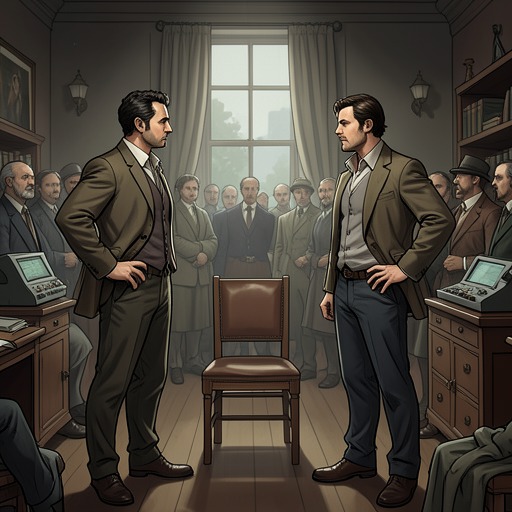
The transfer does not happen immediately. Beppe vanishes for two months while looking for a van large enough, leaving Marco to try calling him and asking after him at the club without learning what has happened. When Beppe finally returns with transport, he brings the other modelers, whom he calls the boys although all are over fifty. Their care makes the removal feel less like disposal than a ceremony of recognition. Six arrive with their hats in their hands and stand enchanted before the work of the Engineer, as they call Probo.
A Community That Had Never Been Close
One of the visitors tells Marco that it is a great honor to be there and to inherit the models. He had once owned the shop where Probo bought his trains and discussed technical matters; seeing Probo’s layouts had long been one of his own great wishes. Yet Probo intimidated him, and he never asked to see them. The two men had shared a deep interest and held one another in high regard, but had met only rarely across decades, despite living in Florence. Probo’s reserve kept his work and his relationships at a distance: even with someone who understood the same technical world, he disclosed little beyond the practical details.
That revelation changes the meaning of the handover. The models had not simply been waiting for a suitable destination; they had been made within a network of admiration that never became genuine intimacy. By placing them with the association, Marco gives the work to people capable of understanding its craft, while discovering how little even its closest potential admirers had known of it. Preservation does not undo Probo’s reserve, but it allows the models to be seen and used beyond the private room that had contained them.
Moving the Models
The association members devise supports to protect the plastic constructions, wrap them in bubble wrap, and carry them on their shoulders. One of the largest cannot pass through the doors, so they lower it through a window on ropes. The work takes an hour and a half. In the van, Beppe drives with two men beside him, while the other three ride in the back holding the oversized model, which projects a meter beyond the vehicle and would otherwise fall. The awkwardness of the move measures the models’ physical presence as plainly as their delicate detailing does: they cannot be handed over casually or separated from the care their scale demands.
Afterward, Marco assumes that, in keeping with his father’s customary privacy, he will never see the modelers again. But the association’s discreet reputation briefly surfaces in an unexpected place. The next day, at the rotisserie where Marco regularly buys roast chicken, an older cook approaches him and whispers that he has heard the boys were with him. Only after Marco fails to understand does the man quietly clarify that he means Probo’s models, which people say are very valid. The exchange carries the models’ reputation out of the basement and into ordinary neighborhood life, still in the form of a secret passed from person to person.
Inheritance and Meaning
Marco’s account of the transfer is written to his brother Giacomo Carrera as an email about how he arranged their father’s three train models. Its detailed, practical narration—measurements, inaccessible club rooms, the van, the window, the men’s hats—makes inheritance a matter of specific acts rather than abstract sentiment. Marco cannot restore his father’s work to the years in which it was made or make Probo less reticent. He can, however, keep the models from being destroyed and put them into the hands of people who will build on the knowledge they contain.
The layouts also stand apart from the other objects Marco sorts through. He gives away architectural models, leaves the dollhouse made for Irene Carrera in her room, and keeps a model associated with Bolgheri. The railway models require a different solution because their scale consumes a room and their craftsmanship makes destruction unthinkable. Their passage from the family house to the association therefore joins practical necessity to a belated encounter: Probo’s work reaches an appreciative community only after his son has carried it out into view. Even the cook’s whispered praise echoes the quietness that shaped its maker, while confirming that the work has acquired a life beyond the privacy in which it was built.