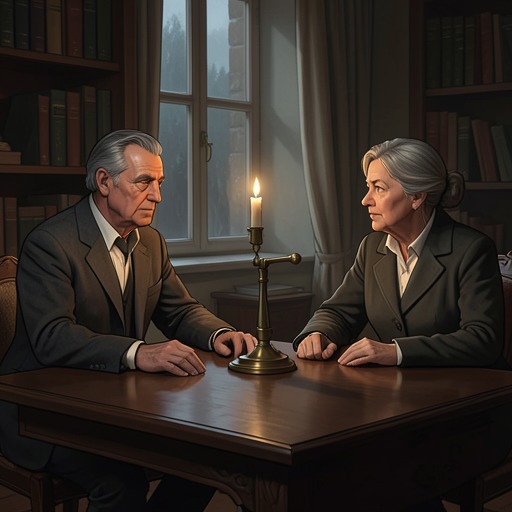
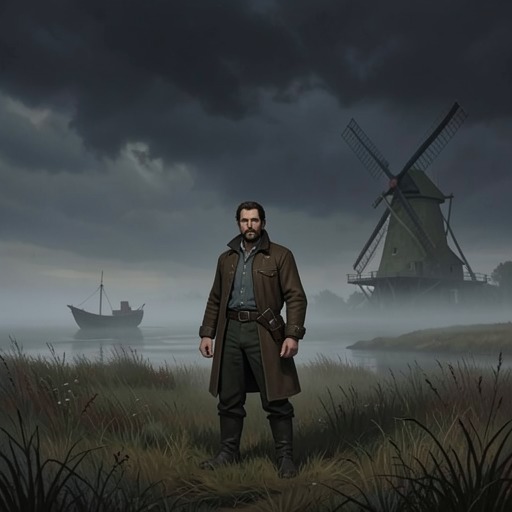
Probus Carrera and Aldino Mansutti's friendship
The HummingbirdProbus Carrera and Aldino Mansutti’s friendship was deep and adventurous, but a fatal accident and the memory of a dangerous quarrel led Probus to question whether chance could fully separate Aldino’s death from his own anger. Years afterward, on the way to a dinner with Aldino’s family, Probus tells Letizia Delvecchio how he used calculations to accept the accident as nearly impossible—and why that explanation eventually brought him back to his own fleeting capacity for violence.
A friendship shaped by loss
Aldino had been Probus’s childhood friend and companion in a friendship Probus describes as deep, rich in adventure and emotion. By the time of the conversation with Letizia, Aldino has been dead for eleven years. His death remains present rather than settled: the evening’s destination is a dinner hosted by Aldino’s widow, and the journey takes Probus and Letizia along the Aurelia state road, near the stretch where the accident occurred.
Aldino was riding a new Guzzi V7 Special near the church of San Leonardo, between Pisa and Livorno, after crossing the Arno. A bucket carrying 170 liters of water detached from a helicopter working with Italian firefighters against a large fire in the lower Pisan hills; the helicopter had been supplied to the nearby American military base at Camp Darby. The bucket struck Aldino. The death was often described as a motorcycle accident, but that label concealed the extraordinary chain of circumstances Probus could not accept as ordinary or adequate explanation.
Probus’s effort to calculate chance
Probus had obtained the investigation’s data, including the helicopter’s route, speed and altitude, the bucket’s weight and water load, wind speed, and the motorcycle’s speed. His first calculations did not demonstrate the accident’s improbability, as he had intended. Instead, they suggested that it followed inevitably from a fixed field of forces, leaving no way out. The result challenged his effort to make the death intelligible without making it feel predetermined.
He then changed methods, imagining the simpler, more creative approach he associated with Letizia. The decisive illustration was not a long chain of calculations but one comparison: the helicopter covered 43 meters per second, while Aldino travelled at 23.5 meters per second. If the bucket’s hook had broken one second later, it would have fallen 43 meters farther east, toward the church; Aldino would have been 23.5 meters farther along the road. Probus’s reasoning reduces the catastrophe to a difference of three hundredths of a second. He concludes that the fatal alignment belonged to a class of events whose actual probability was so close to zero that there was, in effect, nothing useful to calculate.
This account is not merely a technical explanation. Probus calls the new perspective a vision of Aldino’s death that he has carried with him and only now shares with Letizia. He contrasts the accident with being struck by lightning during a storm: lightning has a visible context, with bolts repeatedly reaching the ground, whereas Aldino’s death depended on a far rarer and more intricate convergence. The calculations give Probus a way to acknowledge the accident’s contingency, but they do not close the question of responsibility that the friendship itself raises.
The quarrels and the remembered gun
Probus recalls two memorable quarrels. The first occurred when the friends were twenty and college students. He no longer remembers the cause; it may have involved an invitation to a party or a girl, and he allows that he may have been at fault. They overcame it quickly and never spoke of it again.
The second quarrel took place years later, when both men were graduates, married, and fathers. They were hunting together in a reserve belonging to Titti’s father at Vallombrosa. Aldino unexpectedly shot a partridge Probus believed he should have shot, firing from behind him while Probus was aiming. Probus judged Aldino’s action unfair and dangerous, but describes his own response as hysterical and disproportionate: he shouted insults, some unjust, then left in anger and fear. Aldino remained behind with the dog and the bird.
The detail that changes the memory is that both men were armed. Probus had a loaded shotgun in his hands and was furious. Looking back after Aldino’s death, he asks whether that outburst might briefly have contained an impulse to raise the gun and shoot his friend. He does not claim to remember such an intention or to have acted on it. Instead, he wonders whether an urge could have existed for an instant too brief to notice or retain—a possibility made more disturbing because the accident itself, as he has calculated it, depended on only three hundredths of a second.
Confession, kinship, and the meaning of the accident
As Probus tells the story, he pauses to ask whether Letizia is following him. She listens closely, moved not simply by the argument but by the self-portrait it reveals. When she asks what he means by connecting himself to Aldino’s death, Probus answers through the old quarrel: if Aldino’s fate turned on an almost impossibly rare coincidence, then the fleeting possibility that Probus had wanted to kill him makes the two events feel, in his mind, morally inseparable. He concludes that it is as if he had killed Aldino, though the account provides no evidence that he caused the accident.
The scene ends not with a resolution to the uncertainty but with Probus leaving the car and joining Aldino’s widow and her two daughters at the restaurant. The friends’ history thus remains present at a family gathering from which Aldino is absent. Probus’s explanation holds two incompatible pressures together: the accident was contingent beyond meaningful calculation, yet the remembered instant of anger makes him feel implicated. His friendship with Aldino survives in the form of this unresolved reckoning, where grief turns a remote accident and an old quarrel into a single question of responsibility.