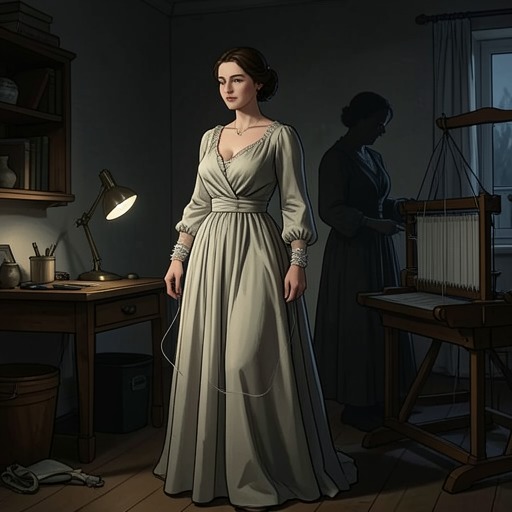
The thread
The HummingbirdThe thread is both a childhood perception and a family image through which Marco Carrera comes to understand Adele Carrera’s distress. It first appears when Adele’s world is overwhelmed by instability, returns during a later crisis in Munich, and disappears as she finds a more dependable home in Florence. Years afterward, when a climbing rope breaks and Adele dies, the image returns in Marco’s anguished recognition that he had spent part of her childhood trying to protect it.
Appearance and Recurrence
The thread is described as something behind Adele’s back, an image that appears when she is in danger of being overwhelmed by circumstances her parents fail to understand. It is not a decorative symbol imposed from outside her experience: its appearance and disappearance follow changes in her ability to bear the world around her. When the family’s upheavals become intolerable, the thread returns; when Adele moves to Florence and gains stability, it vanishes.
The image also gives form to what the adults cannot initially see. Adele has been moved between Italy and Germany, and her early life includes trauma, a mother in severe psychological distress, and a father who, in Marco’s later judgment, had not been able to protect her. Her thread signals that something is wrong before her parents can fully perceive the danger. Its recurrence therefore matters not simply as a symptom, but as a message that the family has not yet learned how to read.
Family Crisis and Recognition
Marco’s understanding of the thread develops through regret. He recognizes that Adele had relied on dysfunction only when there was danger her parents still did not perceive; when they began to understand, she recovered. During the Munich crisis, the thread returns and the city becomes, in his account, an inextricable and unlivable web. The image points her inadequate parents toward a lesser evil, rather than promising an uncomplicated good.
Looking back, Marco concludes that Adele possessed a powerful, untamed wisdom. His part was not to cure or overrule that wisdom, but to provide the stability she had never known. That meant continuing periodic visits to her mother in a sanatorium, and respecting Adele’s loving bond with her younger German sister even when the relationship was painful and complicated. Once Adele could lean on the stability of home, she could let the thread unwind for good.
The Thread and Adele’s Later Life
For the nine years after Adele moved to Florence, the thread remained absent, and she showed no further detachment from reality. Marco’s account links that quiet period to the practical life he built around her: he worked, managed the household, and raised his daughter while also caring for his parents. Adele, meanwhile, studied and worked, and sometimes went away in waves or leaps to replenish herself in nature. Marco stayed with Miraijin when Adele left, giving the child the dependable care Adele herself had lacked.
The absence of the thread does not mean that Adele’s history has been erased. Marco continues to worry about her, but his experience has taught him to distinguish a past sign of crisis from the person she has become. He sees her as a reliable and conscientious young woman, and the thread’s long disappearance helps explain why he trusted her to make her own choices, even when those choices brought risks he could not control.
The Broken Rope
After Adele dies in a climbing accident, Marco learns that the rope broke from rubbing against the rock. His grief fixes on the material fact of the failure: a climbing rope is made of polyester with a high-strength inner core, and, as he insists, it should not break. But the broken rope carries a second, personal meaning because Adele’s childhood thread had already made rope an emblem of danger and of the fragile bond he thought he was guarding.
When the thread is named in the conversation about the accident, Marco says he spent half of Adele’s childhood protecting it, trying to keep it from tangling or breaking. The words reveal the limit of his care as well as its depth. He could offer Adele stability and respond, eventually, to the distress her image expressed; he could not make her life invulnerable. The thread thus joins two losses across time: the childhood danger Marco learned too late to recognize, and the fatal break he could not prevent.
Meaning in the Narrative
The thread changes significance as Marco’s knowledge changes. At first it is an alarming sign that Adele’s parents do not understand; in retrospect, it becomes evidence of her capacity to register dangers adults overlook. Its disappearance marks a real improvement in her circumstances, not a simple claim that the earlier wounds never existed. Its return in Marco’s final recollection transforms the image again, from a sign he could interpret and respond to into a reminder of the boundary of parental protection.
The rope’s literal break and the childhood thread’s threatened break make the motif especially painful: the image that once helped Marco understand what Adele needed cannot save her from the later accident. The thread holds together the novel’s account of care as attentive but never absolute. Marco can accompany Adele, give her a stable home, and honor the wisdom he recognizes in her; he cannot guarantee that either a symbolic thread or a physical rope will hold forever.