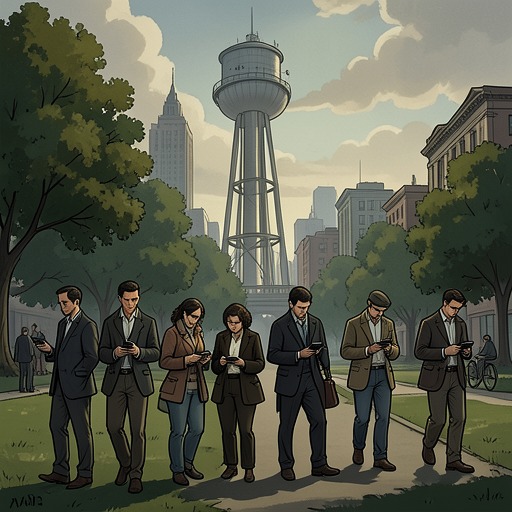
Irvington’s urban decay
The InnocentIrvington’s urban decay is embodied by a vast, rust-red beer-bottle water tower and the neighborhood that has slowly disintegrated around it. The landscape is more than a backdrop: it gives material form to Matt Hunter’s limited means and to his sense that returning to a more prosperous suburban life would be a change he is not yet able to make.
The Brewery Bottle and a Diminished Landmark
The bottle dominates the skyline above Matt’s home, its crown rising 185 feet. It once served as a water tower, clad in copper-plated steel with glossy enamel and a gold stopper; spotlights made it visible for miles at night. Pabst Blue Ribbon’s brewery had been here, but the company abandoned it in 1985. By the time Matt encounters the landmark, its beer-bottle-brown appearance is actually rust red, its label has vanished, and its former illumination and polish belong to the past.
The tower’s physical decline is linked to the surrounding neighborhood’s. The area, once robust, has not collapsed in one spectacular blow; it has, in the narrator’s formulation, slowly disintegrated. The brewery’s ruins make that deterioration palpable: nobody has worked there for twenty years, yet the eroded remains look as though they have been abandoned for much longer. The contrast between the tower’s former brilliance and its present rust turns a piece of local infrastructure into a visible measure of accumulated neglect.
A Neighborhood Matt Can Afford to Call Home
Matt and Olivia Hunter live in a declining two-family dwelling off Main Street, held together by aluminum siding. They occupy its right side; the Owens, an African-American family of five, live on the left. Each half has two bedrooms and one and a half bathrooms. The property’s modest condition places the couple within a specific everyday setting rather than an abstract picture of decline.
The broader neighborhood is described as seedy, in the strangely comforting shadow of the giant bottle. When Matt was fresh out of prison, he felt he deserved no better, and he could afford little better. Despite objections from his family, he began renting there nine years before the present-day passage. The account resists reducing his choice to a single psychological cause: guilt about what prison required of him might seem an obvious explanation, but Matt knows such matters are not simple. He has no better explanation than that he cannot yet return to the suburbs; the transition would be too abrupt, like a diver suffering the bends.
The surroundings that have become home are named in their ordinary particulars: a Shell gas station, an old hardware store, a corner deli, winos on cracked sidewalks, cut-throughs to Newark Airport, and a tavern hidden near the old Pabst brewery. The list sets the worn city in motion as a lived-in place, shaped by everyday routes and businesses as well as by vacancy. The airport cut-throughs and concealed tavern sit alongside the disintegrating brewery, giving the neighborhood a texture that cannot be reduced to the ruin alone.
Uneven Measures of Prosperity
The contrast with Livingston makes the decay socially legible. There, lush lawns are treated as a serious matter, and allowing green grass to turn brown can invite a neighborly dispute over a new Weber Genesis Gold backyard grill. In Irvington, by contrast, the grass around Matt and Olivia’s dwelling has nearly died during a drought, and nobody cares. The narration sharpens the contrast into a blunt observation: lawns were a rich man’s game.
The drought has lasted three weeks without rainfall on the East Coast. That detail makes the dead grass more than a symbol of neglect: the environment itself is under pressure, while the meaning assigned to its effects varies with wealth and place. In the suburbs, a browned lawn becomes a social grievance; in Irvington, it registers as one more condition that residents do not have the resources or inclination to contest. The same visible change thus carries different weight across the economic divide.
The Decay as Home and Measure of Change
Irvington’s worn setting is bound to Matt’s post-prison circumstances, but the narrative does not treat the neighborhood as merely a punishment or a temporary way station. He has lived there for years, and its streets and local landmarks have become familiar enough to constitute home. The giant bottle’s shadow is both a sign of a vanished industrial presence and, strangely, a comforting feature of the place he knows.
Matt’s reluctance to move to the suburbs gives the landscape a further function: it measures the pace at which he can change his life. His family’s protests do not make him ready to leave, and Olivia’s arrival from Virginia does not automatically make him demand a different neighborhood. The worn city is therefore neither simply chosen freely nor described as an entirely imposed condition. It is the place his limited finances and his sense of distance from suburban life currently allow him to inhabit. Its slow deterioration, visible in the rusted tower, empty brewery, cracked sidewalks, and dying grass, gives that in-between position a concrete shape.