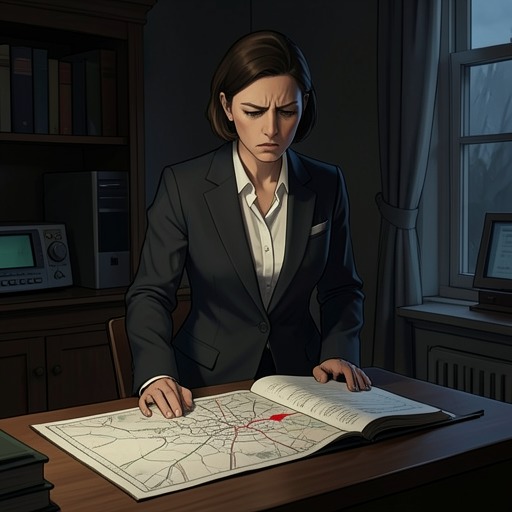
Matt Hunter
The InnocentMatt Hunter is the novel’s central character, introduced at twenty as a middle child from an upper-middle-class suburb in northern New Jersey. A fatal fight, an uncertain memory, and a prison sentence mark the beginning of a life in which love and happiness coexist with guilt, mistrust, and the fear that the past will repeat itself. His story turns on a persistent question: whether a person can take responsibility for what happened without being defined forever by it.
Identity and Background
Matt grows up in a wealthy town on its poorer side. His parents work hard and love him unconditionally; he worships his older brother and is more tolerant than close toward his younger sister. That family background gives his later losses particular force: imprisonment separates him from home, and his father’s death while he is incarcerated becomes another event he interprets through guilt.
At twenty, Matt is involved in a fight whose decisive moments remain uncertain even to him. He cannot tell whether he lunged, whether the other man pulled or pushed him, or whether one of them simply lost footing on the icy sidewalk. He returns to the moment repeatedly in memory, but never arrives at a definitive answer. The account preserves the distinction between the fatal outcome and the unresolved question of intent: the uncertainty does not undo what happened, but it complicates how Matt understands his responsibility.
The Fight, Trial, and Imprisonment
Campus security and then the police arrive quickly. Matt tells them what happened, and his parents hire a prominent New York City lawyer, who advises him to plead self-defense. He does. The legal defense offers a formal account of the fight, but it cannot settle Matt’s own recurring doubts about the moment on the sidewalk.
At sentencing, the jury’s verdict is difficult for Matt to hear over the sounds that continue to intrude on his attention. The press is watching, and the judge sentences him in a politically charged climate: he will not be sent to a comparatively comfortable prison reserved, in the account’s terms, for privileged white men. Six months into his incarceration, his father dies of a heart attack. Matt blames himself and wants to cry, but cannot. The death compounds the cost of his imprisonment with a bereavement he experiences as another consequence of his own actions.
The memory of the fight remains not as a solved recollection but as an enduring sound and a recurring uncertainty. Years later, Matt wonders whether prison changed him, considering the possibility that someone can enter prison as one person and leave as another. His concern is not abstract: violence has become something he recognizes in himself, and he does not know whether it began with the original fight, was intensified by incarceration, or has since acquired a life of its own.
Marriage and Renewed Threats
Matt eventually builds a life with Olivia Hunter. In the weeks after they fall in love, she teaches him what love means to him; he tells her the truth about his past, and she accepts it. They marry, and when Olivia becomes pregnant they celebrate by buying matching camera phones. The details establish a real domestic happiness, but also place an object associated with their shared life at the center of the later plot’s concern with evidence, privacy, and suspicion.
That marriage comes under pressure when Matt concludes that Olivia has been covering her tracks and wonders why. At another point, he is told that someone has read all about his case and has asked police contacts for the full story, a reminder that his criminal history remains available to others as a way of judging him. A later hypothetical reconstruction of the case against him shows how quickly that history could organize suspicion: an ex-con previously imprisoned for killing a man in a fight receives mocking photographs that appear to show his wife with Charles Talley, hires a private investigator, goes to a hotel, and becomes involved in a fight. A desk clerk, possible security footage, and physical evidence could all reinforce that account. The sequence shows how the facts of Matt’s past can make a damaging interpretation of new events seem immediately plausible.
Matt’s efforts to respond to danger are also shaped by caution and responsibility. When his phone rings late, he first reaches to silence it, then considers that Cingle Shaker may be in trouble and need his help. The number is private, and he suspects it could be the police station. Even a small decision to answer or ignore the call carries competing possibilities: helping someone in danger, or facing renewed attention from law enforcement.
Violence, Loyalty, and Accountability
During the later crisis, Matt learns that Charles Talley and Max Darrow are both dead. The news lands within a widening chain of threats and uncertainty, rather than as a contained return to the original case. Matt’s attention is divided between the people who may need help and the danger his own involvement could bring to them.
In a confrontation involving Kimmy Dale, Olivia, and Cal Dollinger, Kimmy falls and Olivia disappears from view. Matt presses on and, realizing that there is no time to spare, uses his momentum to leap toward a window where Dollinger is standing. The action is urgent and physical, but its significance lies in Matt’s return to violence under different circumstances: he acts to intervene in an immediate threat, while remaining conscious of how close such action is to the violence that first defined his life.
Matt’s relationship with Loren Muse brings the unresolved past into direct conversation. Loren tells him that she always blamed him. The accusation is not a simple verdict on the fight; it makes explicit that Matt’s actions have continued to shape other people’s grief and understanding. In speaking with Sonya McGrath, he also encounters the possibility that Stephen did not know the boys involved in the fight. Sonya insists to Clark that what happened to Stephen was an accident. Her statement offers a competing moral interpretation, but does not erase the death, the blame, or the uncertainty that Matt carries.
Return and Change
After the crisis, Matt and Olivia fly home the same day. He uses a cane and limps, though the impairment is not expected to last. At the moment of arrival, he tells Olivia that he thinks he should go alone. The choice marks a shift in the terms of his return: he is going back toward unresolved relationships and consequences, but does not ask his wife to accompany him into the immediate confrontation.
Matt faces Clark McGrath and warns him not to come near his family again, threatening to kill him if he does. The threat shows how strongly Matt’s protective impulse can take the form of the violence he has spent years trying to understand. It is not a clean transformation from violent man to peaceful one; rather, the novel places his desire to keep his family safe beside the danger of making violence his answer.
The epilogue returns to Matt’s name, restating the identity with which the story began. That return gives the ending a circular shape without suggesting that the intervening history has been undone. Matt remains the man who cannot settle exactly what happened on the icy sidewalk, the former prisoner whose history makes others doubt him, and a husband and father determined to protect his family. His development lies in having to live among those identities and choose what responsibility will mean, even when certainty and absolution remain out of reach.