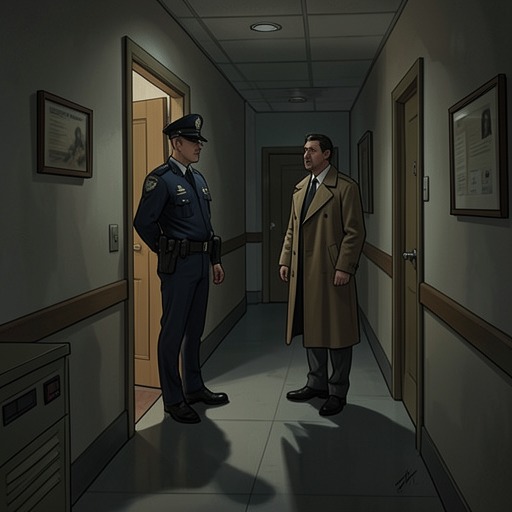
Matt Hunter's flight to Reno
The InnocentMatt Hunter's flight to Reno begins when two deaths make him an immediate suspect and ends with him landing in Nevada after evading police, stealing a car, and manipulating air-travel checks. The escape is both a change in his circumstances and a reversal in his conduct: a man who had spent years avoiding anything unlawful now uses prison-acquired skills to keep moving while the case against him catches up.
The arrest threat and escape
Matt hears a woman scream and tells Olivia Hunter that Charles Talley and Max Darrow are dead. He believes the officers arriving at the house intend to arrest him for their murders. When he says he has to leave, Olivia insists that they should leave together. Matt refuses, taking her twenty dollars as the two watch Lance Banner approach the front door with two police officers.
Olivia proposes a division of risk: Matt should slip out the back while she wakes Marsha Hunter and tries to delay the officers. Before he goes, Matt tells Olivia he loves her. Her words about their life being worth fighting for stay with him as he leaves, turning the escape from a purely tactical retreat into an effort to preserve a shared future, even though he does not bring her with him.
In the backyard, Matt sees Kyra watching. Their eyes meet, and he reads a small smile in her expression. When Kyra screams, the officers turn away from the house and rush toward her. Matt uses the opening to run in the opposite direction, toward the woods, and does not look back until he is deep among the trees. Her intervention gives him the crucial first break in a flight that will depend on a succession of improvised opportunities.
From the woods to the road
Matt spends more than an hour on foot, first crossing the woods and then keeping away from main roads. At Livingston Avenue he catches a bus to Bergen Community College in Paramus, sleeping through the roughly hour-long ride. The commuter campus offers a chance to disappear among parked cars, and the limited security makes it possible to search without drawing immediate attention.
Matt has learned car theft from Saul, a prison inmate whose repeated joyriding arrests eventually led to a life sentence after a fatal crash. Following Saul’s method, Matt looks for a car with its keys hidden in a magnetic box rather than trying to force a lock. After nearly an hour, he finds a white Isuzu with a quarter tank of gas and keys above one of its tires. He drives toward Route 17, choosing the familiar route across the George Washington Bridge rather than the less familiar route north over the Tappan Zee. His intended destination at this point is Westport, Connecticut.
At the bridge toll, Matt worries that he may be recognized. He removes the bandage from his head and replaces it with a New York Rangers cap he finds in the back seat, but the toll crossing passes without incident. He listens to two radio stations for reports about himself, the dead men, or a fleeing suspect and hears none. The absence of a bulletin does not make him safe; it leaves him to navigate the escape without knowing how widely the police are searching.
Reaching Reno
The route changes when Matt decides he has to reach Reno and concludes that he must fly. He stops at a Great Western off Route 80 and uses another lesson from prison: he wants a license plate bearing the letter P, then covers part of the letter with black electrical tape to make it read as a B. He buys the tape at Home Depot and chooses a car in an employee lot, reasoning that its owner is likely to be inside at midmorning. The alteration is crude under close inspection, but he hopes it will suffice for the journey to Harrisburg, Pennsylvania.
Air travel poses a different problem. Matt knows the evasion advice he has learned dates from before September 11, when airport security was less stringent, so he treats the plan as a risk requiring speed and luck. From a pay phone near the New Jersey border, he first books a flight from Newark to Toronto, creating a misleading reservation, then uses another phone to make the reservation he actually needs. He writes down the booking number and proceeds to the airport.
At the counter, Matt presents his driver’s license. The agent enters his name but cannot find him in the system; when she asks for the booking number, the reservation supplies the route through the check-in process. He boards under the name Huntler, a one-letter alteration of Hunter. The security guard checks his photograph and face but does not catch the mismatch between the license and boarding pass, a discrepancy that can pass amid the volume of passengers and printed passes. Matt reaches the gate just as it is about to close, takes an aisle seat, and sleeps until the pilot announces the descent into Reno.
Consequences and significance
The escape depends less on a single master plan than on a chain of small advantages: Kyra’s scream diverts the officers; a hidden key makes the Isuzu accessible; an unremarkable toll crossing leaves Matt unrecognized; and a booking number and near-identical surname carry him through the airport. Each step buys distance without resolving the accusation that set him running. His flight is therefore a temporary evasion, not a clearing of his name.
The episode also marks a concrete break with Matt’s self-imposed rule of avoiding unlawful activity. After years of keeping away from crime, he applies Saul’s car-theft advice, takes a vehicle and another car’s plate, alters the plate with electrical tape, and uses false travel details to avoid detection. The methods that once belonged to prison stories become tools of his present survival. The contrast is central to the escape: Matt seeks freedom from an arrest he considers unjust, yet pursuing it draws him further into conduct that can compound his legal danger.
The flight also sits within a story driven by misleading evidence and uncertain interpretation. Earlier, Matt has seen a man on a phone screen whom he cannot identify, and later realizes that Olivia did not send the video even though it came from her phone. Elsewhere, an implant’s serial number offers a concrete trace to investigate, while sunlight through a window helps establish that a photograph and video were taken at different times. These clues underscore the difference between what an image or record appears to show and what it can actually establish. Matt’s escape unfolds in that same unstable evidentiary world: he is pursued in connection with two deaths, while the means of identifying and judging him are themselves vulnerable to deception and error.
The destination is Reno, reached not through a clean break but through accumulated improvisations. By the time Matt lands, the attempt to outrun the immediate arrest threat has required him to act against the law he once tried to keep clear of. The journey’s decisive outcome is thus double: he gets away from the officers at the house and reaches Nevada, but his passage there transforms avoidance into active evasion.