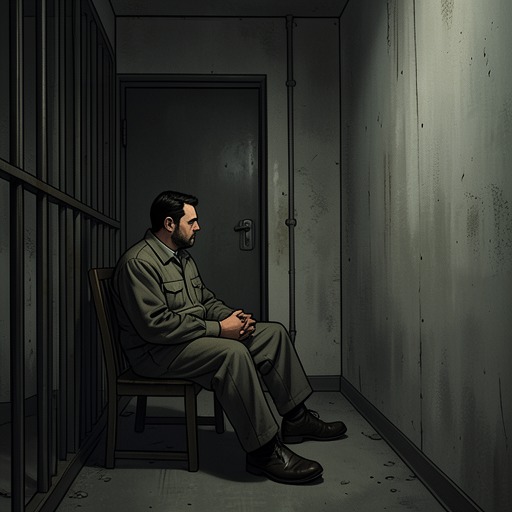
Matt Hunter's post-incarceration status
The InnocentMatt Hunter’s life after prison is marked by a contradiction: he is legally free, yet the institution’s violence, learned habits, and public stigma continue to structure his choices. His post-incarceration status is not a clean return to the person he was before; it is an uneasy condition in which survival has changed him, while relationships and ordinary domestic life offer imperfect grounds for belonging.
Identity and the Mark of Prison
Matt’s past includes a fatal fight, a plea of self-defense, and a prison sentence shaped in part by public attention. After campus security and police arrive, his parents hire a lawyer from New York City, who advises him to plead self-defense. At sentencing, he struggles to hear the verdict through the sounds that persist in his mind. Because the press is watching, he is not sent to what he understands as a lenient, country-club prison. His status as an ex-con thus begins not simply with punishment, but with a public case and a sentence whose severity he associates with election-year scrutiny.
Prison leaves concrete consequences. Matt is beaten twice more and spends three weeks in the infirmary; years later, he sometimes finds blood in his urine, a lasting reminder of an assault on his kidney. Six months into his incarceration, his father dies of a heart attack. Matt blames himself and wants to cry but cannot. The sentence therefore contains both physical harm and a bereavement that becomes bound up with his own guilt, rather than being experienced as a period that can be neatly put behind him.
Habits That Follow Him Outside
After prison, Matt notices that his preferences and instincts have shifted. Before incarceration, he would not have entered a rough bar like Mel’s; afterward, he finds himself drawn to rougher places. The men there look physically imposing, and the atmosphere carries an unspoken expectation that a visitor should be able to defend himself. Matt is unsure why he now feels at home in such surroundings, but the change leads him to wonder whether his taste for violence has roots in prison.
The novel makes that change more than an individual quirk. Matt considers whether his old acquaintance, Detective Lance Banner, was right that prison changes a person. Lance later puts the thought bluntly: before Matt went inside, Lance says, he would have beaten him even with two broken arms. The remark frames Matt’s altered capacity for violence through another person’s perception, making the transformation visible in the changed balance between the two men.
Prison’s Social Education
Matt’s altered instincts sit within a wider critique of incarceration. Prison teaches him to survive through distance: to remain aloof, avoid alliances, trust no one, and stay ready to protect himself. It does not teach the skills needed to rejoin society or become productive; its lessons run in the opposite direction. This account helps explain why release alone cannot restore his former life. The habits that made survival possible inside persist beyond the prison walls, where they can obstruct trust and belonging.
That conditioning also appears in Matt’s recurring distress. He wakes suddenly, sweating, with tears in his eyes and his body shaking. These episodes register prison’s aftermath not as a completed chapter but as an experience that continues to intrude into his life after release. The narrative links such lingering effects to the institution’s daily lesson of danger, while leaving recovery neither immediate nor assured.
Release, Belonging, and Persistent Fear
Nine years after his release, Matt remembers his first night as a free man in Bernie Hunter’s home, where Bernie had brought him. Marsha Hunter was outwardly polite, but Matt later recognizes the reservations that politeness concealed: even someone who believed him innocent and thought he had suffered a bad break might fear having a former prisoner woven into the household. The house represents refuge from people like Matt, exposing how legal release leaves social suspicion intact. His first night there is therefore not uncomplicated welcome but a tentative entry into a life that others may still regard as risky.
Matt’s own sense of freedom is equally uncertain. He suspects that fear and disbelief, rather than any simple inability to adapt, kept him from accepting that prison was behind him. The warm bed seemed capable of being a cruel illusion, with confinement waiting to reclaim him. That expectation gives freedom a fragile quality: he is out, yet cannot immediately trust that release will last.
Lasting Trauma and the Possibility of Connection
Matt’s continuing distress is also measured by what the past does to his capacity for closeness. When Olivia explains how she encountered Cassandra’s body at eighteen, she describes being unable to move even after hearing Emma scream from another room. The account places Matt in the position of hearing a disclosure rooted in the violence surrounding Olivia and Emma, while also making clear that the experience belongs to Olivia’s memory, not his. His post-prison life therefore unfolds alongside other people’s unresolved histories, rather than in isolation from them.
At a later point, Matt considers whether what he has learned about Olivia changes his love for her. He still attends to the small, familiar details of their shared life: her expressions, gestures, laughter, and habit of taking his hand. The contrast matters. His history has made trust difficult, but the marriage remains a lived bond, not merely a source of suspicion or a test of his adjustment. Affection does not erase the past; it gives their relationship a present that the past has not wholly displaced.
A Continuing Public Shadow
Matt’s former-con status also shapes how others can interpret new events. When he receives mocking photographs that appear to show Olivia with Charles Talley, investigators can assemble a damaging account from facts that seem to fit his record: an ex-con previously imprisoned for killing a man in a fight, a private investigator, a late-night hotel confrontation, and the prospect of witnesses and security footage. The sequence shows how a past conviction can make suspicion feel persuasive before the circumstances are fully understood. His release does not free him from being read through the earlier case.
The novel sets that public suspicion beside the private afterlife of imprisonment: learned self-protection, recurring distress, grief, and the struggle to accept safety. Nor does the closing account of Adam Yates’s suicide resolve Matt’s experience into a simple lesson about survival. The novel notes that Yates’s children will know the truth of their father’s death, though not about the videotape; what haunts them will not be the images he feared. Matt’s post-incarceration status thus belongs to a wider pattern in which consequences persist through memory, family, and the stories people can or cannot tell. Freedom is real, but it is not the same as an untouched return.