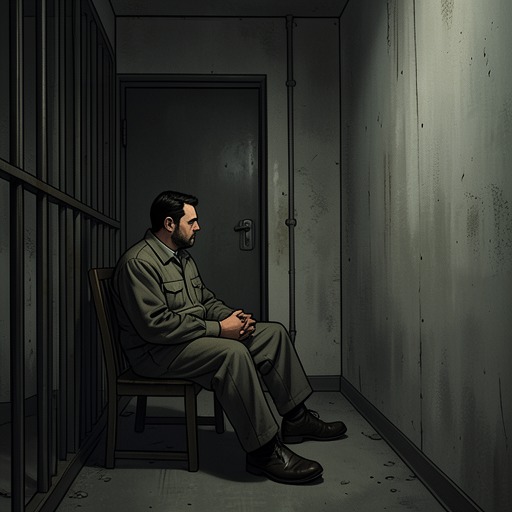
Prison’s transformation of Matt
The InnocentPrison’s transformation of Matt is not simply a hardening acquired behind bars. It is a lasting alteration in his instincts: prison teaches Matt Hunter to distrust dependence, prepares him to treat violence as a source of control, and leaves him unable to accept freedom as secure. The consequences surface both in what he keeps hidden and in his difficulty inhabiting an ordinary, welcoming room after release.
Violence and the habits of survival
At one point, Matt notices his own desire for a physical confrontation. He wonders where this appetite for violence came from and considers whether Detective Lance Banner was right that prison changes a person. The thought gives the change a troubling ambiguity: Matt recognizes a new impulse in himself, but also wonders whether incarceration has made it part of who he is. Violence seems to offer focus, even as he fears what acting on it could mean.
The change is also evident in Matt’s view of toughness. Recalling his college friend Duff, Matt measures the distance between the man he once thought was tough and the person he has become. He believes he could now defeat Duff without difficulty, but the comparison brings him no pride. Instead, it shows how prison has altered the scale by which Matt understands physical strength: the toughness familiar to his former friends seems inadequate beside what he has learned to endure.
The gun and prison’s lessons
After leaving jail, Matt buys a Mauser M2 semiautomatic on the street and conceals it in a lockbox. He tells no one—not his brother Bernie, his wife Olivia, or Sonya McGrath—and cannot settle on an explanation for owning it. When Olivia is expecting a baby, he recognizes that he should dispose of the gun, yet doubts he can bring himself to do so. Its secrecy separates his private response to danger from the family life around him.
Matt understands that the weapon is more likely to lead to disaster than to save him. He knows it is wrong, but it gives him a strange feeling of comfort; as his circumstances worsen, he looks at it again. That comfort exposes the persistence of prison’s survival logic beyond prison itself. Matt can intellectually recognize the danger and still feel drawn to the protection the gun appears to promise.
The narrative identifies the lesson behind that attachment as one of isolation. In prison, Matt has learned to keep aloof, avoid alliances, expect no one to be trustworthy, and remain ready to protect himself. Those skills help explain why the gun is emotionally difficult for him to relinquish: it materializes the conviction that he can depend only on himself. The institution has not equipped him to assimilate or become productive; in Matt’s account, it has trained him in habits that work against both.
Release without security
The guest room in Marsha Hunter’s home holds two moments of Matt’s life as a free man. Nine years before the scene with Olivia, Bernie brought Matt there on his first night out of prison. Marsha was polite, but Matt later imagines the reservations that might have accompanied having him in her house. He understands how even belief in his innocence and sympathy for his bad break could coexist with a wish to keep his life separate from someone marked by prison.
That social unease is connected to the desire to keep danger outside the home. Matt reflects on the impulse to protect children and to trust that well-kept lawns can keep harmful influences away. The image makes reintegration fragile: release does not erase the stigma surrounding a former prisoner, nor does a respectable domestic setting automatically make others feel safe with him. Matt is physically inside a family home, but the fear of what his presence signifies remains part of the scene.
Matt’s own first night in that room was marked by crying. He had not cried in prison, and he cannot reduce the release-night tears to a simple explanation. Fear of showing weakness may have contributed, as may the accumulated anguish of four years, but he rejects the idea that either fully accounts for it. His stronger explanation is disbelief: he could not accept that he was actually free or that prison was behind him.
Freedom feels to him like a cruel hoax. He imagines that the promise of release could be staged only to return a person to confinement, making the prospect of liberation itself a source of fear. The warm bed and the assurance that prison is over cannot immediately become reliable facts in Matt’s mind. The release that should reverse confinement instead leaves him waiting for confinement to return.
A transformation that follows him
When the story returns to the same queen-size mattress nine years later, the room links Matt’s first hours of freedom to his later life with Olivia. His prison experience remains present not as a completed episode but as a framework for interpreting safety, strength, and trust. The hidden gun belongs to this continuing aftermath, while the memory of crying reveals that physical endurance never meant emotional certainty about release.
The transformation is therefore double-edged. Prison makes Matt more prepared for physical conflict and more self-reliant, but those adaptations sit uneasily beside the possibility of intimacy and family life. He knows that the habits formed in confinement may threaten the future he wants, yet recognition alone has not made it easy to discard them. The return to Marsha’s guest room gives that conflict a precise shape: the place where Matt was first free is also where the narrative shows how little freedom, at first, felt like safety.