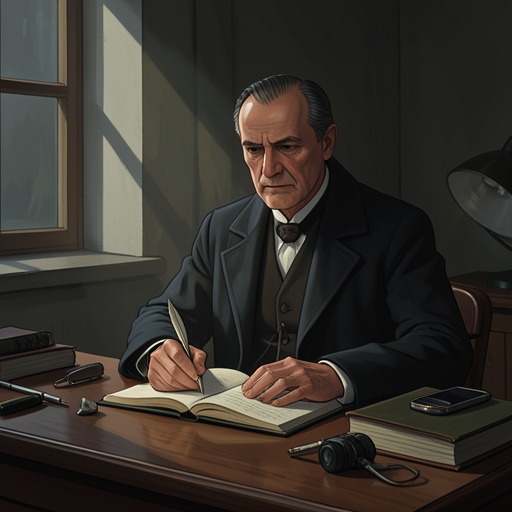
"Elma Dazhen" Meng
The Interpretation of Dreams“Irma’s injection dream” is the specimen dream through which Sigmund Freud demonstrates his method of interpreting dreams by free association and argues that dreams fulfil wishes. Its apparent defence against professional blame becomes more complicated when set beside the real medical events behind it: Freud’s treatment of Emma Eckstein, his reliance on Wilhelm Fliess, and his own earlier responsibility in the case of Ernst Fleischl von Marxow. The dream thus serves both as a demonstration of Freud’s theory and as a revealing instance of how its discreet interpretation could leave more difficult associations in the background.
A specimen for Freud’s method
Freud introduces the dream in the second chapter of The Interpretation of Dreams, after surveying earlier accounts of dreaming and locating his inquiry within a wider cultural tradition. He treats the popular conviction that dreams have meaning as closer to the truth than scientific scepticism, while seeking to give that conviction a scientific basis. His method is free association: the dreamer relaxes deliberate concentration and allows ideas to arise spontaneously. Freud recounts his own dream, follows the associations it prompts, and identifies the wish he believes gave rise to it.
The interpretation Freud presents concerns a professional mistake. In the dream’s latent meaning, responsibility for a mistaken diagnosis falls on a colleague rather than on Freud. The dream’s material draws on everyday recollections and permits one person to stand in for another; verbal similarities link ideas, while ordinary logical relations need not hold. For Freud, these transformations show how a concealed wish can find expression in a dream whose surface does not announce it plainly.
The example gives the theory a concise first demonstration: a dream that may seem to recount or defend against an uncomfortable professional situation can, through interpretation, be understood as fulfilling a wish. Freud acknowledges the modest character of the wish he extracts—professional rivalry—and the account’s focus on it leaves open how much further the associations might be pursued.
The events behind the dream
The biographical context begins in March 1895, when Freud treated Emma Eckstein, a young woman with hysteria. Assuming a sexual origin for her condition, Freud thought Fliess might help by operating on her nose. After the operation, Eckstein continued to suffer nosebleeds. About a fortnight later, a severe haemorrhage led Freud to call in another doctor, who removed half a metre of gauze that Fliess had left in her nasal cavity.
Freud was deeply distressed by Fliess’s incompetence, yet reassured him that he was not to blame for what Freud called a minimal oversight. He also attributed Eckstein’s nosebleeds to her desire for the doctor’s love. Against this history, the dream’s displacement of blame onto colleagues has a sharper biographical edge: the dream’s imagined defence resembles Freud’s real effort to protect Fliess from responsibility in a case that had become distressing for him.
Guilt and professional relationships
The dream’s associations reach beyond the discreet reading Freud gave his audience. One concerned Freud’s friend Ernst Fleischl von Marxow, a physiologist in Ernst von Brücke’s laboratory whom Freud greatly admired. Fleischl suffered from a painful infection in his right hand, underwent repeated operations, and became dependent on morphine taken for pain. Freud, an early advocate of cocaine as an anaesthetic, encouraged him to replace morphine with cocaine, which was then thought not to be habit-forming. The account links Fleischl’s subsequent cocaine abuse and premature death to Freud’s painful sense of responsibility.
Read against these circumstances, the dream’s apparent story of professional rivalry also encodes guilt. Its self-defence does not simply assign fault elsewhere: it is entangled with Freud’s memories of advice that harmed a friend and of a medical case in which he defended a colleague whose actions had endangered a patient. The dream thereby brings professional competition, loyalty, and responsibility into the same interpretive field.
The account also emphasizes the relations among the men surrounding Eckstein’s treatment. Eckstein is made to bear responsibility for her own haemorrhages in Freud’s explanation, while the case becomes a channel for affection between Freud and Fliess. In the dream, Irma is surrounded by male doctors who examine and treat her. The scene therefore supports an interpretation that sees the patient’s place in the dream as bound up with male professional ties, as well as with the dreamer’s efforts to defend himself.
Theory, concealment, and significance
Freud’s published interpretation makes the dream an orderly illustration of wish-fulfilment, but its context exposes a tension between that explanatory purpose and the disturbing material associated with it. The stated wish—that a colleague, not Freud, be responsible for a diagnostic error—is supported by the dream’s professional setting. Yet the case history brings into view a more complicated record of responsibility: Freud’s endorsement of Fliess, his defence of him after Eckstein’s operation, and his earlier recommendation of cocaine to Fleischl.
That tension matters to the dream’s place in Freud’s argument. The dream shows how familiar events can be rearranged, how blame can be displaced, and how a seemingly straightforward account can carry associations that its first interpretation does not exhaust. It establishes the method’s persuasive force by turning a dream into evidence for a hidden wish; at the same time, the fuller context makes the interpretation itself an object of scrutiny, because the dream’s defensive structure may conceal more than professional rivalry alone.