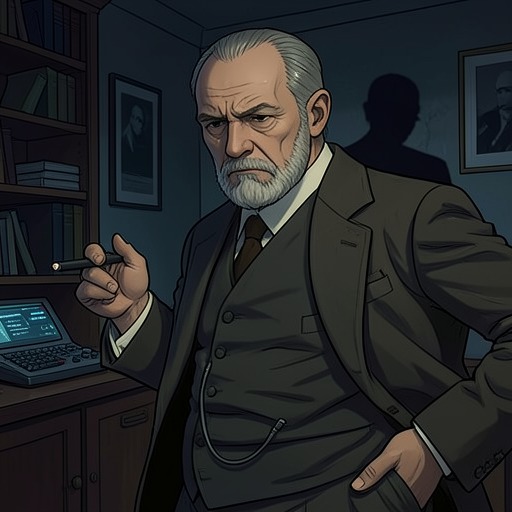
Two psychical agencies in dream formation
The Interpretation of DreamsTwo psychical agencies in dream formation are the wish-producing system and a second agency that controls access to consciousness, censors the wish, and alters how it appears. The model treats a dream’s distressing surface not as proof against wish-fulfilment but as a possible effect of the conflict between the two agencies: one generates the wish, while the other acts defensively upon its expression.
The Two Agencies and Consciousness
The first agency forms the wish uttered by the dream. The second imposes censorship on that wish and distorts its expression. The distinction is not simply between two kinds of dream content; it concerns two different functions in the production of a dream. One originates the wish, while the other determines whether and in what altered form its material may reach consciousness.
The account begins from a contrast between latent dream-thoughts and manifest dream-content. Before analysis, the latent thoughts are not conscious, whereas the manifest dream is recalled as having been conscious. This difference suggests that the second agency’s authority consists in permitting access to consciousness. Nothing from the first system becomes conscious unless it has first passed the second; in granting passage, the second agency may also make whatever changes it sees fit. Consciousness is therefore understood not as the process that generates ideas, but as a distinct psychical act: a sensory organ that perceives content supplied from elsewhere.
Censorship and Distortion
The model draws on an analogy with political censorship. A writer who wants to communicate unwelcome truths to those in power must anticipate suppression, whether words are spoken or published. Depending on the severity of the censorship, the writer may hold back an attack, speak allusively, or disguise criticism as an apparently harmless account—for example, by describing two mandarins in the Middle Kingdom while intending the bureaucrats of the Fatherland. The stricter the censorship, the more elaborate the disguise may need to become, while still allowing a reader to infer the real target.
The close correspondence between this kind of censorship and dream-distortion supports the hypothesis that they share a structure. In both cases, an originating expression is shaped by a second authority that restricts what can pass and modifies how it is presented. The political analogy makes the dream mechanism legible: distortion is not random noise, but the effect of an agency that permits expression only in a form compatible with its censorship.
The Dream of Friend R.
The theory also explains an apparent contradiction in the dreamer’s own dream about his friend R. The dream had shown striking affection for R., although the interpretation disparaged him. The dreamer compares this mismatch to a political conflict: a ruler jealous of his power faces lively public opinion, which wants an unpopular official removed. The tyrant responds by awarding that very official a high distinction at the moment of opposition, not because he has any independent reason to honor him, but to demonstrate that public opinion has no authority over him.
In this analogy, the first agency’s wishful efforts would slander R. as a numbskull. The second agency, which governs access to consciousness, counters that tendency by bestowing excessive affection on him in the dream. The conspicuous praise is thus not evidence that the underlying wish has changed; it is a defensive response to the first agency’s hostile impulse. The discrepancy between the dream’s affectionate surface and the interpretation’s disparagement gives the theory a concrete instance of how the agencies’ competing activity can shape manifest content.
Distressing Dreams and Wish-Fulfilment
The distinction between the agencies returns the discussion to a central problem: how a dream with distressing content can be understood as wish-fulfilment. The answer is that distortion may allow distressing content to disguise a desired one. Such dreams contain something distressing to the second agency while fulfilling a wish of the first. They count as wishful dreams because every dream comes from the first agency; the second acts defensively upon the dream rather than creating it.
This account also sets a limit on interpretation. If attention is confined to what the second agency contributes—the censorship and distortion—the dream remains puzzling, and the problems noted by earlier authorities are left unresolved. Its hidden meaning must instead be demonstrated through analysis in each individual case. The theory supplies a framework for that work, not a substitute for it: a troubling dream cannot be declared a disguised wish-fulfilment without tracing the particular wish and the transformations that conceal it.