Aslan–Emeth relationship
The Last BattleThe Aslan–Emeth relationship is revealed when Emeth, a Calormene who has sought Tash all his life, meets Aslan beyond the Stable door. Aslan receives him not as an enemy but as a beloved child, and explains that sincere, honorable service offered unknowingly to him is not lost. Their encounter directly overturns the Ape’s claim that Aslan and Tash are interchangeable: they are opposites, and the moral character of an act determines whom it truly serves.
The Meeting Beyond the Door
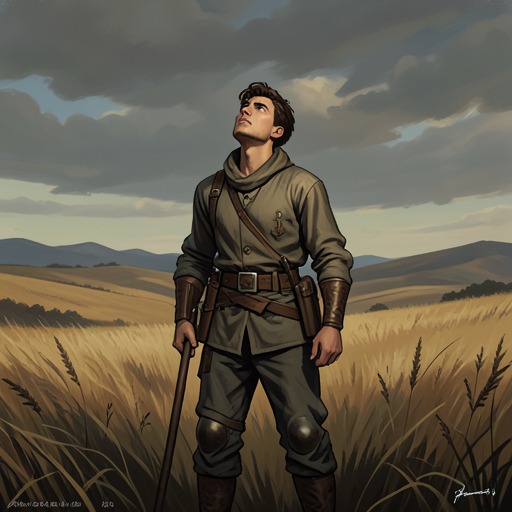
Emeth recounts that after entering the Stable he found himself in sunlight and a broad, beautiful country, rather than the dark hovel he had seen from outside. Having fought and killed a guard who tried to slay him, he set out through the land seeking Tash. In a narrow passage between two rocks, a great Lion came to meet him. Emeth describes the Lion’s speed, immense size, golden hair, and bright eyes; although he expected to die because he had served Tash rather than Aslan, he judged that seeing the Lion was better than possessing worldly power without that encounter.
Aslan bends his head and touches Emeth’s forehead with his tongue before welcoming him. Emeth objects that he is not Aslan’s son but Tash’s servant. Aslan answers that the service Emeth has done to Tash is counted as service done to him. The welcome comes before the explanation: the relationship begins in recognition and acceptance, not in Emeth first correcting his religious allegiance.
Service, Names, and Moral Opposites
Emeth asks whether the Ape was right that Aslan and Tash are one. Aslan rejects the claim, saying that they are opposites. His explanation distinguishes a person’s professed intention from the moral reality of what that person does: an oath kept for the sake of the oath is truly sworn to Aslan, even if the swearer invokes Tash, and Aslan rewards that faithfulness. Conversely, cruelty committed in Aslan’s name serves Tash, however the perpetrator describes it.
This account gives Emeth’s long search a meaning he had not understood. He admits that he has sought Tash all his days; Aslan tells him that he would not have sought so long and truly unless his desire had been for Aslan. The encounter does not affirm that the two gods are interchangeable or that every act of devotion is good. Instead, it separates the false naming promoted by the Ape from the ethical substance of service: what is vile cannot be offered to Aslan, and what is not vile cannot be offered to Tash.
Acceptance and the Continuing Journey
After their exchange, Aslan breathes on Emeth, removes the trembling from his limbs, and helps him stand. He tells Emeth little more than that they will meet again and that Emeth must go further up and further in, then disappears in a storm and flurry of gold. Emeth continues onward, describing his happiness as so great that it weakens him like a wound. His account makes the relationship both a welcome and a beginning: acceptance does not end the journey, but sends him further into the country and toward a promised reunion.
Significance in the Final Judgment
The meeting answers the distorted religious teaching that has helped confuse the Narnians. Earlier, the Ape declares that Tash is merely another name for Aslan, after the Lamb asks how Aslan could be friends with a god associated with human sacrifice. Under the resulting deception, some creatures believe Aslan himself has ordered the killing of the Wood-Nymphs and their enslavement; others fear they have unknowingly offended him. Aslan and Emeth’s encounter makes the distinction the Ape erased: cruelty does not become good by being attributed to Aslan, and sincere moral service is not made worthless by the name under which it was offered.
The relationship also belongs to the larger separation at the Stable door, where creatures face Aslan and either turn away in fear and hatred or enter on his right. Emeth’s welcome is an especially clear instance of the second outcome: his mistaken understanding of whom he served does not prevent recognition of the goodness in his actions or his desire for truth. The scene therefore presents judgment not as a simple test of religious labels, but as a revelation of what a creature’s choices have actually served.
That welcome does not erase grief for the world that has ended. Aslan’s followers mourn Narnia, and Tirian says it would be discourteous not to weep for the world he has known. Yet the final assurance that the old life was a cover and title page, and that the real story is beginning, places Emeth’s promised reunion within a larger continuing life. His encounter makes that future concrete: the one he sought without understanding has received him and called him onward.