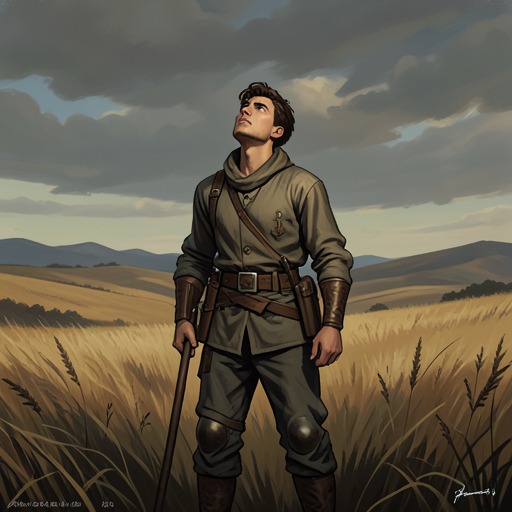
Emeth's encounter with Aslan
The Last BattleEmeth’s encounter with Aslan is the moment when his sincere search for Tash is answered by the very figure he believed he had not served. Inside the stable, he enters a larger, sunlit country, survives an attack by a guard, and journeys through its open landscape looking for Tash. Aslan meets him, welcomes him, and explains that the goodness Emeth performed in Tash’s name was received as service to Aslan: not because the two gods are one, but because they are opposites. The encounter gives the novel’s final answer to the confusion deliberately fostered in Narnia, while making the value of a life turn on its deeds and deepest desire rather than on the name under which it was lived.
From the Stable into the New Country
Emeth recounts that he entered the stable expecting to see Tash, whom he believed had at last arrived among the Narnians. As soon as he crossed the door, he found himself in bright open country, although the hovel had looked dark from outside. There was no time to wonder at the change: a fellow Calormene attacked him, and Emeth understood that the man had been placed there by the Ape and the Tarkaan to kill anyone who was not in on their deception. He fought the guard, killed him, and cast him back through the doorway. The episode exposes the stable’s apparent interior as a threshold into a different, far wider reality, while showing that the conspirators’ deception has extended even to the violence awaiting those who enter.
Once outside the stable, Emeth saw the sky and broad lands, smelled their sweetness, and wondered whether he had reached Tash’s country. He began to travel in search of the god he had served all his life. His route led through grass, flowers, and trees to a narrow passage between two rocks, where he encountered a great Lion. The contrast between the dark, cramped hovel and the country beyond it prepares the encounter as both an arrival and a correction: Emeth has reached the reality he sought, but not under the identity he expected.
The Meeting and Its Reversal
Emeth describes the Lion as immense, swift, golden, and more beautiful than anything in the world. He fell at Aslan’s feet, believing that the Lion would recognize his lifelong service to Tash and put him to death. Yet Aslan bent down, touched his forehead with his tongue, and welcomed him as a son. Emeth answered that he was Tash’s servant, not Aslan’s; Aslan replied that the service Emeth had done to Tash would be counted as service done to Aslan.
Emeth then asked directly whether the Ape had spoken truly in claiming that Tash and Aslan were one. Aslan rejected that claim. He explained that he accepted Emeth’s service not because he and Tash were identical, but because they were opposites: no vile service could be done to Aslan, and no service that was not vile could be done to Tash. A person who kept an oath for the oath’s sake had, without knowing it, truly sworn by Aslan, who would reward that good act. Conversely, a person who committed cruelty in Aslan’s name served Tash, and Tash accepted the deed. The distinction turns on the moral character of the act, not on the religious name spoken over it.
Desire, Service, and Recognition
The revelation does not erase Emeth’s own account of his faith. He tells Aslan that he had sought Tash all his days; Aslan answers that Emeth would not have sought so long and truly unless his desire had been for Aslan. The encounter therefore recognizes both the sincerity of Emeth’s search and the difference between his understanding of its object and the truth he finds. Aslan’s welcome does not treat the two gods as interchangeable, nor does it make intention alone a substitute for conduct: the explanation hinges on the opposition between good and vile service, and on the kind of act actually performed.
The scene also reverses the political and religious language imposed on Narnia. The Ape had claimed that Tash was only another name for Aslan, using the supposed equivalence to blur the division between Narnia and Calormen and to serve the false Aslan conspiracy. Earlier, a Lamb’s pointed question about how Aslan could be friends with a god associated with killing had drawn the animals’ attention, but the Ape had silenced the challenge by repeating the equation. Aslan’s answer to Emeth finally makes the distinction plain: similarity of names or claims cannot make opposed powers one, and invoking Aslan does not turn cruelty into his service.
Release and Further Journey
After explaining the truth, Aslan breathed upon Emeth, took the trembling from his limbs, and helped him stand. He told Emeth that they would meet again and that he must go further up and further in, then disappeared in a storm of gold. Emeth continued wandering in search of Aslan; he tells the assembled kings and ladies that his happiness is so great that it weakens him. His arrival in the new country is thus not a conclusion that confines him to a single meeting, but the beginning of an ongoing journey toward the one he has found.
Emeth’s account belongs to a larger ending in which the doorway divides those who face Aslan in hatred and fear from those who look at him with love, even when they are afraid. The judgment of the creatures reveals that some who had appeared to be Talking Beasts cease to be so and pass into Aslan’s shadow, while others enter through the Door. Emeth’s welcome offers a distinct case within this final separation: though he had understood himself as a servant of Tash, Aslan receives him because the good he truly did was not the service of Tash. The encounter answers the false equation with moral distinction and transforms an apparent misdirection into recognition.
The Ending Beyond Narnia
The meeting comes as the old Narnia is ending. Aslan calls the stars home, and at his command the great Time-giant brings the destruction of the world to its final close. The survivors mourn what has been lost: Lucy says it is not wrong to grieve for Narnia, and Tirian agrees that he and the others should mourn the world he has known. Against this sorrow, Emeth’s welcome shows that the passage through the stable is not merely an escape from a fallen land; it is entrance into a reality where the true character of service is disclosed.
The book’s last revelation extends that transition beyond the destruction of Narnia. Aslan tells the children that a real railway accident has taken the lives of their family and themselves in the Shadow-Lands, then describes the end of their former existence as the beginning of a greater story. Emeth’s encounter anticipates this pattern of ending and beginning: he crosses a door expecting judgment from Tash, meets Aslan instead, and is invited onward. His story gives the final world’s welcome a precise moral meaning: faithful goodness is recognized even when the seeker has misunderstood whom he serves.