Griffle
The Last BattleGriffle is the Black Dwarf who leads the Dwarfs in their refusal to join Tirian’s resistance, even after the false rule of the Ape has ended. His defining claim, “The Dwarfs are for the Dwarfs,” becomes both a declaration of independence and the logic of a destructive isolation: the Dwarfs reject help, undermine every other force, and ultimately remain trapped in the distrust they have chosen.
Identity and Introduction
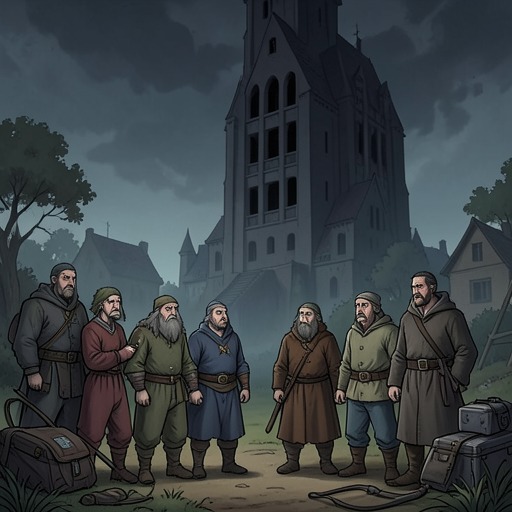
Griffle is introduced as a “not–very–nice looking Dwarf” with hair and beard “as black as soot.” When Jill tells the assembled Dwarfs that she and Eustace have come from another world and that Aslan sent them, Griffle answers for his followers. He says he has heard as much about Aslan as he wants to hear for the rest of his life, and the other Dwarfs growl their agreement that the news is a trick. His leadership is apparent not through a formal account of his office, but in the way the group’s response gathers around his contempt.
The Dwarfs’ rejection is not simply a refusal to recognize the Ape’s defeat. They will not accept Jill’s testimony, or the claim that Tirian’s cause is backed by Aslan. Their sneering grins and repeated accusations of trickery set the terms of their encounter with the rescuers: any claim of truth is treated as a possible deception, and any offer of liberation is met with suspicion.
Defiance of Tirian and Aslan
When several Dwarfs demand that Tirian show them Aslan, Tirian explains that he cannot make the lion appear at his bidding and says, “He's not a tame lion.” Griffle and the others seize on the phrase, repeating “not a tame lion” in a jeering singsong and comparing it to what “the other lot” had told them. The words that express Aslan’s freedom from human command are turned into evidence, in the Dwarfs’ eyes, that all sides have been repeating the same empty claims.
Griffle then answers Jill’s assurance that she has seen Aslan by suggesting that she has merely learned her lines. The exchange shows how completely suspicion has displaced trust: neither direct testimony nor Tirian’s inability to summon Aslan can persuade the Dwarfs. Later, at the campfire, Griffle’s voice mocks the claim that Aslan will appear, asserting that Tirian never possessed anything but a donkey wearing a lionskin and has now lost even that. The Dwarfs join in a taunting song about Tirian not knowing what to do. Their mockery helps Rishda Tarkaan address the other Narnians by insisting that a real Tashlan remains in the Stable, keeping the false religious claim alive amid the conflict.
The Dwarfs’ Cause and Their Attacks
Tirian’s appeal to the Dwarfs is both practical and political. After the Calormenes have been driven back, he calls them to use their swords rather than their tongues, reminds them that they can fight well, and urges them to return to their allegiance. Griffle’s group refuses: they want no kings and declare that the Dwarfs are for the Dwarfs. Their independence is therefore not a return to ordinary Narnian life; it is a refusal to take part in a shared cause, even when Tirian offers them a place in the fight against the Calormenes.
The Dwarfs’ position becomes unmistakable when more than twenty Talking Horses charge up the hill. Tirian and his allies begin to cheer, but Griffle’s archers shoot into the oncoming herd. Horse after horse falls before any can reach the King. Griffle’s followers then taunt Eustace for having thought they were on his side and explain that they do not want either faction to win. The attack is not a misdirected shot or an accidental betrayal: it is a deliberate refusal to let the resistance benefit from the Horses’ arrival.
Griffle’s policy extends to the Calormenes as well. When the enemy troops return toward their commander, the Dwarfs jeer at them; then Griffle directs his archers to shoot at the Calormenes, telling his men to aim carefully. He says they want no more of the Calormenes than they want Monkeys, Lions, or Kings. The narrator makes the consequence plain: the Dwarfs would rather remain and kill members of both sides than escape to safety, because they want Narnia for themselves. Yet the strategy is unequal. The Calormenes wear mail, while the Horses had no protection, and Rishda Tarkaan commands organized troops. Griffle’s willingness to attack everyone does not give the Dwarfs control of events; it leaves them exposed within a battle shaped by forces better equipped than they are.
Isolation and the Ending
Griffle’s most important consequence is not a change of allegiance, but the persistence of refusal. At the Stable, a Dwarf repeats that no one has taken them in and that the Dwarfs are for the Dwarfs. Aslan answers that they will not let him help them: they have chosen cunning over belief, and their prison is in their own minds. The Dwarfs’ repeated slogan thus acquires a grim final meaning. Their self-proclaimed independence has become a confinement, maintained by their fear of being deceived.
The final judgment scene does not reduce every Dwarf to the same fate. As creatures approach Aslan, those who look on him with fear and hatred turn away and disappear into his shadow; those who love him, though some are frightened, enter through the Door. Among the latter is a Dwarf whom Eustace recognizes as one of the archers who helped shoot the Horses. This Dwarf’s presence among the welcomed creatures makes clear that Griffle’s group is not an unchangeable category: the earlier violence does not prove that every individual Dwarf must reject Aslan forever. The evidence does not identify this Dwarf as Griffle, however, and Griffle himself is not shown among those entering.
Griffle’s character is defined by the gap between the independence he proclaims and the freedom he secures. He rejects kings, Aslan, the Calormenes, and the possibility that another group might be acting in good faith, while his followers’ attacks help prevent any side from establishing the peace Tirian seeks. Their slogan sounds like self-rule, but Aslan’s description of their inward prison reveals its cost: a refusal to trust becomes a refusal to be helped. The story leaves Griffle’s individual fate unstated, while presenting the Dwarfs’ collective distrust as a spiritual and political dead end.