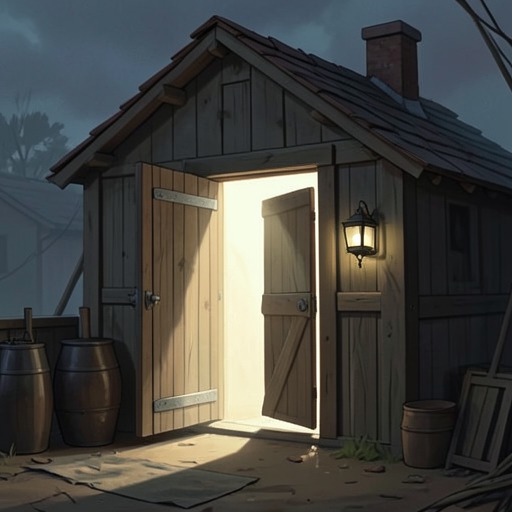
Its inside is bigger than its outside
The Last Battle“Its inside is bigger than its outside” expresses the astonishing spatial and theological reversal at the heart of the Stable’s final revelation: what appeared from without to be a small enclosure opens within onto a country that cannot be contained by its exterior. The phrase applies first to the Stable itself, then helps explain how the destroyed Narnia can be both truly lost and present in a more enduring reality.
The Stable’s Two Sides
After looking through a hole in the Stable door, Tirian sees the dying fire and the dark figures outside, in Lantern Waste, where his last battle took place. Turning back, he finds blue sky, grassland extending in every direction, and friends laughing around him. His first explanation is that the Stable seen from within and without must be two different places. Lord Digory answers with the compact formulation that gives the expression its name: the inside is bigger than the outside.
The contrast is not merely between a narrow building and a broad landscape. The same doorway faces two radically different conditions: outside, Calormenes discuss entering the Stable to look for Rishda Tarkaan or setting it on fire; inside, Tirian stands in open country among people who have passed through the door. The threshold makes the Stable seem less like an ordinary container than a boundary between worlds whose visible dimensions cannot account for what lies beyond it.
An Image Recalled Across Worlds
Queen Lucy connects the scene to an earlier world. In their own world, she says, a Stable once contained something larger than that whole world. Her recollection makes the present disclosure part of a recurring pattern: an outwardly small or limited place can hold a reality exceeding the world around it. The statement broadens the image beyond the immediate space Tirian is seeing, without making the two stables identical in every respect.
The surrounding events give the Stable’s inner vastness a decisive consequence. Aslan calls for time, the door opens, and creatures approach him. Some turn away into his shadow; others enter through the doorway and join the company within. The opening is therefore not only a spatial marvel but a point of passage and judgment, separating those who reject Aslan from those who come in to him.
The Larger Reality of Narnia
Later, Lord Digory explains that the Narnia which had a beginning and an end was not the real Narnia but its shadow or copy. The real Narnia, he says, has always existed and always will; even England is a shadow or copy of something in Aslan’s real world. The Stable’s impossible proportions prepare the reader for this distinction: outward appearance does not measure inward reality, and an ending in the shadow-world need not mean that everything of value has ceased to exist.
That explanation does not erase the destruction of the old Narnia or the grief it causes. Lucy insists that mourning for the frozen land is not wrong, and Tirian agrees, saying that Narnia is the only world he has known and that refusing to mourn would be discourteous. The image therefore holds two truths together: the familiar Narnia has ended, while its dear creatures have been drawn through the door into the real Narnia.
From Enclosure to Beginning
At the end, Aslan reveals that the children and their parents have died in a real railway accident. He frames the transition as the end of a term and the beginning of a holiday, and as a dream ending with morning. In that final account, the Stable’s inward enlargement belongs to a still greater reversal: what seemed to be the end of life is the beginning of the real story.
The expression thus links a concrete architectural paradox to the book’s account of reality, loss, and continuity. The Stable’s exterior offers no measure of the country within; likewise, the death of the shadow-like Narnia does not contain or cancel the reality beyond it. Its force comes from making that difference visible at a door, where a small enclosure opens onto a world—and where the ending becomes an entrance.