Jewel
The Last BattleJewel is a Unicorn and Tirian’s dearest friend, a bond of mutual loyalty that endures through the fall of old Narnia and finds its fulfilment in the country beyond it. He is not merely the King’s companion: he saves Tirian’s life, stands with him at the edge of death, and is the first to give words to the sense of home that the deeper Narnia awakens.
Identity and Bond with Tirian
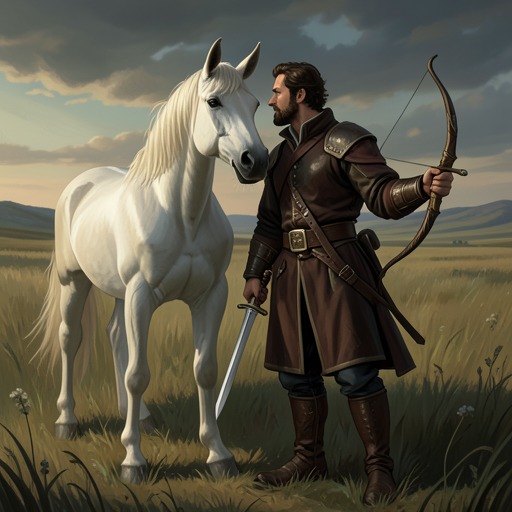
Tirian and Jewel love one another like brothers, and each has saved the other’s life in the wars. Their friendship is expressed in practical trust as much as affection. One spring morning, while the two are alone at Tirian’s hunting lodge, Jewel stands beside the King’s chair, bending his neck to polish his blue horn against his cream-colored flank. The King is absorbed in troubling news and asks whether more will come; Jewel answers that the tidings would be the most wonderful heard in their own days or in those of their fathers and grandfathers, if true. The scene establishes a companion who listens and shares the weight of the King’s hopes rather than serving as a ceremonial presence.
The physical closeness of the pair recurs when they travel together. As Tirian crosses the River at a ford, Jewel keeps to his right to break the current, while the King puts an arm around the Unicorn’s neck. Jewel’s steadiness helps them both reach the southern bank safely. In a later, grimmer rescue, Tirian finds Jewel hobbled and tied by a bridle to a ring in the stable wall. Jewel recognizes him by voice, and Tirian tells him to stand guard and place his horn against the Calormene sentry’s breast. The scene reverses their customary roles: Tirian frees his friend, then trusts Jewel’s strength to secure their escape.
Faith and Moral Conflict
When reports claim that Aslan is commanding dreadful acts, Jewel asks how Aslan could order them. Tirian, shaken by the possibility that the Aslan they have believed in might be unlike the one appearing in the world, resolves to return, surrender his sword to the Calormenes, and ask to be brought before Aslan for judgment. Jewel recognizes the danger at once and tells him that he will go to his death. His warning does not break the friendship or turn into a contest of authority; it makes clear how much is at stake when Tirian’s faith drives him toward a perilous choice.
Jewel’s own response to danger is marked by a different kind of steadiness. As Rishda Tarkaan calls for loyal warriors and invokes the wrath of Tashlan, the Unicorn is among the allies whose presence makes a direct attack on Tirian more difficult. Rishda knows that facing a Unicorn alongside Tirian and an Eagle would be too much. Jewel’s courage is therefore not only a private virtue between friends: it has a practical effect in the confrontation, making him a formidable defender of the company.
The Last Night and the Stable
Before the final advance on the stable, the company waits in cover. Tirian sleeps with his head against Jewel’s flank, as soundly as he might in his royal bed, until a gong wakes him and signals that the hour has come. He asks Jewel to kiss him and seeks forgiveness for any offence, great or small, between them. Jewel replies that he could almost wish Tirian had offended him, so that he might have the chance to forgive. He recalls their shared joys and says that, if Aslan gave him a choice, he would choose no other life than the one he has lived and no other death than the one they are going to meet.
This farewell makes their mutual dependence explicit: even facing death, neither reduces the friendship to fear or regret. The group wakes Farsight and moves toward the stable, leaving Puzzle behind with a kind word and instructions to wait. Jewel and the others take up their positions, while the companions’ parting words set the coming danger against the life of shared happiness they have already known.
When the stable appears as a grim door, Jewel gently noses Jill and offers the possibility that it may instead be a door into Aslan’s country, where they will sup at his table that night. The comfort is not a denial of peril; it is a way of seeing the same threshold in light of trust. Later, when the people have sat on the grass to hear the story and the Dogs have noisily drunk from the stream, Jewel remains standing, polishing his horn against his side. Even in a pause for rest and narration, he retains the composed, attentive bearing associated with him throughout the story.
Recognition of the Deeper Country
Beyond the old Narnia, the landscape is presented as a fuller, more meaningful counterpart to the familiar world. Jewel gives the company’s response its clearest expression: he stamps his forehoof, then declares, “I have come home at last! This is my real country! I belong here. This is the land I have been looking for all my life, though I never knew it till now. The reason why we loved the old Narnia is that it sometimes looked a little like this. Bree–hee–hee! Come further up, come further in!” His recognition makes the new country not simply a place reached after the old world’s end, but the reality that had been faintly anticipated in the love of Narnia itself.
Jewel immediately turns recognition into movement. He springs into a gallop, and the others discover that they can keep pace with him, including the humans, the Dogs, Puzzle, and Poggin. When they reach the pool below the Great Waterfall, Jewel calls for everyone to continue, plunges into the water, and leads the way upward through it. The ordinary limits of movement no longer govern the ascent: he is seen moving up the waterfall, with his horn parting the water above him, while Tirian follows close behind. At the top, the company reaches the river beyond the falls, and Jewel again calls, “Further up and further in,” before they hurry onward into the Western Wild.
At the steep green hill crowned by golden gates, Jewel’s cry gathers the whole company into one final advance: “Further up and further in!” They charge up the slope together, but pause at the gates, uncertain whether they may enter. Their hesitation ends when a horn sounds within the garden and the gates swing open. Jewel’s repeated call has carried the company to the threshold; the opening that follows answers their forward movement with welcome.
Narrative Role and Significance
Jewel’s arc joins loyalty to recognition. In old Narnia, his friendship is shown through embodied acts of mutual aid: breaking the river’s current for Tirian, enduring danger beside him, and accepting a last farewell without bitterness. In the deeper country, he becomes the first to name the meaning of their arrival. His joy does not detach him from his companions; it leads them onward, and he repeatedly turns discovery into a shared journey.
His status as a talking animal is essential to that role. Jewel has his own history of friendship, judgment, courage, and longing; he is neither a mount nor a decorative emblem for the King. The distinctive horn that he polishes in quieter scenes becomes a mark of his strength in peril and, at the waterfall, part of the image of his ascent. By recognizing the new land as his true home and inviting the others further in, he gives the ending a voice of both personal fulfilment and communal hope.