Lionskin
The Last BattleThe Lionskin is a genuine lion’s hide, recovered from the pool and altered by Shift into a costume for Puzzle. Its material reality makes the deception possible, but it does not make Puzzle convincing: the disguise works only at a distance, in poor light, and when the donkey stays quiet. Shift exploits that narrow illusion to present Puzzle as Aslan, while the skin’s later use in a false accusation shows how the same object can serve both impersonation and scapegoating.
Discovery and Material Form
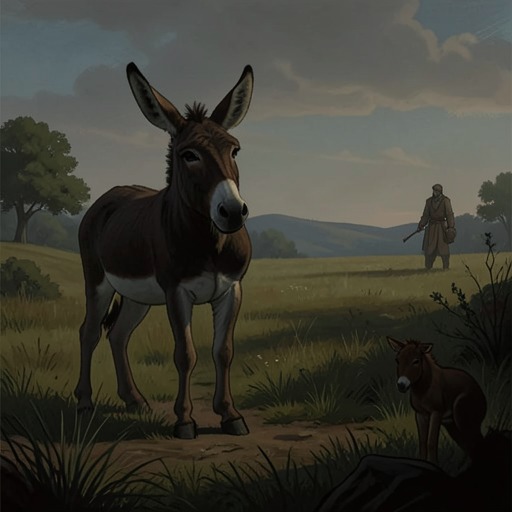
Shift’s scheme begins when he sends Puzzle into the cold, violent water to retrieve a large object. The donkey is battered by the current, swept beneath the waterfall, and repeatedly carried away from what he is trying to catch. Nearly exhausted, bruised, and numb with cold, he finally grips it with his teeth and drags it out. The object is so large it tangles around his forehooves; when he drops it before Shift, the Ape examines it rather than attending to Puzzle’s suffering.
Shift identifies the find as a lion’s skin. It is not a supernatural token: a hunter killed and skinned the lion in the Western Wild months earlier. The hide’s natural origin sharply contrasts with the sacred identity Shift later tries to attach to it. Puzzle, who associates lions with Aslan, thinks the skin deserves a decent burial. Shift dismisses that concern, tells him not to think, and claims it will become a warm winter coat. The promise of warmth and Puzzle’s deference to Shift turn the hide from a troubling relic into a garment he is persuaded to wear.
Shift’s Alterations and the Disguise
Alone, Shift takes needle, thick cord-like thread, and large scissors from his house in the tree. The Dwarfs have taught him to sew, and he uses that practical skill to reshape the hide. He cuts away part of its body because it is too long for Puzzle, converts the removed piece into a collar for the donkey’s long neck, and sews that collar between the lion’s head and shoulders. He adds ties beneath Puzzle’s chest and stomach. While working, he repeatedly looks up at passing birds, wary of being seen by a Talking Bird.
When Puzzle returns from the errand Shift has used to send him away, Shift presents the altered skin as a labor of kindness. He complains that Puzzle has not thanked him, and the donkey apologizes and eagerly agrees to try it on. Shift has to pull and push the heavy hide into place, tying its legs and tail to Puzzle’s own. The result is visibly imperfect: Puzzle’s grey nose and face show through the lion’s open mouth. Anyone familiar with a real lion would recognize the imposture at once. Only a distant observer, in dim light, unfamiliar with lions, and unable to hear Puzzle bray or his hooves, might mistake him for one.
From Coat to False Aslan
The costume’s stated purpose changes as soon as Shift sees how it might be used. He tells Puzzle that he will pretend to be Aslan and that Shift will tell him what to say. Puzzle objects that impersonating Aslan would be wrong and worries about what would happen if the real Aslan appeared. Shift counters that Aslan must have sent the skin to help them set things right, and argues that Aslan does not appear nowadays. This reasoning turns an obvious fraud into a supposed authorization, while Puzzle’s dependence on Shift and limited confidence leave him vulnerable to the Ape’s instructions.
The disguise therefore does not make Puzzle a convincing lion in itself. Its effectiveness depends on restricted sight and sound, and on Shift controlling what other animals are told. In public, the hide becomes a visual prop for a lie: the audience is encouraged to treat a donkey in a lion’s skin as the presence of Aslan. The gap between the actual wearer and the identity imposed on him is the basis of Shift’s power. The costume offers a counterfeit appearance, while Shift supplies the claims that make others interpret it as divine authority.
Exposure and Reversal
The deception is exposed when Jill enters the Stable to discover what is really inside. In the darkness she strikes a light and finds not Aslan but Puzzle, an old donkey with a bundle of lionskin tied to his back. She draws her knife and orders him to come out; Puzzle is already fed up with the Stable and is ready to leave. His release makes the costume’s practical function plain: it had been used to confine and display him as part of the false-Aslan scheme.
Later, Shift tries to redirect the Beasts’ anger by denouncing a supposed impostor in a lionskin. He claims that a donkey has been wandering in the woods pretending to be Aslan, and calls for the animals to seize it. This accusation reverses the truth: Puzzle had been made to impersonate Aslan under Shift’s direction, but Shift now presents the wearer as an independent offender. After Jewel whispers to her, Jill quietly cuts the remaining cords binding the hide to Puzzle and kicks the heavy skin into the thickest bushes. Removing it prevents Puzzle from being caught in the very disguise Shift has invoked to condemn him.
Narrative Significance
The Lionskin links bodily discomfort to political deception. It is heavy, cold, awkwardly fitted, and visibly incapable of transforming Puzzle into a real lion; the costume’s material flaws remain present even while Shift tries to make its appearance carry a false meaning. Puzzle’s physical vulnerability is concrete throughout: first he risks himself in the pool to retrieve the hide, then he is tied into it, and finally Jill has to cut him free.
The object’s changing roles expose the difference between appearance and authority. First it is treated as a potentially sacred remnant because it belonged to a lion; then Shift calls it a coat, reshapes it into a disguise, and uses it to stage a false Aslan. When that performance is threatened, he turns the same hide into evidence against Puzzle. The skin never changes what it is. What changes is the story Shift makes others believe about the body inside it.