Narnia under the False Aslan
The Last BattleNarnia under the False Aslan is a regime built on a lie about who speaks for Aslan—and on the organized coercion that makes the lie govern daily life. Shift presents himself as Aslan’s sole interpreter, recasts freedom as obedience, and announces a future of compulsory labor and deportation. Behind this performance stands the Calormene alliance; beyond it, the fall of Cair Paravel shows that the regime’s reach is not merely rhetorical but military.
Authority and the False Aslan
Shift appears before the Talking Beasts dressed in a scarlet jacket made for a dwarf, ill-fitting jewelled slippers, and a crown that looks like paper. Seated beside a pile of nuts, he cracks them with his jaws and spits out the shells, repeatedly pulling up his jacket to scratch. The shabby spectacle does not make his authority harmless: the crowd faces him in misery and bewilderment, while Tirian and Jewel have been brought as prisoners and the Beasts groan when they see them. The gap between the costume’s claim to majesty and its ridiculous particulars gives visible form to a rule sustained by deception rather than genuine sacred authority.
The Beasts ask why they cannot see Aslan properly or speak to him face to face, as they could in the old days. Shift answers not by producing Aslan but by declaring that times have changed: Aslan, he says, has been too soft and will now discipline them until they think he is a tame lion. This threat recasts the Beasts’ remembered access to Aslan as an indulgence that can be withdrawn. The resulting moaning and silence register the immediate effect of the claim: their hope of direct encounter is replaced by fear of punishment.
Shift then denies that he is an Ape, insists that he is a Man, and uses supposed age and wisdom to explain why he alone may hear Aslan. He describes the animals as stupid and makes himself the indispensable channel through which Aslan’s commands must pass. His assertion that Aslan cannot be bothered to speak to them converts exclusion into an alleged divine decision. The regime thus controls not only what the Beasts must do but also the terms on which they can interpret authority: any challenge to Shift can be made to look like a challenge to Aslan.
Labor, Deportation, and the Language of Consent
The regime’s economic program is announced as a settled arrangement with the King of Calormen. Shift says that all who can work will be made to work: horses, bulls, and donkeys are to be sent to Calormen for pulling and carrying, while moles, rabbits, and Dwarfs are to be sent to the Tisroc’s mines. The Beasts protest that Aslan would never sell them into slavery. Shift rejects their description, promising wages instead—but stipulating that their pay will go into Aslan’s treasury, supposedly to be spent for everyone’s good. The chief Calormene’s formal agreement with Shift gives the scheme the appearance of official consent, while the actual workers have neither a choice of destination nor control over their earnings.
Shift presents this extraction as a plan to make Narnia worth living in, naming oranges and bananas alongside roads, cities, schools, and offices. The promise of imported goods and public institutions is bound to a more revealing list: whips, muzzles, saddles, cages, kennels, and prisons. The list exposes what the promise of improvement entails for the people being ruled. Their labor is to finance a transformed country, but the instruments of restraint are part of the transformation from the outset.
An old Bear states what the official program excludes: the Beasts want to be free and want to hear Aslan speak for himself. Shift answers by defining freedom as doing what he tells them. His formulation turns a word for self-direction into a demand for compliance, and it is backed by his prior threats, his monopoly on access to Aslan, and the Calormenes who have captured Tirian and Jewel. The regime’s language does not merely disguise force; it tries to make submission sound like freedom and forced labor sound like shared benefit.
Calormene Alliance and Military Conquest
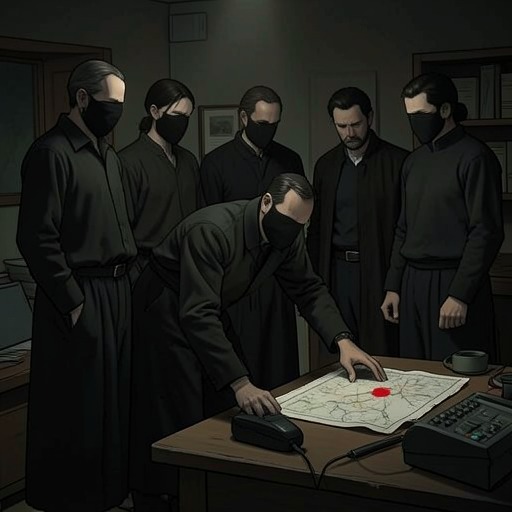
The Calormenes’ role is explicit from the outset of the prisoners’ arrival at the clearing. A commander presents Tirian and Jewel to Shift as captured murderers, invoking the permission of Tash, while the soldiers have taken Tirian’s sword, bound his hands, put a halter around Jewel’s neck, and seized Tirian’s gold circlet. Shift receives the prisoners as the supposed mouthpiece of Aslan, but the scene shows the practical partnership behind his claim: Calormene force supplies the captives, and Shift supplies a religious-political justification for the new order.
The extent of that partnership becomes clear in Farsight’s report to Tirian. Cair Paravel is filled with dead Narnians and living Calormenes; the Tisroc’s banner flies over the royal battlements, and Narnian subjects flee toward the woods. Farsight says that twenty great Calormene ships entered the harbor under cover of darkness two nights earlier, and that Cair Paravel was taken from the sea. The capital’s capture gives the regime a military foundation beyond its control of the clearing and its threats against the gathered Beasts.
Farsight’s second sight places the cost of conquest closer to Tirian: five leagues nearer than Cair Paravel, Roonwit lies dead with a Calormene arrow in his side. Farsight was with him in his last hour and carries his message that all worlds draw to an end and that a noble death is a treasure no one is too poor to buy. The report joins the regime’s political reality—an occupied capital and a dead counsellor—to the resistance’s knowledge that the struggle may end in death. Narnia under the False Aslan is therefore both an ideological fraud and a conquest: its promises of order cannot be separated from the invasion, imprisonment, threatened deportation, and killing through which it operates.
The Regime’s Contradictions
The rule’s central contradiction is visible in the distance between its claims and its arrangements. Shift says he is only conveying Aslan’s wishes, yet insists that Aslan will speak only to him; he denies slavery while announcing the forced removal of workers and the diversion of their wages; and he promises to make Narnia worth living in while naming cages and prisons among its improvements. Each contradiction narrows the Beasts’ capacity to trust their own experience. Their memory of speaking with Aslan, their desire for freedom, and their objection to forced labor are all presented as errors to be corrected by Shift.
That method depends on making coercion sound like common sense and consent sound as though it has already been secured. The Tisroc supposedly agrees with Shift; Shift claims to act for the common good; and the Beasts are told that obedience is true freedom. But the scenes disclose the machinery beneath those assertions: Calormene soldiers bind prisoners, Calormene ships seize the capital, and the announced labor plan sends Narnian peoples away to serve the Tisroc. The regime’s language tries to conceal domination by renaming it; its visible actions reveal what the renaming is for.