Narnia’s End and the Judgment of Its Creatures
The Last BattleNarnia’s End and the Judgment of Its Creatures is the book’s passage from political deception to cosmic reckoning. Aslan’s call brings the stars and the creatures of Narnia to the stable door, where each creature’s response to him determines which way it goes. Beyond this judgment, the old world is destroyed in stages; the children learn that their own earthly lives have ended, and that what seemed an ending is the beginning of the Great Story.
The false order and its violence
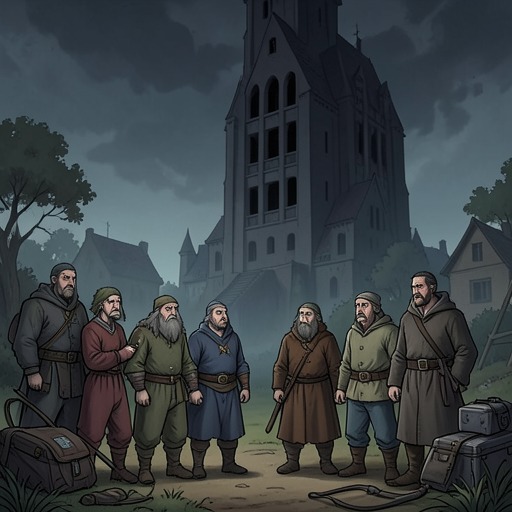
The catastrophe grows out of a regime that has used Aslan’s name to make coercion sound like benevolence. The Ape announces that the creatures’ work will not end when the timber is carted: those able to work will be compelled to do so. Horses, bulls, and donkeys are to be sent to Calormen for labor, while moles, rabbits, and Dwarfs are to work in the Tisroc’s mines. The claim that their wages will be deposited in Aslan’s treasury disguises the extraction as a public good, while the Ape’s promised future of roads, cities, schools, offices, whips, muzzles, saddles, cages, kennels, and prisons exposes the coercive order concealed within that promise.
When an old Bear insists that the creatures want freedom and want to hear Aslan himself, the Ape answers by redefining freedom as obedience to his commands. His declaration that he alone speaks for Aslan is not merely a lie about his identity: it is a way of cutting the creatures off from any independent test of his authority. When a speaker denounces him as a liar and begins to raise the difference between Tash and the good Lion, Calormenes strike him and knock him down. The Ape orders him taken away and tied to a tree, claiming that justice will come later. The silencing and detention make the fraud’s political method plain: dissent is recast as disobedience, then removed from hearing.
That false theology culminates in an explicit plan for mass killing. Rishda Tarkaan orders his soldiers to take their opponents alive if possible and drive or throw them into the stable, where they are to be burned as an offering to Tash. Farsight recognizes the irony: Rishda hopes thereby to win Tash’s pardon for his own unbelief. The stable, presented by the conspirators as an instrument of sacrifice and control, becomes instead the threshold at which the creatures’ ultimate fate is disclosed.
The summons and the gathering
After explaining that the Dwarfs will not accept help because they have chosen suspicion, Aslan goes to the Door with the others. He raises his head and calls that the time has come, repeating the summons until the Door flies open. From beside him, the children look out over a world that has become almost entirely dark. The flames of the bonfire have gone out, and beyond the trees the stars are difficult to distinguish from the blackness.
A huge shape rises in the north beyond the River Shribble. Jill and Eustace recognize the giant they once saw asleep beneath the moors, formerly known as Father Time. Aslan explains that, awake, he will have a new name. The giant raises a horn; after the delay in which the sound travels, its note reaches them as both terrible and strangely beautiful. Stars begin to fall in dozens, then scores and hundreds, like silver rain. A growing starless patch spreads across the sky until the children understand that it is not a cloud but emptiness: all the stars are falling, summoned home by Aslan.
The stars are people, not distant balls of fire. They descend with shining hair and spears, hiss as they land, and stand behind the group, where their fierce white light illuminates the woods and gives every leaf and blade of grass a sharp shadow. Aslan’s own immense shadow stretches away to the left beneath the now permanently starless sky. The light also reveals creatures coming down from the Northern Moors: dragons, giant lizards, and featherless, bat-winged birds. Soon cries, footsteps, paws, and beating wings announce a vast flight toward the doorway. Talking Beasts, Dwarfs, Satyrs, Fauns, Giants, Calormenes, men from Archenland, Monopods, and beings from distant islands and unknown western lands race to Aslan.
Judgment at the Door
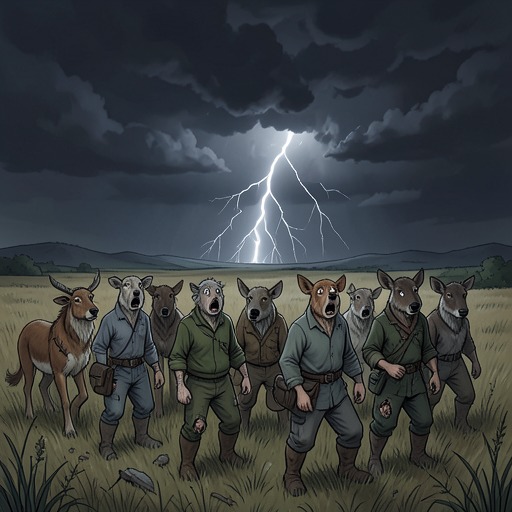
The creatures cannot pass the doorway without looking directly into Aslan’s face. Some react with fear and hatred. In the Talking Beasts, that expression lasts only a fraction of a second before they cease to be talking animals and become ordinary animals. They turn to Aslan’s left and vanish into his enormous shadow; the children never see what becomes of them. The scene makes judgment visible as a separation enacted through each creature’s encounter with Aslan, rather than as a verdict delivered at a distance.
Others look at Aslan and love him, even when they are frightened. They enter through the Door on his right. Among them are creatures the defenders had believed dead: Roonwit, Jewel, the good Boar and Bear, Farsight, the Dogs, the Horses, and Poggin. Eustace recognizes even a Dwarf who had helped shoot the Horses. The return of the dead and the inclusion of a former enemy complicate any simple division based on reputation or past allegiance; at the doorway, what matters is the creature’s response to Aslan.
The sight of those restored friends turns the judgment into reunion as well as separation. Roonwit cries, “Further in and higher up!” and gallops westward. The Bear, who had struggled to understand, catches sight of fruit trees and hurries toward them; Poggin stays to shake hands and grin, while Jewel rests his white head over Tirian’s shoulder and the King whispers to him. Their gestures make the new country tangible through recognition, welcome, food, and renewed companionship.
The destruction of the old world
The creatures who flee into Aslan’s shadow are not the only ones who disappear from the old Narnia. The dragons and giant lizards take possession of the land left behind, uprooting and devouring the trees. As the forests vanish, the country’s humps and hollows become visible; the grass dies, leaving bare rock and earth. The destroying creatures themselves grow old and die, their flesh shriveling until only skeletons remain scattered across the dead land. For a long time, everything is still.
A dreary dawn follows. Digory and Polly recognize the sun’s condition because they once saw a dying sun in another world: it is enormously enlarged, dark red, and casts a bloodlike reflection across the shoreless water. The Moon rises in the wrong position and appears red as well. Flames reach from the sun toward it; the two bodies draw together into a burning mass, shedding fire into the sea and raising steam. The apocalyptic sequence strips away not only the living landscape but the familiar order of the heavens.
At Aslan’s command, “Now make an end,” the giant throws his horn into the sea, stretches an arm across the sky, and squeezes the sun as one might squeeze an orange. Darkness follows instantly. The air that enters through the Door is ice-cold, and icicles already form along its edges. The end is thus at once a destruction of the world outside and a threshold experienced from the safe side of Aslan’s presence.
Death and the beginning of the Great Story
The children’s understanding of the ending changes when Aslan tells them that the railway accident was real and that they, along with their parents, are dead. His words recast death not as an interruption into nothingness but as the close of one term and the start of a holiday, the waking from a dream into morning. This revelation binds the destruction of Narnia to the children’s own passage out of their former world: the catastrophe is real, but it is not the final reality.
The narrator then distinguishes the end of the stories from the beginning of the children’s real story. Their lives in the earthly world and their adventures in Narnia have been only its cover and title page; the Great Story continues forever, with each chapter better than the one before. The ending therefore joins judgment, loss, and renewal without treating them as interchangeable. The old Narnia is genuinely ended, its creatures divided at the Door, yet those welcomed by Aslan enter a reality whose promise exceeds the history that has just closed.