Puzzle
The Last BattlePuzzle is the donkey whom Shift exploits to impersonate Aslan, making him the visible center of the False Aslan deception without making him its willing author. His journey from an overworked, easily persuaded companion to a creature who can approach the real Aslan carries the story’s distinction between being deceived and choosing deception: Puzzle is responsible for the false appearance, but the book repeatedly shows how Shift’s authority, confinement, and manipulation have narrowed his choices.
Identity and Background
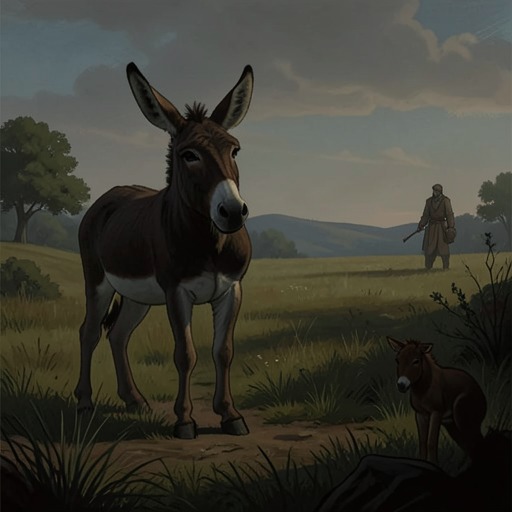
Puzzle lives near Caldron Pool, beside the great waterfall at the western end of Narnia, with Shift, an aged Ape whose tree-house stands in the fork of a great tree. The two call each other friends, but their daily arrangement exposes the imbalance. Puzzle carries water after Shift fills the skin bottles, makes trips to towns with empty panniers and returns with heavy ones, and watches Shift eat the nicest things he brings back. When Puzzle accepts this as fair because he cannot eat grass and thistles, Shift reinforces his dependence by insisting that Puzzle is not clever enough to judge what should be done. Puzzle believes his friend is cleverer and thinks it kind of him to offer friendship at all.
That trust is more than a personality quirk: it is the condition Shift turns into control. Puzzle does not confidently contest the Ape’s decisions, and when he tries to raise an objection, Shift dismisses his judgment. Puzzle’s repeated assent and sighing obedience make him vulnerable, but they also establish that the false performance later imposed on him is not born of ambition or a desire to rule Narnia.
The Lionskin and the False Aslan
When Shift spots a yellow object floating down the waterfall, he orders Puzzle into Caldron Pool to retrieve it. Puzzle hesitates at the command, but Shift presents the dangerous task as something that simply must be done. The object proves to be a lionskin. Puzzle questions whether even a wild lion’s skin ought to receive a decent burial, because lions are solemn in light of Aslan; Shift cuts off the moral doubt and proposes making the skin into a warm winter coat for him.
Puzzle is uneasy about wearing it. He anticipates that the other Beasts might misunderstand what they saw, but Shift answers his concern by claiming the labor of making the coat has exhausted him and that Puzzle is ungrateful. The appeal works: Puzzle apologizes and asks to try it on. Shift binds the heavy skin beneath Puzzle’s body, ties its legs to the donkey’s legs and its tail to his tail, and leaves Puzzle’s grey face visible through the lion’s open mouth. The disguise is imperfect: anyone who has seen a real lion would recognize it, and a bray, noisy hoofbeats, close inspection, or good light would expose it. Yet at a distance and in poor light, someone unfamiliar with lions might mistake him for one. Shift tells Puzzle that onlookers would think he was Aslan himself; Puzzle replies that this would be dreadful.
The costume thus makes the deception legible in two ways. It gives Shift a means to manufacture the appearance of Aslan, while Puzzle’s immediate fear shows that he understands the moral danger of being mistaken for the Lion. He is nevertheless kept inside the Stable and displayed as the false Aslan. When Jill enters, she finds not a supernatural presence but a donkey wearing the lionskin. She draws her knife and tells him to come with her, but Puzzle is already fed up with the Stable and willing to leave.
Rescue and the Truth About His Captivity
After Puzzle is brought out, he tells Tirian that he believed Shift when the Ape said Aslan wanted him to dress up that way. Puzzle explains his obedience through his familiar conviction that he is not clever like Shift and had only done what he was told. He also reveals how completely Shift controlled his life during the deception: Puzzle had not known what was happening outside, was let out only for a minute or two at night, and on some days was forgotten when it came to giving him water. His account recasts the apparent embodiment of the false Aslan as a confined and neglected donkey, isolated from the events carried out in his name.
Jill asks the others not to punish Puzzle, putting her arms around his neck and insisting that Shift was responsible. Tirian calls him a brave and woodwise subject but also disobedient, then lets him live. Puzzle’s release changes the immediate political situation: Tirian can show the approaching Dwarfs the donkey and expose the Ape’s plot. Yet the evidence of Puzzle’s suffering does not by itself persuade the Dwarfs to trust what they see. The wider story’s crisis of belief therefore separates Puzzle’s truthful explanation from the response of those who refuse to believe.
The True Narnia and Encounter with Aslan
After the old Narnia ends, Puzzle enters the true Narnia with the other creatures. He does not immediately join the company moving west. Although he has come through the Door, he keeps out of his friends’ way as much as he can—and out of Aslan’s way in particular. The real Lion makes him ashamed of the nonsense of dressing up in a lionskin, and Puzzle does not know how he could look Aslan in the face. His retreat is not another deception: it is a response to having impersonated the one he now sees truly.
Eventually, he sees his friends going west and gathers courage to follow after eating some of the grass, which he says is the best he has ever tasted. He still doubts that he can face Aslan. Lucy reassures him that it will be all right when he really does, and Puzzle continues with the others toward the higher country.
As the company travels onward, Aslan appears among the cliffs, and Puzzle is the first person he calls to him. The donkey approaches looking feeble and silly beside the enormous Lion, as small as a kitten beside a St. Bernard. Aslan bows his head and whispers to him. The humans cannot hear either exchange: Puzzle’s private encounter is kept outside their knowledge. His ears droop at the first thing Aslan says, then perk up at the next. The visible change does not disclose the words, but it marks a turn from shame toward renewed hope and acceptance.
Character and Significance
Puzzle’s story depends on a clear contrast between appearance and agency. The lionskin makes a donkey look, under restricted conditions, like the Lion; the false authority depends on hiding the ordinary creature beneath the costume and keeping him from the world. Once rescued, Puzzle can explain how the disguise was imposed and how his obedience was cultivated. His case gives concrete form to the difference between serving a lie by deliberate choice and being used by someone who exploits trust and self-doubt.
His eventual approach to Aslan completes a movement the Stable could not: Puzzle first fears that the real Lion will confirm his shame, but he follows his friends and is summoned rather than rejected. The book leaves Aslan’s whispered words unheard, giving Puzzle’s reconciliation privacy rather than turning it into a public explanation. What the narrative does reveal is the sequence of his change: he comes out from confinement, follows west despite his embarrassment, and stands before the real Aslan. In the final movement from the ending of the old Narnia into the beginning of the Great Story, Puzzle is not left behind as the costume he wore. He is called forward as himself.