Shift–Puzzle relationship
The Last BattleThe relationship between Shift and Puzzle is a friendship only in the language its participants use. In practice, the old Ape directs, deceives, and benefits from the donkey’s labor, while Puzzle mistakes obedience for loyalty and Shift’s manipulation for evidence of his own inadequacy. Their unequal bond becomes politically consequential when Shift turns Puzzle into the concealed body of the false Aslan: a private pattern of control is made into a public instrument of deception.
Identity and the Everyday Imbalance
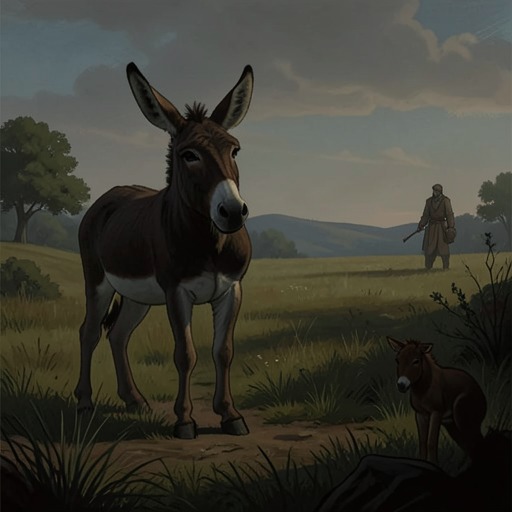
Shift and Puzzle live near Caldron Pool, beside the great waterfall at the western end of Narnia. Shift is an exceptionally old Ape, established in the district so long that no one remembers when he arrived. Puzzle, a donkey, is his sole friend and neighbor. The narrator immediately qualifies the friendship: although the two call each other friends, their arrangements look more like those between master and servant.
The imbalance is built into ordinary work. When they go to the river, Shift fills the skin bottles with water, but Puzzle carries them home. When goods are needed from towns farther down the river, Puzzle makes the journey with empty panniers and returns with them full and heavy. The labor and the benefit are divided just as unevenly: Shift eats the nicest things Puzzle brings back, while Puzzle accepts the arrangement without complaint.
Shift presents this taking as fairness, arguing that because he cannot eat grass and thistles as Puzzle does, he must make up the difference in other ways. Puzzle agrees. The exchange establishes the bond’s recurring logic: Shift supplies the explanation, and Puzzle, trusting him, treats that explanation as a sufficient reason to yield. What Shift calls friendship gives him the privileges of command without requiring Puzzle to recognize himself as subordinate.
How Shift Secures Puzzle’s Compliance
Shift’s most consistent means of control is to define Puzzle as incapable of sound judgment. Whenever Puzzle tries to argue, Shift tells him that thinking is not his strong point and that Shift understands better what needs to be done. Puzzle accepts the verdict, calls himself unintelligent, and sighs before doing as he is told. His self-doubt is not simply a personal trait in the story; it is repeatedly reinforced by the very companion on whom he relies.
The episode at the pool makes that pressure visible in action. When a yellow object comes down the waterfall, Shift decides it may be useful and orders Puzzle to get into the dangerous water to retrieve it. Puzzle questions whether this is necessary. Shift answers not by sharing the risk or weighing the danger, but by making Puzzle responsible for the problem: how else, he asks, can they get it?
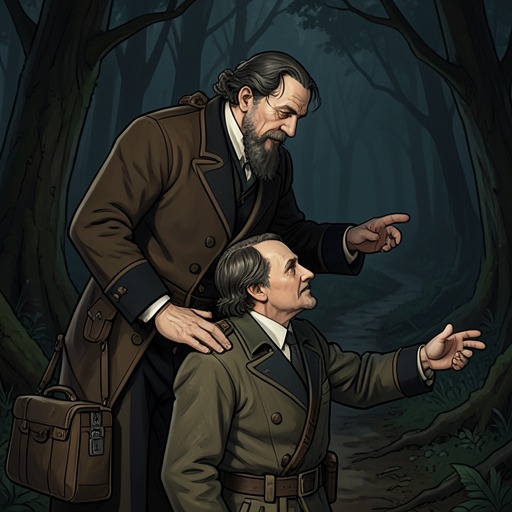
When Puzzle hesitates over the cold, churning pool, Shift turns the objection into an accusation of selfishness. He claims that Apes have weak chests and catch cold easily, says he will go in himself, and speaks as if Puzzle’s suggestion may make him die. Puzzle immediately begs him not to, apologizes for forgetting his supposed weakness, and volunteers to enter instead. Shift’s show of vulnerability reverses the apparent direction of care: Puzzle takes the danger upon himself to protect the companion who has maneuvered him into it.
Even after Puzzle has gone into the water, Shift briefly calls that perhaps he should do it after all. Puzzle answers that Shift has promised not to and insists on continuing. The exchange shows how the pressure works beyond a single order: once Puzzle has accepted responsibility for Shift’s safety, he treats turning back as a breach of his own promise. He is battered by the swirling pool and nearly exhausted before he manages to seize the object with his teeth.
The Lionskin and the False Aslan
The object Puzzle retrieves is a lionskin. Puzzle questions whether it should receive a decent burial, reasoning that lions are solemn because of the one he reveres. His objection shows that he has a moral and religious scruple of his own, even as he lacks confidence in his ability to act on it against Shift’s judgment. Shift cuts off that line of thought by telling him not to get ideas into his head and promising instead to make the skin into a warm winter coat for him. Puzzle says he would not like wearing it, but his reluctance does not stop Shift from taking control of what the skin will be used for.
Later, Jill discovers the consequence of that unequal decision-making. She enters the Stable and finds Puzzle inside with a bundle of lionskin tied onto his back: there is no Aslan there, only the disguised donkey. Puzzle has been made the visible body of Shift’s false Aslan scheme, while Shift’s deception has depended on keeping the reality hidden from those outside.
Puzzle does not present himself as a willing conspirator when the disguise is uncovered. He says Shift told him Aslan wanted him to dress that way and that he believed Shift would know. His familiar admission that he is not clever recurs here as the explanation for his compliance: he did what he was told because he trusted Shift’s account and doubted his own understanding. What had seemed like personal meekness has enabled an imposture with consequences for Narnia.
Confinement, Exposure, and the Relationship’s Meaning
Puzzle’s account also reveals the cost of the arrangement beyond the disguise. He says he was fed up with living in the Stable, did not know what had been happening outside, and was let out only for a minute or two at night. Some days he was not given water. His confinement gives physical form to the control that had already shaped their life together: Shift’s use of Puzzle is no longer limited to work, food, or persuading him to take risks. Puzzle has been shut away and denied even basic care while being used to sustain the false appearance.
When Jill asks that Puzzle be spared, she insists that the fault belongs to Shift and describes the donkey as sorry and harmless. Tirian accepts this distinction and lets Puzzle live. The decision separates the deceiver from the creature he deceived: Puzzle has participated in the impersonation, but the evidence of his captivity and his explanation show why participation is not the same as a freely chosen plot.
Puzzle’s relationship with Shift therefore helps show how domination can operate through apparent intimacy rather than open force alone. Shift’s commands are backed by a repeated lesson that Puzzle is too foolish to decide for himself; his emotional appeals make Puzzle feel responsible for protecting him; and the word “friend” disguises the unequal exchange of labor, food, freedom, and risk. The eventual exposure does not erase Puzzle’s agency or his earlier doubts, but it makes the conditions of his obedience legible. Shift’s supposed friendship has depended on Puzzle’s trust while steadily narrowing the choices he believes he can make.