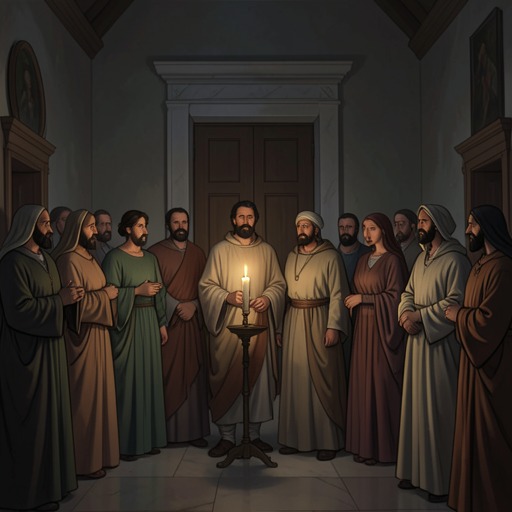
Star People
The Last BattleThe Stars are people of the heavens, not distant burning globes: when Aslan calls them home at the end of Narnia, they descend as a radiant host and stand behind the gathered creatures. Their return both lights the judgment at the stable door and marks the passage from the ending world into the next order of existence.
Nature and Summons
The Stars’ arrival begins when the great giant blows his horn at Aslan’s command. The sky fills with shooting stars—first dozens, then scores, then hundreds—while an expanding emptiness overtakes the heavens. The darkness is not a cloud but the space from which the stars have vanished: every star is falling because Aslan has called them home. The visible heavens are thus transformed from a familiar backdrop into a scene of summons and departure.
The falling lights are not flaming celestial bodies. In Narnia, stars are people, as Edmund and Lucy had encountered before. They come down with long hair like burning silver and spears like white-hot metal, moving faster than falling stones. Their landing hisses and burns the grass. This physical arrival makes their identity unmistakable: the spectacle in the sky is also the arrival of living persons, called out of their accustomed place to witness the world’s last events.
The Stars as Light and Witness
The host gathers behind Aslan and his companions, a little to their right. Its fierce white light falls over their shoulders and floods the Narnian woods ahead. Trees, bushes, and almost every blade of grass stand sharply visible, each with a black shadow behind it; even the leaves’ edges seem sharp enough to cut. The scene’s brilliance is not gentle daylight but a concentrated illumination that makes the landscape legible at the moment it is about to disappear.
Against that light, Aslan’s enormous shadow streams away to the left of the doorway. The Stars’ position therefore contributes to the visible arrangement of the final judgment: light comes from behind the assembled witnesses, while Aslan’s shadow reaches out across the landscape. As the creatures run up to the door, they must look directly into Aslan’s face. Those who meet him with fear and hatred turn to his left and vanish into the shadow; those who love him, even when frightened, enter through the doorway on his right. The Stars illuminate this division, but the decisive encounter is with Aslan, not with the celestial host.
The Stars also remain present as the inhabitants of the dying world arrive. Behind their white light, creatures pour up from the woods and gather before the open door. Among those welcomed are beings the survivors had thought dead, including Roonwit, Jewel, and Poggin. Their return takes place under the Stars’ illumination, joining the spectacle of cosmic judgment to the recognition and reunion of Narnia’s lost companions.
Place in Narnia’s Ending
The disappearance of the Stars from the sky and their presence on the ground form a single reversal: the heavens empty as the celestial people assemble to witness the end. Once they have come down, the sky is starless forever. Their light makes it possible to see the woods and the approaching multitudes, but it cannot preserve the world they reveal. Dragons and giant lizards take over Narnia, tear up the trees, and reduce the country to bare rock and earth; the monsters themselves eventually grow old and die. The Stars’ arrival belongs to the final sequence in which the old world is exposed, judged, and brought to its close.
That ending proceeds beyond the disappearance of the forests. A dreary dawn rises over the waste; the sun, swollen and dark red, appears to be dying, and the moon is drawn into it until they become a single burning mass. At Aslan’s order, the giant throws his horn into the sea, reaches across the sky, and squeezes the sun out. The world falls into total darkness, and ice forms at the edges of the doorway. The Stars have already been called from the sky, and their gathering behind the witnesses provides the fierce light by which Narnia’s final creatures approach Aslan before this last extinguishing.
Significance
The Stars make the ending’s cosmic scale visible without turning it into an impersonal astronomical event. A falling star is a person returning at a summons; the emptied sky is not merely a change in scenery but the departure of its inhabitants. Their presence also sharpens the contrast between the world that is ending and the reality beyond its threshold: the stars’ light reveals the ruined landscape even as the survivors pass through the door toward a further country.
The closing revelation gives this destruction its larger frame. Aslan tells the children that a real railway accident has killed them and their family, and describes their passage beyond death as the end of a dream and the beginning of morning. Narnia’s end is therefore not the end of the story for those who enter the true world. The Stars’ homecoming belongs to that threshold moment: they leave the sky of the old creation, gather as persons before Aslan, and stand witness as one order ends and the greater story begins.