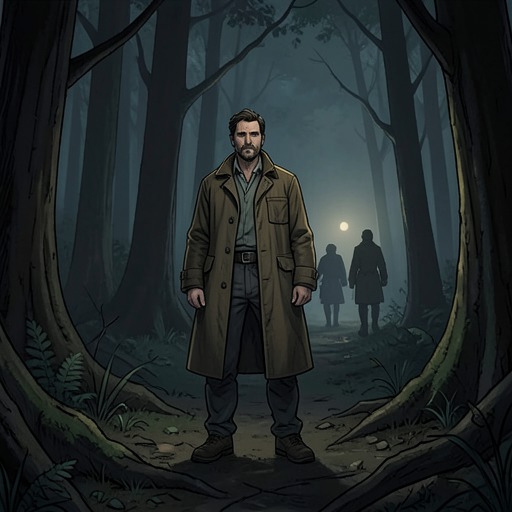
The Dwarfs Refuse to Accept the Truth
The Last BattleThe Dwarfs Refuse to Accept the Truth is not a single moment of disbelief but a refusal repeated at two decisive thresholds: first, when Tirian exposes the false lion-skin and frees the Dwarfs from their captors; later, when Aslan himself appears and offers them food. The first revelation fails to restore trust, and the second makes the consequence unmistakable: the Dwarfs experience their own suspicion as reality and cannot be persuaded out of a prison they insist does not exist.
The exposure of the deception
Tirian brings Puzzle into the light and tells the Dwarfs that Aslan has not come to Narnia: they have been deceived by the Ape, and the supposed lion is the creature taken from the stable. The evidence is no longer distant or abstract. Puzzle is right in front of them, his ill-fitting lionskin bunched on one shoulder and its head pushed back, leaving his gentle donkey face plainly visible. Grass sticks out of his mouth as he mutters that it was not his fault and that he never claimed to be clever. The shabby costume and Puzzle’s bewilderment expose the imposture through its physical details.
But the scene does not settle into grateful recognition. After Tirian and Eustace kill the Calormene soldiers and the Dwarfs deal with the remaining guards, Tirian congratulates Eustace and declares the Dwarfs free. He proposes that they join him in freeing Narnia and calls for three cheers for Aslan. Only a handful of Dwarfs respond, weakly; others growl or say nothing. Tirian’s expectation that the truth will turn former captives into allies is immediately frustrated. Physical liberation has happened, but allegiance and trust have not followed it.
Rejection of Tirian and his allies
Griffle, the Black Dwarf, gives the refusal its bluntest voice: he has heard enough about Aslan for the rest of his life. The others agree that everything is a trick. When Jill identifies herself as the person who rescued Rilian and says that she and Eustace have returned from another world at Aslan’s sending, the Dwarfs exchange sneering grins rather than welcoming her testimony. To them, a new witness does not correct the old deception; her testimony looks like another performance of it.
Griffle questions whether Tirian is really the king and rejects kings as well as Aslans. He says that the Dwarfs will look after themselves and bow to nobody. The others turn this suspicion into a collective rule: no more Aslan, no more kings, and no more stories about other worlds; the Dwarfs are for the Dwarfs. They prepare to march away, explaining that Tirian and his companions rescued them only to use them in some private scheme. Then they depart into the darkness singing their marching song. Their withdrawal is an organized choice, not merely a failure to understand: they refuse the relationships and larger cause that might make their rescue meaningful.
The departure leaves the rescuers subdued. Tirian and Jewel walk sadly at the rear, the King’s arm across the Unicorn’s shoulder, while Jewel nuzzles his cheek; neither tries to comfort the other with words. Tirian had imagined that exposing the Ape’s lie would make the Dwarfs rally to him. Instead, the false Aslan’s deception has damaged belief in the real one. The episode thus gives the fraud a consequence beyond its immediate political success: even when uncovered, it has helped make truth itself appear suspect.
The stable as a prison of interpretation
The Dwarfs’ rejection returns after they have entered the stable. Lucy asks Tirian to see whether anything can be done for them, despite his admission that he feels little love for Dwarfs that day. He goes because she asks. The Dwarfs are no longer tied, yet sit tightly together in a small circle, facing inward and paying no attention to the others until they come close. They behave as if they cannot see; one warns the approaching party not to walk into their faces.
When Diggle specifies where he believes they are, he describes a pitch-black, poky, smelly stable. Tirian insists there is no black hole except in Diggle’s imagination and pulls him bodily out of the circle. Diggle immediately darts back, rubbing his nose and claiming that Tirian has banged his face against a wall. The gesture makes the dispute concrete: Tirian can move Diggle outside the circle, but he cannot make Diggle perceive the space differently. Diggle interprets an act of rescue as an injury that confirms his account of confinement.
This scene reverses the stable’s earlier function in the deception. It was the place from which the counterfeit Aslan was brought out to be displayed; now the Dwarfs treat the stable as a dark enclosure even when the narrative presents it as a place from which they could emerge. Their inward-facing circle gives visible form to a shared conviction that excludes outside evidence. They have escaped ropes and captors, but the belief that every offer is a trick holds them in place more effectively than physical bonds.
Aslan’s offer and its refusal
Aslan appears after the earth trembles and the air grows sweeter. Tirian recognizes his heart’s desire in the golden Lion, and Aslan praises him as the last King of Narnia who stood firm at the darkest hour. Lucy then asks whether Aslan will help the Dwarfs. His answer distinguishes what he can show from what he can do. He approaches them and gives a low growl, but they explain it away as a machine used by the gang at the other end of the stable, insisting that they will not be taken in again.
Aslan next provides an abundant feast: pies, tongues, pigeons, trifles, ices, and wine in golden goblets. The Dwarfs eat and drink, but perceive the food as stable fare—hay, a turnip, a raw cabbage leaf—and the wine as dirty water from a trough. Suspicion then turns their separate misreadings against one another. Each suspects that another Dwarf has found something better; they snatch at the food, quarrel, and end in a fight that smears the feast across their clothes and leaves them nursing black eyes and bleeding noses. Even after this, they insist that there is no humbug and that the Dwarfs are for the Dwarfs.
Aslan explains that they will not let him help them: they have chosen cunning instead of belief, and their prison exists in their own minds, yet they remain imprisoned there. This account links the stable episode to the earlier rejection of Tirian. The same defensive certainty that turned testimony into a trick now turns a feast into rubbish and fellowship into rivalry. Aslan can make the offer; he cannot make them receive it as an offer. The limitation is demonstrated, not merely stated, in the difference between the feast presented and the scraps the Dwarfs believe they are eating.
Consequences at the final threshold
After explaining the Dwarfs’ refusal, Aslan turns to the Door and calls that it is time. The Dwarfs remain behind in their chosen isolation while the narrative moves toward the final judgment of the creatures who come to the threshold. Those who face Aslan with fear and hatred turn to his left; Talking Beasts among them cease to be Talking Beasts, and the creatures disappear into his shadow. Others look at him and love him, even when afraid, and enter on his right. This later division gives the Dwarfs’ repeated choice a larger narrative context: the issue is no longer simply whether they accept Tirian’s explanation of the past, but whether they will receive the reality before them.
The contrast is sharpened by the Dwarfs who do enter. Among the creatures welcomed through the Door is one of the Dwarfs who had helped shoot the Horses; his presence shows that an earlier cruel act does not, by itself, prevent entry. The decisive division is in how creatures respond when they encounter Aslan. The Dwarfs’ earlier slogans anticipate that test, but the narrative does not present them as seeing the truth and consciously choosing evil. Their tragedy is the narrowed perception that makes trust, aid, and even joy appear to be traps.
The episode’s final force lies in the difference between proof and recognition. Puzzle’s visible donkey face should expose the falsehood; Tirian’s release should make the truth politically useful; Aslan’s presence and feast should make it immediate. Each stronger demonstration meets the same refusal. The Dwarfs’ insistence that they cannot be taken in protects them from deception only by closing them off from what is true. Their prison is therefore both a concrete scene in the stable and a moral condition: self-protection has become so absolute that help cannot be distinguished from harm.