The Dwarfs Reject Aslan’s Help
The Last BattleAslan’s failed attempt to help the Dwarfs makes their refusal more than a misunderstanding: they have become so committed to suspecting deception that neither the world nor a genuine gift can reach them. Lucy tries to restore their senses, and Aslan answers her plea with a feast; the Dwarfs reject both, turning abundance into a fight and confirming the isolation Aslan calls a prison of their own minds.
The Dwarfs’ Closed World
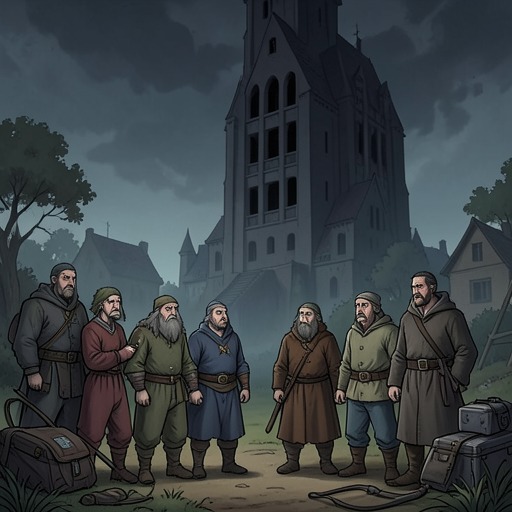
Lucy leads Tirian and the others to the Dwarfs, who sit pressed together in a small circle. Though the cords that had bound them have disappeared, they do not explore or even rest. They face one another, fail to notice the approaching group until it is close, and cock their heads as if they must infer what is happening from sound. Their first response is to warn the newcomers not to walk into their faces, as though the visitors cannot see. Diggle names their supposed surroundings as a pitch-black, cramped, smelly stable, while Tirian and the children can see the open country beyond it. The disagreement is not about a detail of the stable: the Dwarfs and their rescuers inhabit incompatible versions of what is real.
Lucy insists that the Dwarfs can look at the sky, trees, flowers, and at her. When Diggle dismisses sight as impossible in the darkness he believes surrounds them, she points to a pipe in his mouth as proof that she can see him. He treats even this ordinary observation as no evidence, suggesting that someone could identify the pipe by its smell. Lucy then tries a different sense: she picks wild violets and holds the fresh flowers near Diggle, hoping that his nose may work even if his eyes do not. He recoils, calls them filthy stable litter, and nearly strikes her with his fist. The attempted demonstration ends not in recognition but in another imagined insult. The flowers, which Lucy offers as a concrete test of a shared world, become further evidence to Diggle that someone is trying to deceive or offend him.
Lucy’s Appeal and Aslan’s Arrival
Tirian tells the Dwarfs that Lucy is the Queen sent from the distant past by Aslan, and says that her sake alone has stayed his hand despite their treachery. The explanation does not soften their distrust; Lucy, in turn, is distressed by what she sees and asks what can be done for them. Eustace advises leaving them alone. At that moment the earth trembles, the air grows sweeter, and a brightness flashes behind the company. Aslan appears, and the others kneel around his forepaws and bury their faces and hands in his mane. Tirian approaches trembling and throws himself at the Lion’s feet; Aslan kisses him and praises him as the last King of Narnia who stood firm at the darkest hour.
Lucy asks Aslan directly to do something for the Dwarfs. He answers that he will show her both what he can and cannot do, then approaches the circle and growls. The sound shakes the air, but the Dwarfs explain it away as a machine used by a supposed gang at the other end of the stable. They tell one another not to take any notice and insist that they will not be fooled again. Even Aslan’s presence and a sound that physically alters the air cannot dislodge their conviction that they are surrounded by a trick. Their refusal is not caused by an absence of help; it persists in the face of help made unmistakable to everyone around them.
The Feast Becomes a Fight
Aslan shakes his mane, and a feast appears on the Dwarfs’ knees: pies, tongues, pigeons, trifles, ices, and a goblet of good wine for each Dwarf. They eat and drink eagerly, but cannot taste the food as what it is. Instead, they believe they are eating the sort of scraps found in a stable: hay, an old turnip, or a raw cabbage leaf. The wine in their golden goblets seems to them like dirty water from a donkey’s trough. The gulf between what Aslan gives and what the Dwarfs perceive is therefore not a lack of provision. The meal is present, but their interpretation turns its richness into the very degradation they think they have suffered.
Suspicion then shifts from the supposed deceivers to the Dwarfs among themselves. Each suspects that another has received something better, and they begin grabbing and snatching. Their greed leads to a quarrel and then a free fight. Food is smeared over their faces and clothes or trampled underfoot; the Dwarfs end the struggle nursing black eyes and bleeding noses. The feast has become an occasion for them to injure one another, while the gift itself is wasted in the struggle to secure a better share of what they believe is only stable refuse.
After the fight, the Dwarfs insist that at least there is no trick and that nobody has fooled them. They reaffirm their principle that the Dwarfs are for the Dwarfs. Their conclusion treats mistrust as proof of independence, even though the encounter has left them unable to perceive the world before them, unable to accept food, and fighting among themselves. The scene’s irony lies in the distance between their certainty that they have escaped deception and the visible consequences of their refusal.
Aslan’s Judgment and the Door
Aslan explains to Lucy that the Dwarfs will not let anyone help them: they have chosen cunning instead of belief. Their prison exists only in their own minds, yet it is still a prison, because fear of being taken in has made it impossible for them to be brought out. His explanation identifies the limit at the heart of the episode. He can make the feast appear and offer an unmistakable sign of his power, but he cannot make the Dwarfs receive either as they are. Their self-sealing suspicion turns rescue into another supposed fraud.
Aslan then tells the children that he has other work to do. He goes to the Door with the others and calls that it is time, repeating the summons more loudly until the Door flies open. The failed rescue is thus followed not by the Dwarfs’ conversion but by a movement onward to the larger events of the ending: the stars are called home, creatures face Aslan at the Door, and the old order of Narnia reaches its close. In that sequence, the Dwarfs’ refusal stands as a particular judgment about perception and choice within the wider judgment of Narnia’s creatures. The story does not show them accepting Aslan’s help before the narrative turns to what lies beyond the Door.