The Dwarfs Reject Tirian’s Liberation
The Last BattleThe Dwarfs Reject Tirian’s Liberation marks the failure of a rescue that ought to have restored the Dwarfs to Narnia’s resistance. Tirian exposes the false Aslan and frees them from a column bound for the mines, but their experience of deception has made them reject both the truth and the people offering help. Their departure gives the False Aslan scheme a lasting consequence: even after its disguise is exposed, suspicion survives the lie and becomes its own prison.
From Captives to Witnesses
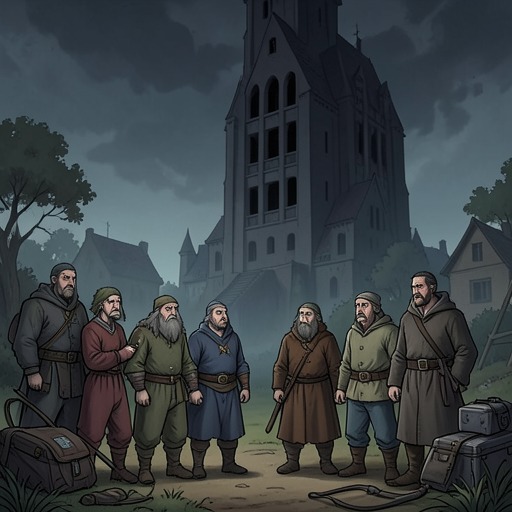
Tirian encounters the Dwarfs by night as they are being marched toward the salt pits of Pugrahan, destined to work in the mines of the Tisroc. A Calormene soldier describes them as obedient manikins, but Tirian challenges the Dwarfs to consider whether the Tisroc has conquered their country in a real battle. They answer that Aslan has sold them and that they cannot resist his orders. Their resignation shows how thoroughly the Ape’s lie has altered their understanding of their captivity: they treat enslavement as an authority issued by the very power they once expected to protect Narnia.
Tirian then pulls Puzzle into the light and identifies the supposed Aslan as the Ape’s imitation. The details make the fraud visible without argument: the lionskin sits in a crooked lump on Puzzle’s shoulder, its head has slipped back, and the donkey’s face looks out beneath it. Puzzle is still nibbling grass and muttering that he is not clever and never claimed to be. The sight gives the Dwarfs direct evidence that the figure presented as Aslan was not the real one. For a moment they stare, apparently astonished at having been fooled.
The revelation immediately becomes a fight. The Calormene soldiers demand to know what Tirian is doing to the slaves, lower their spears, and ask who he is. When their chief orders him to give the password, Tirian answers by drawing his sword and declaring himself King of Narnia. He and Eustace attack the two soldiers at the head of the column; Eustace, pale and frightened, strikes wildly and kills his opponent, while Tirian kills the chief. The Dwarfs deal with the two remaining Calormenes, leaving no enemy alive.
Freedom Offered and Refused
With the soldiers defeated, Tirian congratulates Eustace, tells the Dwarfs they are free, and offers to lead them the next day in freeing all Narnia. He calls for three cheers for Aslan. Instead, only a handful of Dwarfs respond weakly; the few cheers fade, while others growl or say nothing. The military rescue has succeeded, but the moment that should convert liberation into collective resistance stalls.
Jill explains that she and Eustace helped rescue Rilian from enchantment, have returned from another world after hundreds of years, and were sent by Aslan. The Dwarfs answer with sneering grins. Griffle, the Black Dwarf, says he has heard enough about Aslan for the rest of his life; the others join him in calling the whole affair a trick. Tirian tries to distinguish the real Aslan from the Ape’s imitation, but Griffle insists that the King has no better imitation to offer. The Dwarfs’ refusal is therefore not simply uncertainty about Puzzle: they reject the claim that there is a trustworthy reality behind the counterfeit.
Their skepticism hardens into a declared policy of self-reliance. They say they want no more kings, Aslans, or stories about other worlds, and announce that the Dwarfs are for the Dwarfs. As they arrange themselves to march away, Griffle dismisses the rescue as self-interested, alleging that Tirian saved them because he wanted to use them. The Dwarfs then take up their marching song and tramp into the darkness, refusing both gratitude and the offered alliance. Their departure leaves Tirian and his companions to continue without them.
The Cost of Distrust
The refusal wounds Tirian because he had expected the Dwarfs to rally once they understood how the Ape had deceived them. Instead, the exposure of one false Aslan has made them suspect every further claim. In the aftermath, Puzzle remains ashamed and confused; Jill is disgusted with the Dwarfs, while Eustace is still shaken by his first combat. Tirian and Jewel walk behind the others, the King’s arm on the Unicorn’s shoulder and Jewel sometimes nuzzling his cheek. They do not try to console one another with words. The intimate silence contrasts with the Dwarfs’ noisy, self-protective certainty.
Later, after the company has passed through the stable’s true threshold, Aslan offers to help the Dwarfs. They interpret even his low growl as a mechanical trick staged by someone on the other side of the stable and insist that they have not been fooled. Aslan explains that they will not let him help them: they have chosen cunning instead of belief, and their prison is only in their own minds, though they remain imprisoned within it. This later encounter completes the meaning of their earlier refusal. Their suspicion began as a response to a genuine fraud, but becomes self-sealing: every possible sign of help is reclassified as another attempt to deceive them.
The episode also stands against the creatures’ earlier confusion under the Ape’s rule. Animals had heard that Aslan ordered the killing of the Wood-Nymphs and the enslavement of Narnia, and some concluded that they must have done something wrong to deserve his apparent punishment. At the stable, however, the final division is not between those who have and have not heard a claim about Aslan. Creatures look directly at him; some turn away in fear and hatred, while others enter through the Door. The Dwarfs’ earlier refusal anticipates that judgment, but their fate is specifically bound to their insistence that they cannot be taken in again.
Narrative Significance
As an action in the resistance, the episode defeats Tirian’s expectation that revealing the truth will automatically restore trust and solidarity. The physical facts are decisive: Puzzle’s displaced lionskin exposes the impersonation, and the Calormene guards have been killed. Yet evidence alone cannot repair the Dwarfs’ confidence. Having been deceived, they treat every alternative account as a renewed trap and turn liberation into a choice they cannot recognize as freedom.
The event also changes the meaning of the false Aslan’s damage. The Ape’s deception does more than secure obedience while it lasts; it poisons belief in the possibility of an authentic Aslan, so that the exposure of the fraud cannot by itself undo its effects. The Dwarfs’ chant about being for themselves sounds like independence, but their later confinement in an imaginary stable reveals its bitter irony. They reject the offered rescue in order not to be fooled again, and that refusal leaves them unable to receive the help that is real.