The Fall of Cair Paravel
The Last BattleThe Fall of Cair Paravel is the reported capture of Narnia’s royal city by the Calormene force that comes by sea in the night. Farsight’s account makes the defeat unmistakable: the battlements are occupied, Narnians lie dead or flee into the woods, and Tirian can only conclude that Narnia is no more. The city’s loss marks the collapse of the kingdom’s political resistance, while the book’s final movement gives that defeat a still larger, cosmic consequence: the old Narnia ends, but its end is not the last word.
The assault and Farsight’s report
Farsight arrives before Tirian and his companions, gliding down to a rocky crag and greeting the King. Tirian is glad to see him, taking his use of the royal title as evidence that the Eagle is not a follower of the Ape and its false Aslan. But Farsight warns that his news will make his arrival a source of grief. He describes two sights, and the first is Cair Paravel after its capture: the city is filled with dead Narnians and living Calormenes, the Tisroc’s banner has advanced over the royal battlements, and Tirian’s subjects are fleeing in different directions toward the woods.
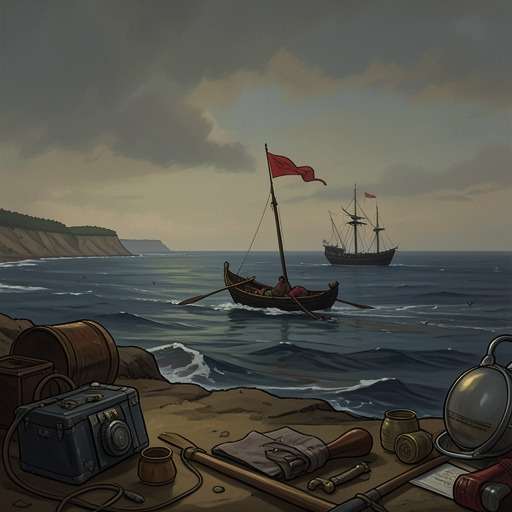
The attack has come from the sea. Twenty great Calormene ships put in at Cair Paravel during the darkness of the night before the previous night. The detail explains how the royal city was taken: the danger was not only a battlefield defeat at Tirian’s position but an assault by a fleet that reached the capital unseen. After Farsight speaks, no one can answer. The report gives the fall the force of a witnessed fact, not a rumor or a threat.
Roonwit’s death and the meaning of defeat
Farsight’s second sight compounds the military news. Five leagues nearer than Cair Paravel, Roonwit the Centaur lies dead, an arrow from a Calormene in his side. Farsight was with him in his last hour, and carries his message to Tirian: all worlds draw to an end, and a noble death is a treasure no one is too poor to buy. The city’s capture is thus joined to the death of a trusted Narnian and to a warning against measuring the kingdom’s fate only by its survival.
After a long silence, Tirian says that Narnia is no more. His words register the difference between the continued existence of its people and the loss of the Narnia they had known: its capital has fallen, its subjects are scattered, and Roonwit is dead. Yet the final chapters complicate the apparent finality of this judgment. At the open Door, Aslan summons the end of the old world; the stars fall from the sky and are called home. The destruction that follows is not a military recovery or a return to the former kingdom, but the ending of Narnia as a world.
From the fallen kingdom to the final judgment
When the creatures run toward Aslan at the Door, their encounter separates them according to their response to him. Those who look at him with fear and hatred turn away into his shadow; among Talking Beasts, that change also means they cease to speak. Those who look at him with love, even when afraid, enter through the Door. Among the creatures who are welcomed are figures the survivors had believed dead, including Roonwit and Farsight. The scene does not undo Cair Paravel’s capture or Roonwit’s death in the old world; it reveals that the apparent losses do not describe the whole reality of the ending.
Aslan then says, “Now make an end.” The Time-giant takes the Sun and squeezes it in his hand, and darkness follows. At the Door, Lucy insists that it is not wrong to mourn for Narnia and asks Peter not to stop her. Tirian agrees: he has seen his mother’s death, and Narnia is the only world he has known, so it would be discourteous not to grieve. Their sorrow preserves the weight of the kingdom’s loss even as they walk onward, speaking of its ancient kings, wars, peace, and glories.
The final revelation extends the meaning of ending beyond Narnia. Aslan tells the children that a real railway accident has killed their father, mother, and themselves, and frames death as the close of one term and the beginning of another. The story ends by calling their new life the beginning of the Great Story. Cair Paravel’s fall is therefore the decisive historical defeat within the last days of Narnia, but not the boundary of the narrative’s world: the fallen kingdom is mourned, the old order ends, and a greater reality begins.