The Great Story
The Last BattleThe Great Story is the name given to the unending life that begins beyond the destruction of the old Narnia. At the close of the book, Aslan tells the children that a real railway accident has killed them in the Shadow-Lands; their former existence was not the final reality, but its threshold. The adventures and endings of the old world become, in retrospect, only the cover and title page of a story that now opens into its first chapter.
From the End of Narnia to a New Beginning
The transition is marked by Aslan’s command at the stable door: “Now it is time!” He opens the threshold, and the ending of the old order unfolds on a cosmic scale. Aslan calls the stars home; the sky empties as they fall to the earth, revealing that the apparent darkness is not cloud but a sky without stars. The summons gathers the world’s creatures at the doorway, where their encounter with Aslan separates those who enter from those who turn away.
The judgment is not merely a change of location. Creatures who face Aslan with fear and hatred turn aside and disappear into his shadow; Talking Beasts among them cease to speak and become ordinary animals. Those who look at him with love, even when frightened, enter through the door. The ending thus makes passage into the new order inseparable from recognition: the same threshold offers entry, but the creatures’ response determines which way they go.
The Destruction of the Shadow World
Beyond the doorway, the old Narnia’s destruction proceeds in stark images. After the stars have been called home, the sun rises enlarged and dark red over the shoreless waters. The moon draws toward it; the two become a single burning mass, and fire falls into the sea. At Aslan’s next command, the giant stretches his enormous arm across the sky, takes the sun, and squeezes it out. The darkness and ice at the door make the end of the familiar world physical as well as cosmic.
That catastrophe does not cancel what mattered in Narnia. The Lord Digory explains that the Narnia the children knew had a beginning and an end: it was a shadow or copy of the real Narnia, which has always existed and always will. Its beloved creatures have been drawn through the door into that enduring reality. The image of a landscape seen first through a window and then in a mirror conveys both continuity and difference: the new Narnia is recognizably related to the old, yet deeper and more wonderful, like waking life beside a dream.
Death, Continuity, and the Final Revelation
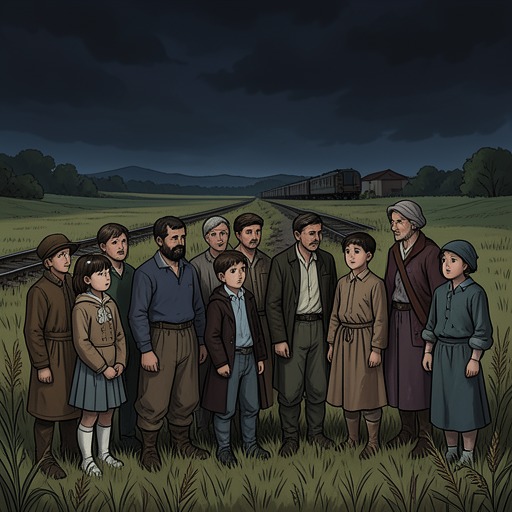
Aslan’s revelation joins the cosmic ending to the children’s own fate. He tells them that the railway accident was real and that they, along with their parents, are dead in the world they once called the Shadow-Lands. He recasts this death as a passage from a completed term into a holiday, from a dream into morning. The old world’s ending is therefore also the moment when the children’s fuller life begins.
The final transformation makes that beginning more than a comforting description. As Aslan speaks, he no longer looks like a lion; the narrator then says that what follows is too great and beautiful to write. The book closes by distinguishing the end of its narrated adventures from the beginning of the characters’ lives: what has been told was only a cover and title page, while the Great Story continues forever, with each chapter better than the one before.
Meaning of the Expression
The expression gathers the book’s ending into a single paradox: an ending can be absolute for one world and still be the beginning of a greater reality. Narnia’s finite history is neither simply preserved unchanged nor dismissed as unreal. It is a shadow whose significant creatures and experiences are carried into a lasting world, where they become part of a life beyond the limits of the old one.
The Great Story also supplies the ending’s governing scale. The summons of the stars, the judgment at the door, the extinguishing of the sun, and the disclosure of the railway accident belong to one sequence: the close of an order followed by entry into another. The final phrase does not promise a return to the familiar adventures; it places them at the beginning of an unending story whose reality exceeds what the old world could contain.