The inside is larger than the outside
The Last BattleThe inside-is-larger-than-the-outside rule describes a recurring law of Narnian space: an entrance or enclosing boundary can open into a world vastly greater than its exterior suggests. Lucy recognizes the law in the final garden after encountering its likeness in the Stable, where apparent confinement gives way to a succession of larger, more real worlds. The principle makes inward movement an expansion rather than a retreat, and gives the story’s last journey its distinctive geography.
The Rule Made Visible
Lucy first states the principle through comparison. Looking at the garden, she realizes that it is like the Stable and “far bigger inside than it was outside.” Tumnus confirms that this is not merely an unusual feature of one place: “The further up and the further in you go, the bigger everything gets. The inside is larger than the outside.” The explanation gives the spatial marvel a direction and a pattern. Movement inward does not approach a final, smaller chamber; each further threshold leads into greater scale.
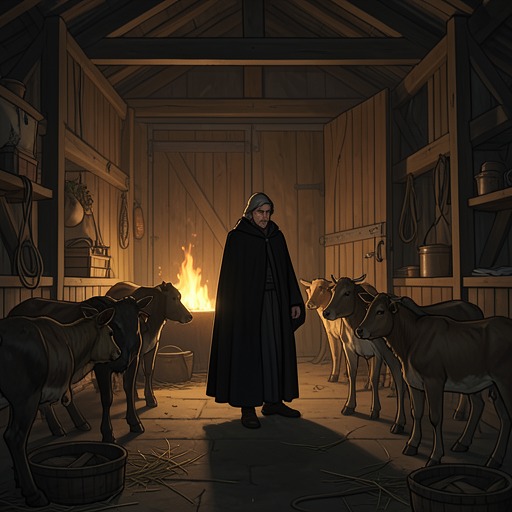
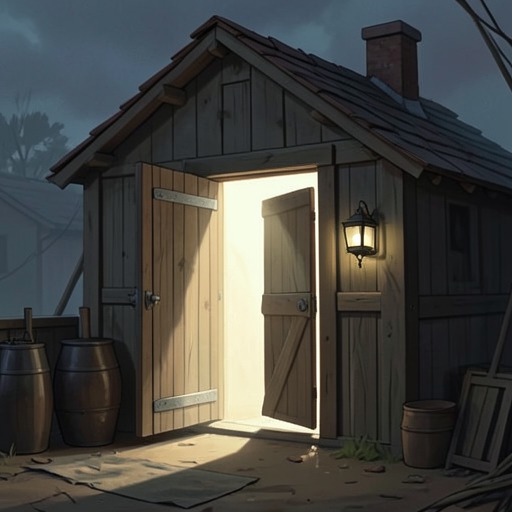
The Stable is the rule’s earlier and most unsettling instance. Its outer door appears to mark a narrow boundary, yet the space beyond it accommodates a world. That contrast makes the Stable more than an enclosure: what seems to be a limited exterior cannot measure the reality within. The final garden recalls this earlier discovery, so the reader encounters the law first as a startling reversal of expectation and later as a principle that can be recognized and understood.
World Within World
Lucy’s recognition develops from a comparison into a description of what lies inside. The garden is not simply a garden enlarged beyond its walls; it is a whole world, complete with rivers, woods, a sea, and mountains. Its features are not unfamiliar to her. She understands that this is still Narnia, but “more real and more beautiful” than the Narnia below, just as the Narnia beyond the Stable door was more real and more beautiful than the world outside it. Her discovery joins spatial scale to a hierarchy of reality: the inner world is not only larger but more fully real.
Tumnus offers an image for the succession of worlds: “like an onion: except that as you continue to go in and in, each circle is larger than the last.” The comparison preserves the idea of nested layers while reversing the expected proportions. The circles do not contract toward a small center. They expand. The phrase “world within world, Narnia within Narnia” captures the result: inward passage reveals not an escape from Narnia but a deeper Narnia, continuous with the one already known and surpassing it in beauty and reality.
The Wider View
The law also changes what can be seen from within. Lucy discovers that, once she fixes her eyes steadily on a distant place, it becomes clear and close, as if viewed through a telescope. From the garden she can see the southern desert and Tashbaan, Cair Paravel and the window of the room that had once been her own, as well as islands stretching toward the end of the world. The rule’s spatial enlargement is therefore paired with a changed relation to distance: the inner vantage makes far-off places perceptible with unexpected clarity.
Even the familiar image of Aslan’s country changes scale. What Lucy had taken for a huge mountain beyond the sea is revealed as part of a great chain of mountains encircling the whole world. A land she initially mistakes for a bank of brightly colored cloud also proves to be real. These recognitions extend the rule beyond the garden’s apparent boundary: entering the more real Narnia does not close off the horizon but discloses a greater world beyond what earlier sight could grasp.
Meaning in the Ending
The rule gives the final movement of the story a structure of continuing discovery. Each passage inward preserves what came before while revealing a greater world within it; the new Narnia is both recognizably the same country and more real and beautiful than its outer counterpart. The Stable’s enclosed appearance and the garden’s apparent limits thus become thresholds, not measures of what they contain.
Tumnus’s formulation makes this pattern a general law rather than an isolated wonder, and Lucy’s successive recognitions show how that law is learned: first through analogy, then through an explanation of expanding circles, and finally through a world that exceeds its apparent bounds. In the ending, greater depth means greater openness. The inside does not terminate at a hidden center; it leads further into an increasingly expansive Narnia.