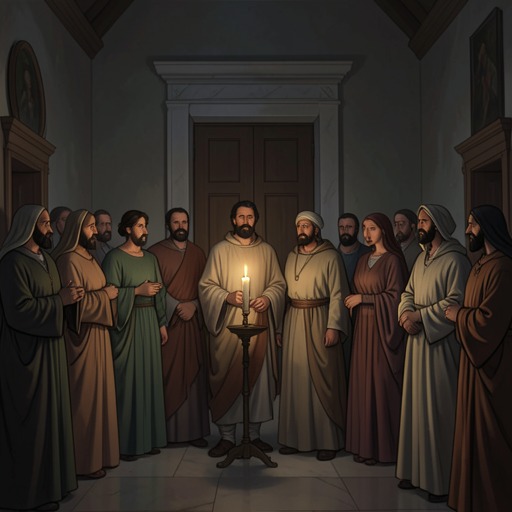
Time-giant
The Last BattleThe Time-giant is a colossal figure who sounds the horn as Narnia’s world reaches its end, then carries out Aslan’s command to extinguish the sun. Though he appears only in the final cosmic sequence, his actions make the closing transformation visible: the old world is brought to darkness, while its end opens onto a new order beyond the Door.
Appearance and Place in the Ending
The Time-giant is first perceived as a huge dark shape against the stars. He raises a horn to his mouth; after the delay caused by sound traveling slowly, its high, terrible, strangely beautiful note reaches those watching. The horn’s call precedes the stars’ fall: Aslan has summoned them home, and the sky gradually becomes empty as they descend to the Door.
The giant’s silhouette is later seen again against the sky. By then, the last light is changing: the sun appears abnormally large and dark red, and its reflection colors the shoreless waters. The moon rises close beside it, and the sun and moon draw together in a final, destructive spectacle. Against this cosmic scene, the Time-giant serves as the figure through whom the world’s ending becomes an action rather than an abstraction.
Actions at the World’s End
After Aslan says, "Now make an end," the Time-giant throws his horn into the sea. He then stretches one arm across the sky until his hand reaches the sun and squeezes it out. Darkness falls immediately. His role is therefore specific and consequential: he does not initiate the final command, but he performs the act Aslan directs, bringing the old world’s light to an end.
The Door remains the boundary between the ending world and those gathered beyond it. After the darkness and cold arrive, Aslan tells Peter to shut it. The Time-giant’s intervention belongs to this larger sequence of summons, separation, and closure: the stars have come home, the world has been emptied and transformed, and its access is finally closed.
Narrative Significance
The Time-giant’s appearance joins immense scale with a simple gesture. The horn first signals the gathering of the stars; the hand that reaches the sun then completes the destruction of the old world. The sequence distinguishes the end of Narnia’s familiar history from the end of the story itself: the world behind the Door is finished, but Aslan’s country and what follows remain beyond that threshold.
This ending does not make the loss emotionally negligible. Lucy says that mourning Narnia is not wrong, and Tirian agrees, explaining that Narnia is the only world he has known and that it would be discourteous not to grieve. The Time-giant’s act thus stands at the boundary between cosmic finality and personal bereavement. Later, Aslan reveals that the railway accident was real and that the children and their parents are dead; he describes the ending as a beginning, with the old life giving way to the Great Story. The giant’s extinguishing of the sun closes one world, not the possibility of life beyond it.