the Talking Dogs
The Last BattleThe Talking Dogs are a company of Narnian animals whose joyful loyalty makes them among the first creatures to answer King Tirian’s call for help. Their collective welcome briefly gives the resistance the fellowship it had hoped for; after Narnia’s end, they remain with the survivors, turning a search for a stranger into an occasion for welcome and then racing with the company toward the deeper country. Their story sets active trust and fellowship against the Dwarfs’ insistence that they will rely on no one but themselves.
Identity and Character
The Dogs retain the habits of ordinary dogs even while speaking and reasoning as allies. Their liveliness is not a decorative contrast to their courage: they rush ahead, return, sniff at the grass, sneeze, argue over scents, and pant with their tongues hanging slightly to one side. The narration emphasizes both sides of their nature, presenting them as intelligent participants in Narnian events without making them any less exuberantly doglike.
Their speech is conspicuously collective. When the Dogs greet Tirian, they speak over one another, promising help and asking to be shown what to do. Later several of them answer Peter together when asked what scent they have found. Their overlapping voices give the group a recognizable social presence: energetic, cooperative, and inclined to treat whatever they are doing at the moment as immensely important.
Answering Tirian’s Call
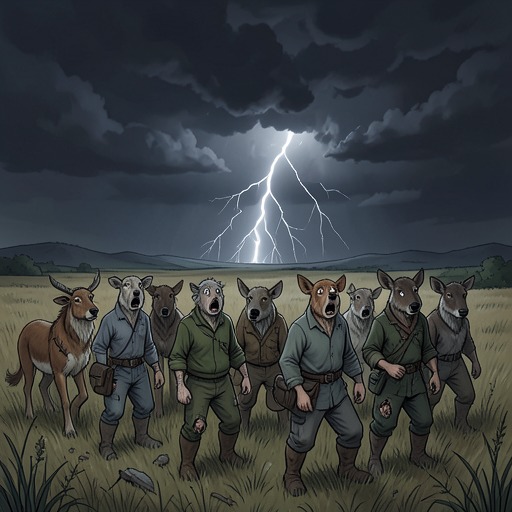
When the animals gather at the King’s meeting, fifteen Talking Dogs bound joyfully to Tirian’s side. They bark, put their front paws on human shoulders, lick faces, and call out their willingness to help. The rush is so forceful that it is compared to a great wave breaking on a seabeach. It is the response the King’s party has been longing to see, and it briefly encourages Eustace to think that events might yet come right.
The Dogs’ arrival also throws the meeting’s divided response into relief. Other small animals soon join them, followed by a Bear and a Boar, but Tirian sees that very few of the creatures present have moved. Those who stay back are afraid that Tashlan will be angry. The Dogs, by contrast, make their allegiance visible in their bodies and voices: they come straight to the King and offer themselves for action.
Their courage is practical as well as affectionate. During the later fighting, the Dwarfs shoot the Talking Horses before they can reach Tirian, and the Dogs’ earlier willingness to help stands against the Dwarfs’ open declaration that they want neither the King’s side to win nor the other side to prevail. The Dogs are not described as changing the battle’s outcome, but their immediate, unqualified solidarity gives the resistance a clear example of loyalty that does not collapse into factional self-interest.
Companions Beyond the Stable
After the survivors have passed through the Stable, the Dogs remain with them as they leave the Dwarfs sitting together in their imaginary Stable. They accompany the company as its members recall Narnia’s old wars, peace, kings, and glories. Their presence carries the companionship of Narnia into the new country rather than leaving it behind with the world that has ended.
The Dogs soon turn the walk into a scent-led search. They race ahead, come racing back, and dart off to sniff at smells in the grass, making themselves sneeze. When they catch a scent that excites them, they argue noisily over what it is, each insisting on the certainty of a nose and objecting to another Dog getting in the way. Asked by Peter what they have found, several answer at once that it is a Calormene. Peter tells them to lead the way, promising that the stranger will be welcome whether he comes in peace or war.
The Dogs’ report leads the company to Emeth, a young Calormene sitting beneath a chestnut tree beside a clear stream. They run ahead and return barking urgently to confirm their discovery. Their sensory alertness moves the encounter forward, but Peter’s response establishes the welcome that follows: the stranger is not presumed to be an enemy simply because he belongs to another people. The Dogs’ noisy detection thus becomes the opening to an encounter across political and religious divisions.
Speech, Fellowship, and Comic Energy
The Dogs help make the survivors’ new community feel companionable rather than solemnly static. When Emeth’s story is about to be heard, they bark that everyone should sit down and have a drink, explaining that they are quite blown from running. Eustace answers that this is what happens when they keep tearing about. The humans sit on the grass; after drinking noisily from the stream, the Dogs sit bolt upright, panting, tongues slightly lolling, ready to listen. Their comic exertion accompanies a serious act of hospitality: the company pauses to hear the stranger’s account.
Their physical comedy continues during the extraordinary ascent of the waterfall. In the fast gallop across the country, the Dogs keep pace with the humans, Puzzle, and Poggin, although the rush of air is likened to driving in a car without a windscreen. At the waterfall, they swarm and wriggle upward, spluttering and sneezing because they keep barking and filling their mouths and noses with water. The difficulty does not turn them back; they continue upward with the others toward the river above.
The scene makes the Dogs’ particular combination of qualities central to their role. Their barking can be inconvenient, and their energetic bodies produce slapstick even in a landscape of wonder, but neither quality excludes them from the company’s advance. They share its impossible journey on equal terms, moving from the urgent defense of Narnia to the exploratory joy of the country beyond it.
Change and Narrative Significance
The Dogs’ circumstances change radically: they first appear as Narnian subjects responding to their King amid a threatened struggle, then as companions walking in a country beyond the Stable and climbing a waterfall that could not be ascended in the ordinary world. The text gives them no separate account of what they think about Narnia’s destruction, but their continued presence and participation show that the fellowship of its creatures survives the transition.
Their strongest contrast is with the Dwarfs. The Dwarfs reject Tirian’s account, refuse kingship and allegiance to Aslan, and repeat that the Dwarfs are for the Dwarfs. The Dogs do not retreat into such self-enclosure: they run toward the King, volunteer help, and later help bring a stranger into the company. Against a group whose distrust makes them unable to accept even visible aid, the Dogs enact trust as movement toward others—an offered paw, a bark of welcome, a nose following a trail, and a willingness to keep pace. Their loyalty is not expressed through a theory of belonging but through repeated acts of approach, assistance, and shared travel.