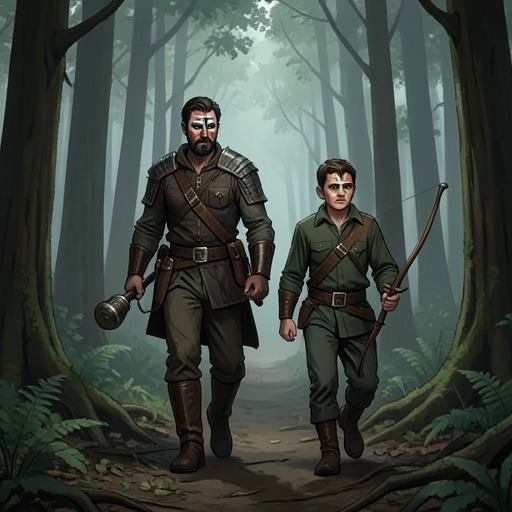
Chingachgook and Uncas’s father–son relationship
The Last of the MohicansChingachgook and Uncas’s father–son relationship joins intimate loyalty to the transmission of a threatened people’s identity. Their bond is shown in battle, in Uncas’s deference to his father, and in the turtle lineage that secures Uncas’s recognition among the Delawares; the narrative’s account of how few Mohicans remain makes their family connection a measure of cultural survival as well as kinship.
Kinship and Lineage
Uncas identifies himself at the Delaware council as the son of Chingachgook and a descendant of the great Unamis, the turtle. The small tortoise tattoo on his chest makes that inherited identity visible: the Delawares recognize the emblem, and Tamenund identifies Uncas as the child who can continue his ancestral place at the council fire. Uncas speaks modestly to Tamenund and bows in reverence to his age and standing, even as his lineage gives him authority before the assembled people.
When Tamenund reflects on the generations since his own people’s earlier history, Uncas explains that four warriors of his race have lived and died, leaving only Chingachgook and himself. The father and son thus embody a line that persists but has been reduced to two living members. Their relationship carries the weight of continuity precisely because so few remain to inherit it.
Shared Action and Mutual Regard
The bond is also enacted in danger. During the rescue of Cora, Uncas moves to protect her from an attacker, while Chingachgook engages Magua in a separate, prolonged fight. Hawkeye’s cry names both Mohican warriors in the same breath, presenting father and son as the returning force that turns the battle. Their roles are distinct, but their joined presence frames the confrontation as a defense of their companions and one another’s cause.
Elsewhere, Uncas’s decision to go to the Delawares rests on ancestral kinship: he calls them the children of his grandfathers. Hawkeye observes that the same blood runs in Uncas, although time and distance have altered its color. That exchange connects Uncas’s paternal inheritance to a wider network of relations and helps explain why his ancestry can matter beyond his immediate family.
A Family Under Pressure
The relationship stands against the loss of the wider Mohican family. Recalling an earlier war fought alongside the Delawares, Hawkeye tells the sisters that Chingachgook and he are the only survivors among those who helped build and defend the blockhouse. The Mohican family had formed the war party; now, as Hawkeye points out, only Chingachgook and Uncas remain of the people he is describing. The recollection makes the father–son pair not merely survivors of a single battle but the remnant of a much larger kin group.
That vulnerability has political dimensions. The Delawares have withheld military support from the French in part because of their old obligations to the Six Nations, and their position leaves their villages, hunting grounds, women, children, and military strength exposed to suspicion. Against this unstable landscape of alliances, Chingachgook and Uncas’s inherited affiliation gives Uncas a recognized place among the Delawares, while their own dwindling family line remains precarious.
Inheritance and Significance
Uncas’s recognition does not erase the losses that precede it. The turtle emblem establishes his descent and changes how the Delaware assembly sees him, but his account of the generations confirms that the lineage has narrowed to father and son. Their relationship therefore gathers two meanings at once: the personal bond between Chingachgook and Uncas, and the fragile transmission of a collective identity through a nearly extinguished family.
The narrative repeatedly places that inheritance in action rather than treating it as an abstract claim. It appears in the warriors’ shared resistance, in Uncas’s respectful address to an elder, and in the emblem that makes his ancestry legible to the Delawares. The father–son relationship becomes the human form through which the story presents continuity under pressure: a surviving connection capable of commanding recognition, yet unable to reverse the losses surrounding it.