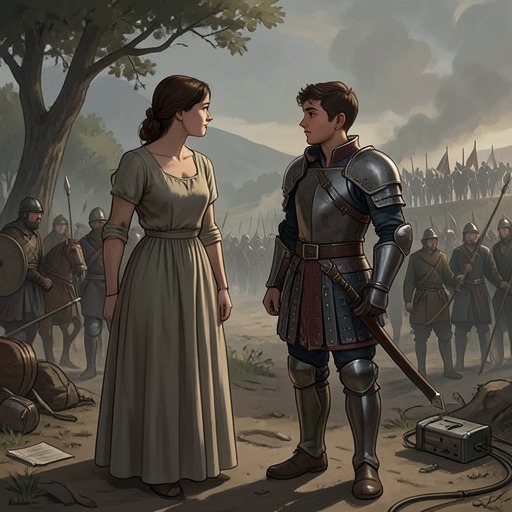
Cora and Uncas's love
The Last of the MohicansCora and Uncas’s love is an attachment recognized most fully in death. The Delaware women infer from Uncas’s inclinations that he loved Cora, and their funeral songs imagine her joining him in the afterlife; this belated recognition turns a private, largely unspoken bond into part of the community’s mourning and memory.
Recognition in the Funeral Songs
At the joint obsequies, the Delaware women address Uncas and Cora in turn. They urge Uncas to show kindness to the stranger maiden and to make allowance for her unfamiliarity with the skills of a warrior’s life. Their tenderness toward Cora is joined to admiration for her beauty and resolve, which they regard as more than compensating for any lack of woodland experience.
The women then speak to Cora as though she were entering a new life with a hunter to provide for her and a warrior to protect her. Their assurances that she need not fear the future lead into a more direct interpretation of Uncas’s feelings: they declare that he was noble and generous, qualities worthy of a warrior and of a person loved by a woman, and suggest that they had recognized his affection during the short time the pair had known one another.
Affection, Ancestry, and Belonging
The elegy connects Uncas’s preference for Cora with his ancestral identity. The singers explain that he belonged to a people once sovereign beside the salt lake and that his wishes drew him back toward those who lived near his fathers’ graves. They present Cora as someone whose conduct had shown her equal to the dangers of life in the woods, and imagine the Great Spirit placing her among congenial spirits where she could be happy.
This account gives their love a meaning beyond personal attraction: the women interpret Cora as a fitting companion for Uncas because of his people’s history and her demonstrated courage. Yet the songs also reveal the period’s racialized assumptions. In praising Cora, the singers describe her blood as purer and richer than that of the rest of her nation, setting her apart through ancestry even as they welcome her into Uncas’s imagined community.
A Bond Preserved in Loss
The relationship receives no earthly resolution in these passages. Instead, it is narrated through the bereaved community’s ceremony, where affection becomes legible in the words of mourners and is carried into a vision of life beyond death. The songs do not present the pair’s bond as an enacted courtship; they preserve it as an interpretation of Uncas’s inclination and as a hope for their reunion.
The surrounding events sharpen that elegiac force. Before the expedition, Uncas takes command of the Delaware war party, and the community prepares for conflict; later, the funeral songs gather the consequences of that struggle into a shared account of the dead. Their imagined companionship therefore stands against the separation caused by war and death, while the singers’ emphasis on ancestral graves and a disappearing people ties the love to the larger history of loss.