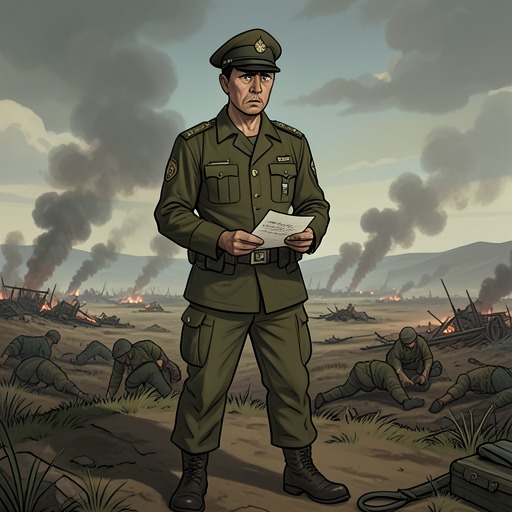
Fort William Henry under siege
The Last of the MohicansFort William Henry under siege is a prolonged military and political crisis in which a poorly equipped British garrison resists Montcalm’s forces, only to learn that General Webb will not send relief. The siege ends in a negotiated surrender, but the promised protections do not secure the departing column from danger, and the fort’s fall reveals how imperial policy, Indigenous alliances, and local military vulnerability converge on the frontier.
Conditions and Defenses
The garrison endures days of privation, noise, and danger as Montcalm presses the siege. Colonel Munro has no adequate means to resist the French advance, while Webb’s army remains on the Hudson and appears to have forgotten the besieged. Montcalm’s Indigenous allies occupy the woods around the portage, and their calls intensify the anxiety within the British encampment.
The defenders nevertheless maintain their resolve under Munro’s leadership. The narrator notes that Montcalm has failed to seize nearby heights, which could have given the besiegers a commanding advantage. On the plain, however, the French batteries are well placed and served with skill. The British can oppose them only with the hurried, imperfect preparations of a wilderness fortress.
The material weakness becomes explicit when Duncan Heyward warns Munro that the camp cannot remain tenable. More than half the guns have burst; the walls are crumbling; provisions are running short; and the soldiers are showing discontent and alarm. Munro recognizes the danger but insists that the fort must be defended while any hope of relief remains, even if the defense were reduced to stones gathered from the shore.
Webb’s Letter and the Decision to Surrender
The decisive blow is not another bombardment but the disclosure of Webb’s captured letter. Montcalm presents it to Munro during their parley. As Munro reads, his military pride gives way to dismay: Webb advises a speedy surrender and states that he cannot send a single man to rescue the garrison. Heyward confirms that the signature is genuine.
Munro takes the letter as a personal betrayal, believing Webb has brought dishonor upon him and his family’s name. Heyward urges him to preserve the garrison’s honor by continuing to resist, and Munro, recovering from his shock, resolves that they will return to the ramparts and defend the fort. Montcalm then offers terms, saying that retaining the fort is impossible and that it must be destroyed, but promising that no privilege valued by soldiers will be denied to the defenders. Heyward asks about their colors; Montcalm says they may carry them to England.
Munro accepts the need to negotiate and sends Heyward to arrange the terms. The capitulation provides that the garrison may retain its arms, colors, and baggage, thereby preserving its honor according to military convention. Hostilities are to cease, and the fort is to be yielded the following morning. The shock of Webb’s abandonment, however, marks a lasting change in Munro: his proud spirit does not recover, and his decline begins soon afterward.
Evacuation and Its Peril
As the British leave the fort, the scale of the evacuation becomes visible. Nearly three thousand people move across the plain toward the road leading through the forest to the Hudson. The French army watches in silence, observing the stipulated military honors and offering no insult. The defeated column includes women and children as well as sick and wounded soldiers; because vehicles and beasts of burden are already occupied by the injured, many must walk, including those too weak to keep pace.
The formal courtesy of the French army contrasts with the threatening presence of Indigenous onlookers along the woods. The departing people are beyond the fort’s protective earthworks, and the narrative shows how the surrender’s military safeguards coexist with a precarious passage through territory where French authority and allied interests do not fully control events. The fall of the fort therefore shifts the danger rather than ending it.
Frontier Alliances and the Meaning of the Siege
The siege belongs to a wider struggle over military allegiance and territory. The Delawares have followed Montcalm into English territory and made incursions on Mohawk hunting grounds, yet withhold support at a critical moment. The account links their hesitation to an old treaty that once made them dependent on the Six Nations for protection and now restrains them from fighting their former masters. To the French, their explanation is that their hatchets are dull and need time to be sharpened; Montcalm chooses to tolerate this passive ally rather than risk turning it into an open enemy.
This uncertain alliance has consequences beyond the battlefield. The Delawares’ distant villages, hunting grounds, women, children, and part of their fighting strength lie within French territory, leaving them exposed to pressure from their nominal allies. Hawkeye likewise describes Indigenous communities divided by colonial policy: the Hurons and Oneidas, despite speaking closely related languages, fight one another, while the Delawares are split between political camps. He argues that white political maneuvering has confused Indigenous loyalties without erasing older enmities.
The conflict’s language also makes the territorial stakes plain. Magua explains the French campaign as an effort to subdue the fort because his master claims the land and has ordered the English settlers driven off; once they agree to leave, they are no longer treated as enemies. The siege is thus both a contest for a military position and an assertion of competing claims to land, with Indigenous nations caught within an imperial struggle whose alliances remain unstable.