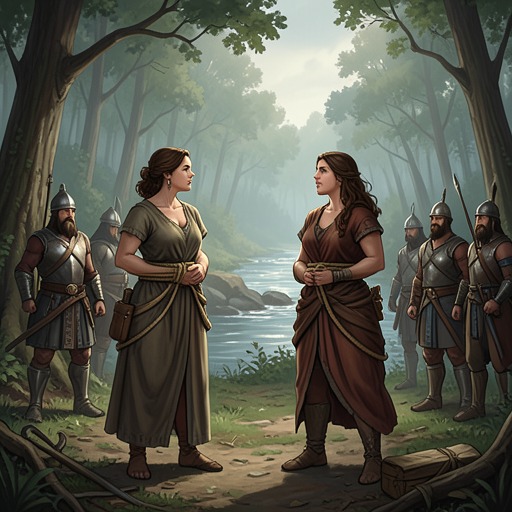
Heyward’s Party Held Captive by the Hurons
The Last of the MohicansHeyward’s Party Held Captive by the Hurons marks a sharp reversal: after sheltering in a cavern, Heyward, Cora, Alice, and David Gamut are seized and carried away. Their captivity becomes both a military consequence of the Huron attack and a means of private leverage, as Magua invokes his grievance against Munro and demands that Cora join him in exchange for the others’ release.
Capture and Transfer
The party’s refuge fails when the Hurons enter the cavern at both ends and drag its occupants out. The attackers bring their canoe around the cataract and use it to carry the captives downriver. Heyward leads the way into the vessel with the sisters and David; on the opposite bank, the Huron band divides, leaving six warriors with the prisoners under Magua’s direction.
Heyward had imagined that he might be kept for delivery to Montcalm, perhaps as part of a political calculation involving Munro. The division of the band destroys that hope: he concludes that the captives are to remain in Huron hands. His attempt to offer rewards to Magua—gold, powder, and other goods—rests on the mistaken belief that Magua’s actions might be explained by a wish to return the sisters to their father.
Magua’s Leverage
Magua rejects the prospect of being bought off and instead presents the captives as instruments of revenge against Munro. He says that Munro’s daughters are in his power and argues that his own grievance can be answered through them rather than by confronting Munro among armed soldiers. Cora asks him to release Alice and direct his anger toward her alone, but Magua makes a different offer: Alice may return to Lake Horican if Cora promises to live with him as his wife among the Hurons.
The demand makes captivity more than physical confinement. Cora is pressed to exchange her own future for her sister’s safety, and she asks Alice and Heyward whether life is worth that sacrifice. Alice refuses the proposed separation, choosing that the sisters should die together rather than accept Cora’s coerced marriage. Magua responds by ending the negotiation and ordering their deaths, but an unexpected rescue interrupts the threat before it can be carried out.
Danger and Rescue
The Huron band’s anger turns against the captives after Heyward explains that Hawkeye and the Mohicans have escaped. The Hurons regard the escape as a loss of their claimed prize, and Alice is placed in immediate danger. Heyward is bound when he tries to intervene; the sisters and David are also secured while the Hurons prepare to punish them. The episode shows that Magua’s authority does not make the prisoners safe: the band’s anger can threaten them even when its leader is present.
Hawkeye and the Mohicans arrive in time to save the captives. Uncas releases Alice, who returns to Cora’s arms, and the sisters’ reunion makes the rescue’s consequence personal as well as practical. Their survival does not erase the danger of their capture, but it restores them to one another and renews the possibility of returning to their father.
Colonial Conflict and Significance
The captivity is embedded in a war over territory and allegiance. When Magua asks why the French commander has brought his young men into the woods and fired on the earthen fort, he is told that the French seek to subdue it, claim the land, and drive away English squatters. The explanation presents military conquest as a contest over who may occupy and control the country, while the captives themselves become vulnerable within that struggle.
Hawkeye later describes the confusion produced by white political maneuvering: peoples who speak related languages can find themselves fighting one another, while the Delawares are divided between opposing alignments. His account connects the party’s immediate peril to a broader history in which white actors have helped turn Indigenous communities against one another. The narrator’s framing likewise recalls that the Mohicans were dispossessed from the country first occupied by Europeans, and that the peoples named in the story have largely disappeared from their former regions. The capture therefore functions not only as an adventure peril but as part of a narrative of colonial warfare, fractured alliances, and Indigenous dispossession.