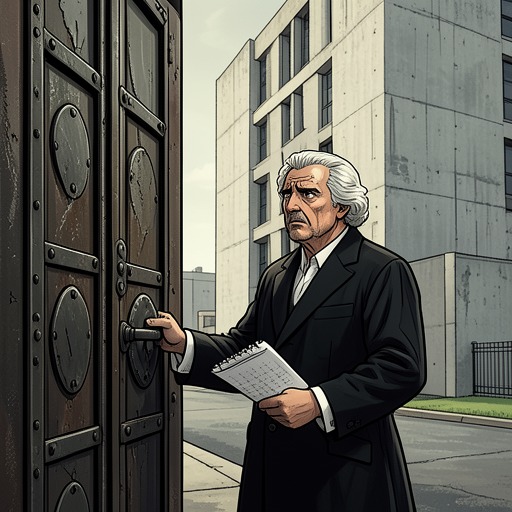
Auxiliary verbs as an engine of education
The Life and Opinions of Tristram Shandy, GentlemanWalter Shandy’s theory of auxiliary verbs turns grammar into an engine of education: instead of leaving a child with a single bare idea, it teaches the mind to set that idea moving through questions, tenses, possibilities, and consequences. The method promises a “North-west passage to the intellectual world,” but its demonstration—making an unseen white bear the subject of an elaborate chain of speculation—also exposes the comic distance between multiplying words and possessing knowledge.
The proposed shortcut to knowledge
Walter presents his educational scheme while discoursing with Yorick about the time children lose in a conventional education. He imagines that the mind has shorter routes to knowledge than the usual ones, though not every child has a parent able to point them out. The metaphor of the North-West passage makes education a search for a quicker route: instruction should not merely store material in the mind but show it how to travel through what it has received.
He identifies the auxiliary verbs as the crucial mechanism. The book first pauses over the thought that a single word reaches its limit when the mind has made a high metaphor from it; the idea then rests until another idea enters. Auxiliary verbs, by contrast, set the soul going independently upon its materials. Walter describes them as an engine around which ideas can be twisted and made to open fresh paths of inquiry. In his account, their value lies less in naming things than in enabling the mind to do something with what it encounters.
The educational claim therefore depends on an important distinction between a stock of ideas and the activity that develops them. A word may yield one metaphor and then come to rest; a system of auxiliaries makes that resting point provisional. By changing how an idea is asserted, located in time, questioned, or imagined, the learner can draw out further conceptions and conclusions. The proposed shortcut is not the omission of thought but a technique for setting thought in motion.
The grammatical engine
Walter lays out the method as a set of verbs and operations. The auxiliaries he names include “am; was; have; had; do; did; make; made; suffer; shall; should; will; would; can; could; owe; ought; used; or is wont.” They are to be varied through present, past, and future tenses, joined to the verb “see,” and put into questions such as whether something is, was, or will be. The same material can be framed negatively, affirmatively, chronologically, or hypothetically.
Those forms change the work asked of a thought. A question tests whether an event exists or may occur; a negative reverses its assertion; a chronological form asks whether it has always been so, happened lately, or began long ago. A hypothetical form asks what follows if a proposition is or is not true. Walter’s examples widen rapidly from the grammar lesson into imagined contingencies, including the possibility that the French might defeat the English or that the Sun might leave the Zodiac. The exercise treats grammatical variation as a way to generate lines of reasoning, not merely as a drill in correct forms.
Walter says that a child’s memory should be exercised in the right application of these forms. Even an apparently barren idea, he argues, can become a store of conceptions and conclusions. The claim gives memory an active role: the learner retains a procedure for working over an idea, rather than simply memorizing a finished body of information. The lesson’s promise is expansive, though the text makes that expansiveness deliberately difficult to separate from absurdity.
The white bear demonstration
Walter tests the principle on a question that makes the limits of direct experience explicit: whether anyone has ever seen a white bear. Trim has not, and Toby objects that the corporal cannot discourse about an animal he has never seen. Walter answers that the fact he wants is precisely the possibility of discussing it without having seen it. He begins turning the bear over through auxiliary forms: whether he has seen one, might have seen one, is to see one, ought to have seen one, or can ever see one.
The example distinguishes imagining a subject from knowing it by observation. The grammar permits a speaker to ask about the bear’s existence in the past, present, and future, or about the possibility and obligation of seeing it. It cannot supply the missing encounter. Walter briefly acknowledges the problem in wishing he had seen one, since he cannot imagine it; nevertheless, his verbal procedure continues to elaborate the absent animal. The bear becomes the exercise’s test case precisely because it is unavailable to Trim’s experience.
When the book returns to the scene after Walter has carried the bear backwards and forwards through half a dozen pages, the exercise has become a performance of its own generative power. Walter closes the book, hands it back to Trim, and declares that Tristram will conjugate every word in the dictionary in both directions. Each word, he says, can be made into a thesis or hypothesis; each thesis or hypothesis produces propositions, and each proposition leads to consequences and conclusions, which in turn open further inquiry and doubt. His image of the child’s head being opened by this engine meets Toby’s counter-image of it bursting into a thousand splinters. Their disagreement gives the theory its sharpest comic tension: intellectual expansion may be fruitful, but expansion without measure threatens to become overload.
A theory enacted as digression
The scene makes the form of the educational theory resemble its operation. Walter moves from the general claim about knowledge to a list of grammatical forms, then to the white bear, then to the promise of conjugating every word. Each step generates another set of possibilities. Rather than offering a short abstract definition and stopping, the narrative lets the proposed engine produce a chain of examples and consequences in front of Yorick, Toby, and Trim.
That performance also keeps the theory from settling into a simple endorsement of limitless verbal ingenuity. The bear can be discussed without being seen, but discussion is not the same as experience; a thesis can generate propositions without guaranteeing that every resulting conclusion is useful. Walter’s ambition is to make every idea productive, while Toby’s fear of splintering registers the possible cost of treating productivity as endless. The distinction between a mind opened by inquiry and one overwhelmed by it remains active within the scene.
The educational scheme’s decisive contribution is thus both practical and comic. It identifies auxiliary verbs as devices for changing the relations a learner can draw from an idea, and stages their capacity to multiply questions, hypotheses, and deductions. At the same time, the white bear and the dictionary-wide ambition reveal the method’s limit: linguistic movement can make inquiry proliferate, but proliferation alone does not establish knowledge. In that unresolved tension, grammar becomes not a passive inventory of forms but a dramatic model of a mind trying to think its way beyond what it has already seen.