Battle of Landen (1693)
The Life and Opinions of Tristram Shandy, GentlemanThe Battle of Landen (1693) is recalled less as a campaign than as a source of lasting bodily consequence and unlikely evidence. A musket-ball wound disabled Corporal Trim for military service and brought him into Uncle Toby’s household; later, an account of a Walloon officer wounded in the head at the battle unsettles Walter Shandy’s theory that the soul is located in the brain.
The wound and its aftermath
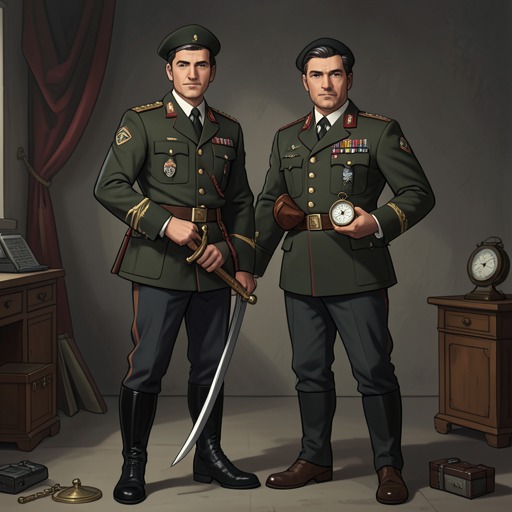
Two years before the affair of Namur, a musket-ball struck Trim’s left knee at Landen and disabled him for service. The injury therefore marks a change in his life: the soldier could no longer serve in the regiment, but his usefulness and the affection he had earned there brought him into Uncle Toby’s service.
Trim’s wartime wound also becomes the beginning of an enduring domestic partnership. He attends Uncle Toby in camp and in quarters, serving as valet, groom, barber, cook, needleworker, and nurse. The range of this work makes the injury’s consequences concrete: military service ends, but a different form of loyal service begins.
A bond formed in service
Uncle Toby and Trim’s connection extends beyond the practical duties created by the wound. Uncle Toby loves him, and their shared interest in fortifications deepens their companionship. After years of listening to his master discuss fortified towns and examining his plans, Trim becomes a capable student of the subject. The injury brings him into Uncle Toby’s household; shared work and military conversation turn that arrangement into a close bond.
The Walloon officer and Walter’s reasoning
Landen returns in a separate conversation as the setting for an account that Uncle Toby tells Walter Shandy. A Walloon officer at the battle had part of his brain shot away by a musket-ball and another part removed afterward by a French surgeon. Despite this, he recovered and performed his duties well without it.
Walter uses the story to test his own theory about the soul. If people can walk about and do their business without parts of their brains, he reasons, the soul cannot reside in the brain. The anecdote does not furnish a general medical account; within the discussion, its force is as a counterexample that allows Uncle Toby to rescue Walter from the conjecture that the soul sits on the pineal gland.
Narrative significance
The battle’s two remembered consequences form a telling contrast. For Trim, Landen is a specific bodily injury that ends military service and redirects his life into faithful attendance on Uncle Toby. For Walter, it is the setting of a story about survival that loosens a philosophical certainty. The novel thus lets a battlefield recur not through an extended account of combat, but through the later lives and arguments shaped by what happened there.