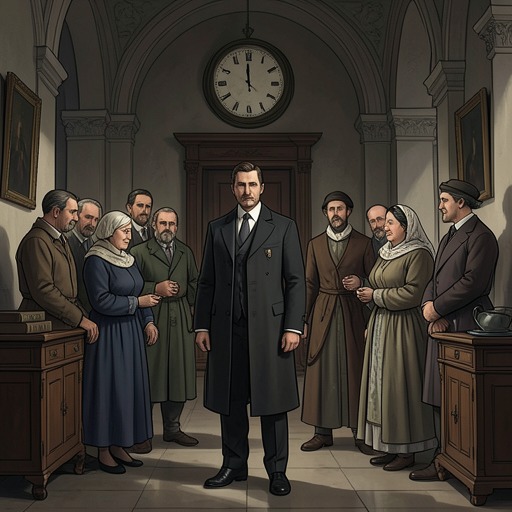
Death of Bobby Shandy
The Life and Opinions of Tristram Shandy, GentlemanBobby Shandy’s death ends the competition between two projects Walter Shandy had been unable to rank: enclosing the great Ox-moor and sending his eldest son abroad. The news reaches Walter amid calculations for his own French journey, transforming a private puzzle of family priority into bereavement. In its aftermath, the loss redirects his attention toward Tristram’s education and leaves the surviving son carrying the weight of his father’s hopes.
The choice before the news
Walter’s first response to a letter is to imagine how its contents might be turned to the honour of his family. A succession of projects takes possession of him: travelling to Rome, going to law, buying stock or John Hobson’s farm, enlarging the house, and constructing a windmill to answer the existing watermill. The grandest remaining schemes are to enclose Ox-moor and dispatch Bobby upon his travels. The sum available cannot finance everything, however, and Walter has to choose between them.
That choice is already charged by family custom. The eldest son is expected to have free passage abroad before marriage, ostensibly for the benefits of exercise and a change of air, but also for the pleasure and distinction of having travelled. Walter has not previously needed to settle the competing claims of this custom and the estate project. Once the lesser schemes fall away, Ox-moor and Bobby’s travels stand opposed as equally compelling plans, and his inability to decide becomes a contest within his own mind.
News arrives during another calculation
The account of Bobby’s death reaches Walter while he is working out the expense of travelling by post from Calais to Paris and onward to Lyons. The journey itself has repeatedly been interrupted: Obadiah has opened the door to report that the household is out of yeast and ask to borrow the great coach-horse to find more. Walter grants permission, then the conversation turns to the horse’s missing shoe. Even as domestic business diverts him, Walter keeps his compasses on Nevers and his post-road book in hand, half calculating and half listening.
The interruption becomes irreversible when Toby reads the letter aloud. Walter first understands the announcement as a departure and demands to know who has gone, whether he left without permission, money, or a governor. Toby clarifies that their nephew is dead. Walter presses the point—whether Bobby died without being ill—and Toby answers that he must have been ill enough, speaking softly and with a deep sigh. The exchange makes the news arrive by stages: Walter’s assumptions about travel and permission give way to the fact of death, while Toby’s manner conveys grief before he fully explains it.
Consequences for Walter and the family
Bobby’s death removes the immediate need to choose between the Ox-moor and his brother’s travels. The bereavement thus settles, by loss rather than decision, the contest that had divided Walter’s attention. It also follows the narrator’s account of another consuming fixation: the bodily friction of Walter’s mental habits, which is said to waste his fat and impair his strength. Bobby’s death rescues him from this preoccupation just as another fresh evil had displaced his earlier vexation over Tristram’s Christian name. The relief is no consolation; the narrative frames it as one sorrow closing over another, not as a genuine solution.
The news also changes the place of Tristram in Walter’s plans. After affairs have become somewhat settled and Susanna has taken possession of Mrs. Shandy’s green satin nightgown, Walter turns to composing the Tristra-pædia, a system intended to govern his surviving son’s childhood and adolescence. The narrator describes Tristram as Walter’s last stake: Walter has lost Bobby entirely and, by his own reckoning, lost three-fourths of Tristram through disappointments concerning his conception, nose, and name. The educational project therefore follows Bobby’s death as a renewed investment in the child who remains.
Narrative form and significance
The death is presented not through a description of Bobby’s final illness or deathbed, but through its arrival in a letter and its collision with Walter’s ongoing calculations. That contrast gives the scene its force: the measured journey across France continues on the page while the family’s future changes in a moment. Walter’s fixed compasses and open road book make a practical, forward-moving task visible just as the news stops the earlier debate over where the family’s resources should go.
The episode also turns the novel’s recurrent movement from one vexation to another into a family event. Bobby’s death ends the unresolved choice about the eldest son’s travels, displaces Walter’s fixation on his own bodily decline, and redirects his hopes toward Tristram’s education. The loss is not folded into a neat moral resolution: it alters the family’s priorities while leaving Walter’s characteristic schemes and anxieties intact, now concentrated on the son who survives.