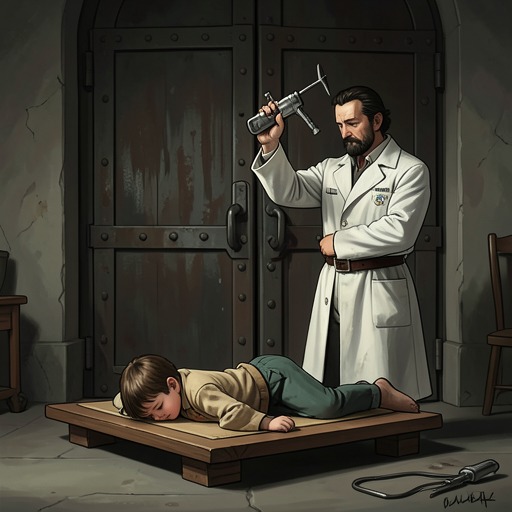
Dr. Slop’s forceps
The Life and Opinions of Tristram Shandy, GentlemanDr. Slop’s forceps are a new obstetrical instrument whose intended promise of controlled delivery becomes entangled with family argument, experimental mishap, and the consequences of Tristram Shandy’s birth. The instrument matters not only as a tool in the delivery room but as the material point where Dr. Slop’s professional confidence meets Walter Shandy’s speculative system and Uncle Toby’s practical concern.
Identity and Purpose
Dr. Slop regards the forceps as the safest instrument of deliverance and has defended them in his book. Walter Shandy chooses him partly because the doctor has also written in favor of delivering a child by the feet, a procedure Walter’s own theory values for protecting the child’s understanding. Their agreement is therefore a coalition of convenience: Dr. Slop’s obstetrical reasons and Walter’s intellectual system point toward a similar possibility, although they do not share the same rationale.
The forceps enter a birth already shaped by disagreement over who should attend it. Walter wants a man-midwife, while Mrs. Shandy insists on the experienced parish midwife and on her right to choose her own attendant. Their settlement leaves the old midwife in charge of the delivery while Dr. Slop is permitted to attend and drink wine with Walter and Uncle Toby in the back parlour. The instrument thus belongs to a divided arrangement: its advocate is present, but the family’s chosen midwife remains responsible for the birth.
Demonstration and Dispute
Before Dr. Slop reaches the delivery room, the forceps are already part of the debate. With his green baize bag on his knees, he reaches inside to produce them at a decisive moment in his argument with Uncle Toby. His fumbling spoils the rhetorical effect; as he draws out the forceps, he also pulls out a squirt. Uncle Toby seizes on the accidental juxtaposition, turning the intended display of professional equipment into a question about what else might accompany a birth. The instrument’s first conspicuous appearance therefore punctures, rather than establishes, Dr. Slop’s authority.
The forceps are then used in a demonstration on Uncle Toby’s hands. Dr. Slop has instructed him to clench his fists together in the shape of a child’s head and sit still. After the experiment, Uncle Toby complains that the instrument has injured the backs of both hands and crushed his knuckles. Dr. Slop answers by proposing several possible faults in the instrument or in his handling of it, including insufficiently protected points, a loose rivet, or awkwardness caused by a cut on his thumb. Walter interrupts this catalogue of possibilities by observing that it is fortunate the experiment was not performed on his child’s head. The exchange makes the forceps’ practical reliability an open question before their use in the delivery itself.
The argument also turns on the uncertain presentation of the child. Dr. Slop asks the midwife whether the part presenting could be the hip rather than the head. She insists that it is the head. Dr. Slop raises a danger associated with mistaking the hip for the head, but whispers the precise possibility to Walter and Uncle Toby rather than explaining it openly. Walter replies that, if the feared situation arose, the consequences would be grave. The forceps are consequently associated not with a settled plan but with uncertainty over what part of the child is presenting and what intervention might follow.
The Birth and Its Consequences
The narrator connects the instrument to the injury to Tristram’s nose. Uncle Toby later learns from Corporal Trim that the forceps have crushed the child’s nose, which Susannah describes as flattened against his face. Susannah is making a substitute bridge from cotton and a thin piece of whalebone taken from her stays in an attempt to raise it. Walter immediately asks his brother to lead him to his room. The improvised bridge gives the forceps’ consequence a concrete domestic afterlife: the instrument is gone from the scene, but the family is left confronting the result and attempting a repair.
Walter’s response exceeds ordinary disappointment at an unsuccessful delivery. He has invested the birth with the hope of preserving what he imagines to be the delicate physical basis of the child’s intellectual powers. He believes that, under the pressure of labour, a child’s pliable head may be compressed by a force averaging 470 pounds, and fears that this will damage the brain and the fine structure he calls the intellectual web. In that system, the forceps’ contact with the nose is part of a wider catastrophe: the child came head-first despite Walter’s precautions, and the instrument has damaged the feature he treats as decisive for the family’s prospects. The narrative presents Walter’s theory as his own belief, not as an established medical account.
Walter calculates that the odds against the forceps striking precisely the part of the body that could damage the family’s fortunes must be a million to one. Uncle Toby counters that matters might have been worse if the hip had presented, recalling Dr. Slop’s earlier warning. The exchange brings the instrument into the book’s recurring traffic between accident and interpretation: a mishap becomes, for Walter, evidence about destiny and inheritance, while Toby’s answer redirects attention to the contingency of what might have happened instead.
Narrative and Medical Significance
The forceps concentrate several competing kinds of authority. Dr. Slop invokes professional technique and a supposedly safer instrument; the midwife’s experience and judgment remain indispensable; Mrs. Shandy’s choice determines who is trusted with the birth; and Walter tries to make obstetrical procedure serve a theory of intellect and family power. The episode does not resolve these claims into a neutral account of medical efficacy. Instead, the instrument is tested through argument, a botched demonstration, uncertainty about the child’s presentation, and the narrated consequence of the delivery.
Its comic role depends on the contrast between technical promise and awkward use. The forceps are introduced as an innovation Dr. Slop believes in, yet their first appearance is accompanied by the squirt, and the trial with Toby’s clenched hands produces a series of excuses rather than reassurance. Later, the instrument becomes inseparable from the injury to Tristram’s nose and from Walter’s expansive fears about intellect, fortune, and the future of the family. A tool meant to control a dangerous passage into life thus becomes the emblem of how intervention, accident, and theory collide in the novel’s account of birth.