Fortresses won or lost by noses
The Life and Opinions of Tristram Shandy, Gentleman“Fortresses won or lost by noses” is the closing maxim of Hafen Slawkenbergius’s tale of the Strasbourg nose uproar. It recasts the city’s loss as an absurd victory of curiosity over civic vigilance: the French enter only after the people, drawn out to follow a stranger’s nose, have left their gates open. The nose becomes both spectacle and explanation, an image through which the tale turns a military defeat into a satire of collective distraction.
The Gates Opened by Curiosity
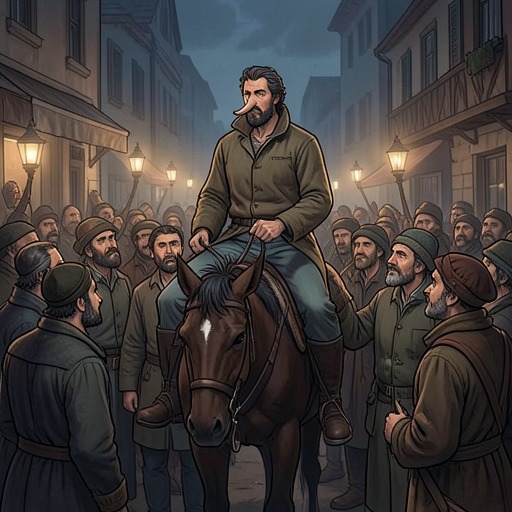
The tale offers two accounts of Strasbourg’s vulnerability. One says that its people anticipated revenues, burdened themselves with taxes, and exhausted their strength until they could no longer keep the gates shut; on this view, the French simply pushed them open. Slawkenbergius interrupts that explanation with an emphatic correction: it was curiosity, not the French, that opened the gates. The French take advantage of the spectacle, entering when the inhabitants have marched out to follow the stranger’s nose.
The reversal makes the city’s defeat at once more comic and more unsettling. The people are not overcome at their defenses but drawn away from them, men, women, and children following a marvel until the ordinary duty of guarding the gates disappears. The French remain opportunistic participants, but the tale assigns the decisive opening to the citizens’ own attention: the invaders push through a breach that collective fascination has created.
From Distraction to Decline
The nose’s power does not end with the gates. The tale says that trade and manufactures have decayed ever since, rejecting the explanations offered by commercial authorities. Its alternative is that noses have so occupied the people’s minds that they could not attend to their business. Curiosity thus passes from a moment of public spectacle into an enduring condition of civic and economic distraction.
The causal claim is deliberately comic in its excess: a nose explains a city’s military exposure and the long decline of its commerce. But the exaggeration holds together the tale’s two consequences. The same collective preoccupation that takes the people away from their work also takes them away from the gates. The nose is not merely an object of curiosity; it is the recurring emblem of attention captured at the expense of practical life.
The Closing Maxim
At the end of the tale, Slawkenbergius fears that Strasbourg will not be the last fortress either won or lost by noses. The maxim expands one comic episode into a general warning, while preserving its unstable double meaning: the nose can be the cause of a defeat, the spectacle that distracts a population, or the figure by which the tale makes human susceptibility visible.
The phrase’s force comes from the mismatch between military scale and bodily detail. A fortress suggests walls, gates, and armed defense; a nose seems a trivial cause for its loss. Yet the story makes that disproportion its point: spectacle can redirect a whole population, and what appears ridiculous can have public consequences. The tale closes not with a conventional account of French strength but with the image of a city undone by what its people could not stop following.