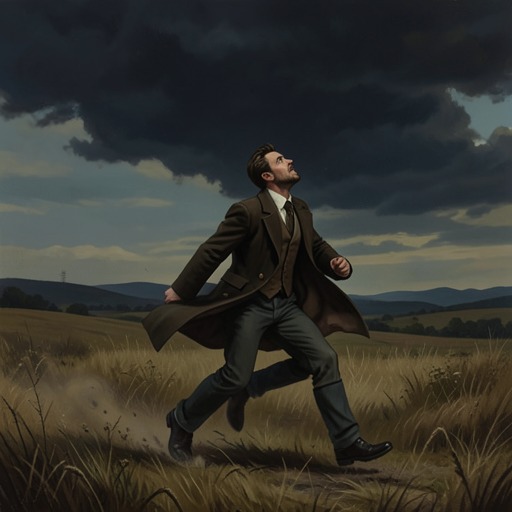
French post-office
The Life and Opinions of Tristram Shandy, GentlemanThe French post-office enters Tristram Shandy’s journey not as a neutral travel service but as an authority that can charge for a route a traveler says he will not take. Its officials enforce payment for royal posts and for changing one’s intended mode of travel; the resulting dispute makes the journey’s practical details—roads, horses, stages, receipts, and notes—part of a comic argument about who controls movement and how travelers describe what happens to them.
Administrative Authority and the Journey
The post-office’s presence is first registered through the ordinary calculations of travel. Between Calais and Paris, three distinct roads compete for consideration, and the representations of local deputies can consume half a day while a traveler decides which route to take. The road by Lisle and Arras is longer but presented as interesting and instructive; another runs by Amiens and offers the prospect of Chantilly. The practical burden of choosing a route belongs to the traveler, but the journey is already shaped by competing claims about what a route is worth.
The expense of postal travel makes that burden more immediate. At each stage, the traveler must pay for horses, count out three livres fifteen sous, and stay alert to discrepancies, missing sums, or coins that will not pass. Even a traveler intent on sleeping cannot simply prepare the precise amount and ignore the transaction: a demand for two additional sous, a disputed twelve-sous piece, or the need to consult the tiny print in a book of post-roads brings him back into the argument. The post-office’s system thus turns uninterrupted travel into repeated acts of calculation and attention.
The Dispute at the Post
The conflict sharpens in Lyons, where the narrator’s chaise has been loaded higgledy-piggledy into a cart and is moving slowly ahead of him. He welcomes the damage as an opportunity to change course: he imagines going by water to Avignon for a hundred and twenty miles at less than seven livres, then crossing the plains of Languedoc on mules or asses. He expects the mishap to save four hundred livres and to make the journey more pleasurable. The prospect of abandoning the road is therefore both economic and imaginative—a chance to exchange the chaise’s fixed itinerary for movement by river and across the countryside.
At the gate, a commissary from the post-office interrupts that plan with a written demand for six livres and some odd sous. When the narrator asks why he owes the money, the commissary says it is required on the king’s behalf. He then specifies the charge: six livres four sous for the next post to St. Fons, on the route to Avignon, because it is a royal post at which horses and postillion cost double; without that status, the amount would be three livres two sous. The narrator objects that he is not going by land. The commissary’s answer is that he may do so if he pleases, but the demand remains in force.
The narrator tries to turn the encounter into a contest of wit, reasoning that he owes the king of France nothing beyond goodwill. The commissary does not answer that proposition on its own terms; he relies on the stated tariff and the official authority behind it. Faced with the insistence that the six livres four sous must be paid, the narrator accepts that he will have to say something clever enough to be worth the money. The exchange makes the fee more than a charge for horses: it becomes the price of an argument in which the traveler has room to speak but little power to alter the outcome.
The Ordinance and the Cost of Changing Course
The commissary supplies a printed paper marked as an order of the king. The narrator reads it quickly and draws out an uncompromising implication: someone who sets out in a post-chaise from Paris must continue travelling in one, or pay for changing. The commissary offers a narrower explanation. A traveler intending to run post from Paris to Avignon cannot change that intention or mode of travel without first satisfying the post farmers for two posts beyond the place where the change is made. The rule, he explains, protects revenue against a traveler’s fickleness.
That explanation clarifies the dispute’s stakes. The narrator does not merely object to the cost of the next horses; he wants to abandon the road for water after the chaise has been damaged. The ordinance makes that change costly by treating a change in intention as something for which compensation is owed. In the traveler’s joke, fickleness itself becomes taxable. His account turns a bureaucratic restriction into a paradox: a journey may be physically redirected, but the financial obligation follows the abandoned plan.
The episode also reveals how the narrator’s travel choices are constrained by money at every scale. He has imagined a cheaper route, estimated the savings, and assigned a value to the pleasure of travelling by water. The commissary’s demand makes that calculation answerable to a separate system of tariffs and royal posts. Rather than settling the matter through a detached explanation of French administration, the narrative stages the rule in an encounter where the traveler must pay and then tries to recover some agency through verbal performance.
Notes, Narrative, and Travel Writing
The confrontation becomes part of the narrator’s travel writing as soon as he resolves to enter the alleged imposition among his remarks. He reaches into his coat pocket for those notes and discovers that they have been stolen. The loss provokes a racket: he asks the commissary whether he dropped any papers beside him, only to be told that he dropped several singular remarks. The reply treats the narrator’s talk as though it were itself a set of lost documents, collapsing the distinction between what he says, what he records, and what can be carried forward as evidence.
That episode belongs to a broader joke about the authority of travel accounts. The narrator admits that he knows little of Calais beyond what his barber told him while whetting his razor. He landed in the evening’s dusk and left in darkness, yet claims he could assemble a long and seemingly precise chapter from scattered information and inference. The chapter that follows begins by supplying alternative names for Calais and proceeds to describe its population, convents, parish church, and altars. The gap between limited direct observation and confident detail makes the conventions of the travel guide visible rather than transparent.
The narrator’s treatment of French travel likewise makes the act of seeing uncertain. He allows that French statements about Paris may be misunderstood either because French speakers do not explain themselves precisely or because English listeners fail to understand them; he declines to decide which side is at fault. The ambiguity becomes especially pointed in his distinction between Paris by daylight and Paris by candlelight. Across roads, tolls, printed ordinances, and city descriptions, travel produces not simple knowledge but a negotiation between observation, hearsay, inference, and official wording.
Narrative Significance
The French post-office supplies the material friction that keeps the journey from becoming a free movement through scenery. It interrupts sleep with repeated payments, interrupts a proposed change of route with a royal tariff, and gives the narrator an occasion to turn expense into comic complaint. Its power is practical rather than abstract: a traveler who wants to reach Avignon by water still faces a charge tied to the road he meant to take.
At the same time, the episode makes administration part of the book’s narrative method. The disputed sum, the two posts charged beyond the point of repentance, and the missing remarks do not remain incidental obstacles; they become subjects for narration and jokes about narration itself. The narrator’s promised account of an imposition is immediately compromised by the disappearance of his notes, just as his account of Calais exposes how a travel writer can fill gaps in experience with assembled detail. The post-office therefore marks both a limit on the traveler’s freedom and a prompt for the book’s characteristic movement from practical interruption into reflection on how journeys are told.