Love as a situation rather than a sentiment
The Life and Opinions of Tristram Shandy, GentlemanLove as a situation rather than a sentiment is Walter Shandy’s explanation of how a person may take up the role and obligations of love without first mastering or expressing love as an inward feeling. Applied to Uncle Toby’s courtship of Mrs. Wadman, the theory makes affection less a private declaration than a position one enters and acts within; the comic gap between Walter’s confident analysis and Toby’s halting proposal keeps the idea open to doubt.
Walter Shandy’s Theory
Walter introduces the proposition while considering his brother’s prospects with Mrs. Wadman. He compares love to entering a military corps: whether or not a man loves the service, once enrolled he acts as though he does and takes steps to show himself capable. In this analogy, the situation comes first; conduct follows from the part assumed, rather than from a fully developed sentiment that precedes it.
The account is offered as Walter’s hypothesis, not as an unquestionable general law. The narrator calls it plausible, but notes that Uncle Toby has an objection, with Corporal Trim prepared to support him. Walter nonetheless presses his interpretation of the courtship. Although Mrs. Wadman affects Uncle Toby and Uncle Toby reciprocates, he predicts that the match will not be made for a year. The discrepancy between mutual inclination and delayed action gives the theory its immediate dramatic setting: a relationship can be present as a social possibility without yet becoming a settled bond.
The Proposal as a Test
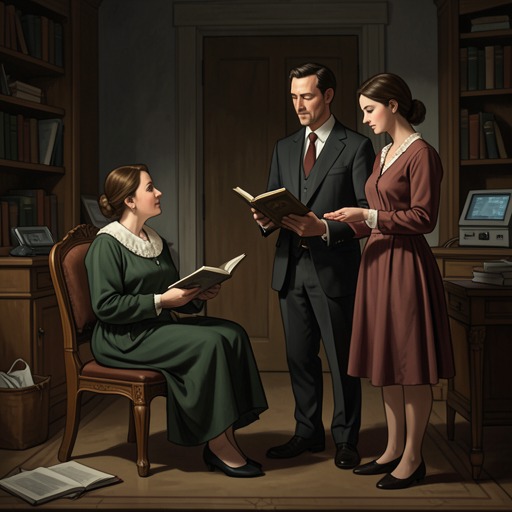
When Uncle Toby eventually tells Mrs. Wadman that he is in love, his declaration is strikingly brief. He says it in three plain words while sitting down, and then does not enlarge upon it. Mrs. Wadman looks down at the sewing in her apron, expecting him to continue, but he has little talent for amplification and treats love as a subject he understands least well. The scene makes the distinction between feeling and its verbal performance concrete: the declaration names love, but does not explain or display it in the conventional manner she seems to anticipate.
The narrator connects Toby’s silence to a larger contrast in beliefs about courtship. Walter admires what he calls his brother’s system and imagines that, if Toby added a pipe of tobacco to it, he could find his way to many women’s hearts. Toby does not understand what Walter means. The narrator cautiously draws from Walter’s enthusiasm a criticism of the assumption that talking about love is equivalent to making it. The argument is not that speech has no place in courtship, but that a declaration alone cannot guarantee either understanding or intimacy.
From Declaration to Shared Commitment
Mrs. Wadman takes up the conversation after the silence has nearly become indecorous. In discussing marriage, she brings Toby to a point where he feels out of his depth. He stops short of further discussion and, with his hand on his heart, offers to take the pains and pleasures of matrimony as they come and share them with her. The proposal is therefore not a polished account of romantic feeling. It is an offer to enter a shared condition and accept its experiences together—the clearest enactment of Walter’s idea of love as a situation.
Toby does not repeat the offer. Instead, he turns to the Bible Mrs. Wadman has placed on the table and happens upon the account of the siege of Jericho, which he begins to read. The abrupt shift from marriage to a military narrative brings his habitual interests into the courtship scene and leaves the proposal hanging rather than resolving it through eloquent persuasion. His actions carry the proposal farther than his words do, but the passage does not establish a marriage or a settled outcome.
Meaning and Limits
The concept gains force from the contrast between Walter’s abstract certainty and Toby’s awkwardly sincere conduct. Walter treats love as a role that can generate the actions associated with it; Toby, unable to elaborate on love, offers companionship in the actual conditions of marriage. The two accounts overlap without becoming identical: Walter describes an explanation of behavior, while Toby makes an offer whose emotional depth remains largely unspoken.
The episode also resists reducing love to either speech or inward sentiment. Toby’s declaration is inadequate as conversation, yet his offer to share married life gives it practical substance. At the same time, his turn to the story of Jericho underscores how readily the courtship is diverted into the military imagery and interests that shape his attention. Love as a situation is thus both a comic theory of taking up a role and a precise description of Toby’s way of approaching commitment: he cannot readily make love eloquent, but he can offer to live its consequences alongside Mrs. Wadman.